Jun 24, 2026 · by Baptiste, founder of Vanpelt Studio
The pre-edit story check: know you have a video before you open the editor
You get home from the shoot, offload the cards, and there’s a question sitting under everything else you’re doing that evening: do you actually have a video? Not “did the audio sound okay” or “was the light good in the afternoon shots”. Those you already know. The real question is structural: does what’s on the card add up to something worth the next twenty hours of your life? Most solo creators don’t answer that question tonight. They answer it on day three of editing, half a timeline in, when a beat turns out to be missing and there’s no good way to get it back. That’s the most expensive possible moment to find out. There’s a cheaper one, and it’s tonight.
The cost asymmetry
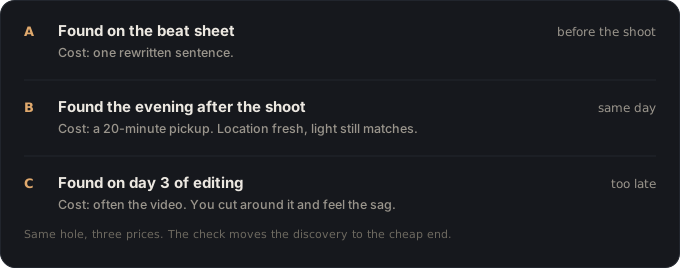
The same missing beat costs a wildly different amount depending on when you find it. Find it the evening of the shoot and it’s a twenty-minute pickup: the set is still standing, the light is still roughly the same, and (this is the part people forget) you’re still wearing the outfit. You grab the camera, shoot the thirty seconds you’re missing, and you’re done before the transcripts finish processing. Find the same hole a week into editing and none of that is true anymore. The set’s been broken down. The light’s different, or it’s raining, or it’s a different season by the time you notice. You’ve usually changed clothes, cut your hair, or grown three days of stubble that wasn’t there in the rest of the footage. A reshoot at that point isn’t a pickup, it’s a production, and solo creators, correctly, almost never do it. So the video ships with the hole in it, weaker than it should be, or it gets shelved entirely and becomes one more unfinished project in the folder.
Put a number on it. A twenty-minute pickup shot the same evening costs, realistically, twenty minutes. The same hole discovered on day three of editing arrives after eight, ten, sometimes twenty hours of cuts, color, and sound work already sunk into a video that turns out not to hold together, and the fix now isn’t twenty minutes, it’s a reshoot that mostly doesn’t happen. That’s not a small gap. That’s the difference between a rounding error and a video that never ships. The check itself takes the same twenty or thirty minutes whether you run it the night of the shoot or three weeks later. The only thing that changes is what it costs you when it finds something, which is exactly why the timing of the check matters more than the check itself.
Why every tool skips this step
Look at what editing software actually optimizes for, and it’s always some version of “process the footage faster.” Cut the silences out automatically. Let you edit video by deleting words in a transcript. Find the fifteen-second clip inside a forty-minute file that might work as a short. Those are real, useful features, and they all answer the same question: how do I get through this footage quicker? None of them ask a different question, which is whether the footage is the right footage: whether it actually contains the story you set out to shoot.
It’s not that the tools are bad at this. It’s that they structurally can’t do it, because they only ever see one side of the equation. An editor opens a folder of clips. It has no idea what you meant to capture, because your plan (the beat sheet, the shot list, the promise you made in the title) never entered the software. A story check is a diff: it compares what you intended against what you got, and a diff is meaningless with only one side of the comparison. Your NLE has the footage. It has never seen your plan. So it can help you trim what’s there, and it will never once tell you that something isn’t.
The manual process
You don’t need software to run this check. You need about half an hour, your footage, and ideally something written down before you shot that says what the video was supposed to be. Here’s the process broken into three steps.
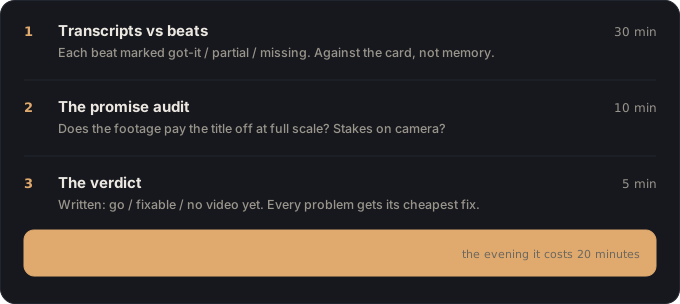
Transcript pass. Before you look at a single frame of video, get everything transcribed. Any tool works here: a free local model, an app you already have, even YouTube’s own auto-captions if you upload privately first. The point isn’t the transcription quality, it’s the format switch: reading is roughly ten times faster than scrubbing through footage at real speed, and it’s not just faster, it’s a better signal. Structural problems: a beat that never gets addressed, a promise that’s set up and never paid off, two takes that contradict each other, jump out on a page of text in a way they don’t when you’re half-watching video at 1.5x wondering if that was the good take. Skim the transcripts first, before touching the timeline. You’re not looking for good lines yet. You’re looking for what’s missing.
Beat-by-beat audit. If you shot from a beat sheet, pull it out now. This is the step it exists for. Go down the list one beat at a time, and for each one write down two things: which clip and timestamp pays it off, and a one-word grade for how well it lands, nailed, usable, weak, or missing. “Nailed” means you’d cut it in without a second thought. “Usable” means it does the job but you’d trade up if a better take existed. “Weak” means it technically covers the beat but you already know it’s going to be a problem in the edit: bad energy, a stumble, something off. “Missing” means there’s no clip that does this beat’s job at all, full stop. Don’t skip this by watching a beat and thinking “yeah, that’s fine”: write the grade down. The writing is what turns a vague feeling into a decision you can act on. If you didn’t shoot from a beat sheet, don’t skip the check: reconstruct one now. Look at your working title and ask what five beats it implies: what’s the hook, what’s the promise, what’s the middle, what’s the turn, what’s the payoff. Write those five lines down cold, then audit your footage against them exactly the same way. It takes an extra five minutes and it’s still much cheaper than finding out on day three that the title promises something the footage never shows.
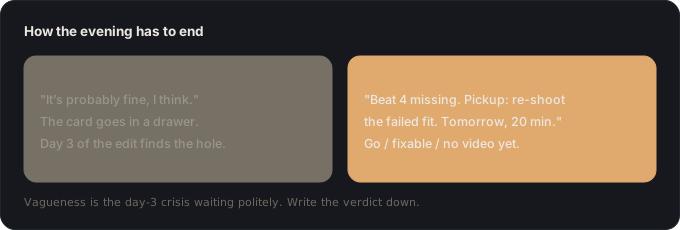
The verdict. Once every beat has a grade, force yourself to write one line that summarizes the whole shoot. There are three honest answers. GO means every beat is at least usable and nothing needs to change. You can open the editor with confidence. PICKUP LIST means one or more beats are weak or missing, but the fix is a short, specific list of shots you can still grab easily: write the list, each one dead simple: what to shoot, roughly how long, what it needs to match. RE-SCOPE means the gap is bigger than a pickup can close, usually because a beat that’s central to the promise just isn’t there and can’t easily be recreated, and the honest move is to change what video this is: narrow the promise to what the footage actually supports, rather than forcing eight beats’ worth of ambition out of five beats’ worth of material. Writing the verdict down, in one sentence, is what makes this whole process worth something. A vague sense that “it’s probably fine” isn’t a verdict. A line that says “PICKUP LIST: need the closing shot of the finished sauna at night, and one clean line about the total cost” is a verdict. It’s specific enough to act on tonight.
The cheapest exit for each problem
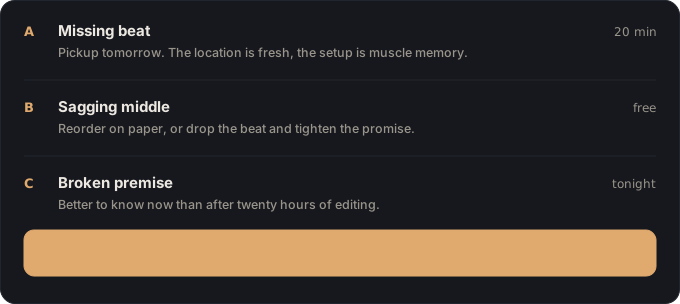
Every problem the audit turns up has a fix, and the fix is almost never “clean it up in editing.” Here’s the pattern across the five problems that come up most:
| Problem found | Cheapest exit |
|----------------------------|--------------------------------------------------|
| A beat is missing | 20-minute pickup while the set/light still match |
| The hook take is weak | Re-angle: open on the payoff, narrate the setup |
| Chronology is broken | Reorder beats; add one bridging line on camera |
| Title promise never paid | Change the promise (title), not the footage |
| The middle wanders | Drop a beat: cut the weakest moment entirely |
The pattern underneath the table: the cheapest exit is almost never “fix it in the edit.” A weak hook doesn’t get fixed by a better cut, a music sting, or a faster pace in the first ten seconds. It gets fixed by shooting a different opening or by changing what the title and thumbnail actually claim, so the promise you’re making up front matches what the footage can actually deliver. A missing beat doesn’t get fixed by cutting around the hole and hoping nobody notices: viewers notice, every time, even if they can’t say why the video felt thin. Reordering costs you nothing but the courage to admit the plan and the shoot didn’t happen in the same order, and it’s almost always available. Editing is powerful for pacing, tone, and rhythm. It is close to powerless for structure. You cannot cut your way into a beat that was never captured.
The checklist
Run through this before you open the editor. It should take longer to read than to actually do, once the transcripts and the beat audit are done.
□ Watched or skimmed every clip (reading transcripts counts)
□ Every beat in the plan has at least one usable take
□ The hook take contains the hook, not just the topic
□ The payoff is on camera, not implied
□ The title's promise is paid off by a specific clip
□ Chronology holds: no beat depends on footage you shot after it
□ B-roll exists for every talking-head stretch over 20 seconds
□ Audio spot-checked on the load-bearing takes
□ Verdict written down: GO / PICKUP LIST / RE-SCOPE
□ Pickups scheduled within 48 hours, while everything still matches
A few of these are worth calling out. “Contains the hook, not just the topic” catches the most common hook failure: a take where you say what the video is about but never actually deliver the jolt that earns the next thirty seconds. Those are different things, and it’s easy to shoot the second while thinking you got the first. “Payoff on camera, not implied” catches videos that describe the result in voiceover instead of showing it: a payoff you only talk about reads as a broken promise no matter how well everything before it worked. And the last line matters as much as any of the audit steps: a pickup list you don’t schedule is just a list. Put the pickups on the calendar within 48 hours, before the window that makes them cheap closes.
When to run it
Run this the evening of the shoot, or the morning after at the absolute latest, never “when I start editing,” because by then the window that makes the findings cheap has already closed. The entire value of the check comes from running it while a pickup is still a twenty-minute errand instead of a reshoot you’ll never schedule. If you wait until you’re deep in the timeline to ask “do I have everything,” you’ve traded a half-hour check for a coin flip on whether the video ships at all.
If you’d rather not run the diff by hand, this check is the heart of Vanpelt Studio. It reads your footage against your beat sheet and hands you the verdict with receipts. No plan to check against yet? Start with the beat sheet.