Oct 16, 2026 · by Baptiste, founder of Vanpelt Studio
YouTube Shorts re-uploads now get less reach: what counts as original
Part of YouTube updates for creators: official YouTube changes, explained in plain English.
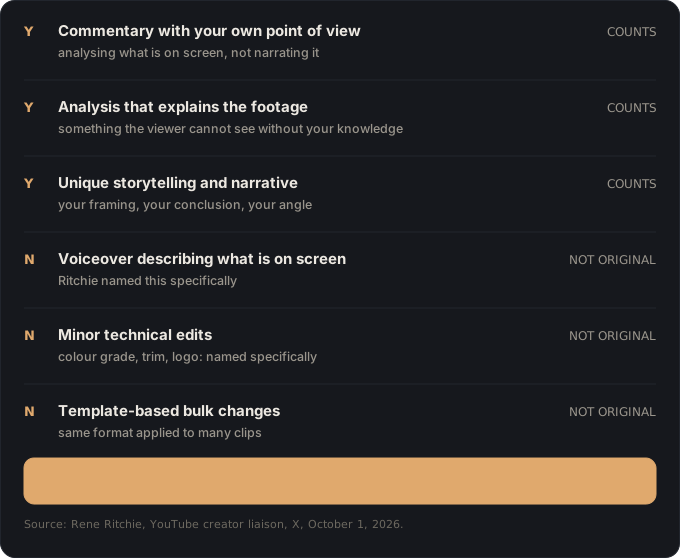
On October 1, 2026, YouTube’s creator liaison Rene Ritchie announced a change to how Shorts are recommended: channels that primarily re-upload other creators’ clips without significant additions get less reach. Voiceover narration, minor technical edits, and template-based bulk changes do not qualify as significant additions. What does: commentary, analysis, unique storytelling: something only you could add.
The change affects recommendations only. Monetisation stays under YouTube’s existing reused-content policy, which already requires borrowed content to be changed significantly.
When you need this: your Shorts reach has dropped since early October. Or you post Shorts that use clips from other channels. Or you re-purpose your own long-form footage into Shorts by adding a voiceover. Read this before deciding whether to change your approach.
What YouTube announced
Ritchie posted the announcement on X on October 1:
“YouTube is updating the recommendation system to further prioritize original Shorts and reduce the reach of channels primarily aggregating or re-uploading other creators’ clips without significant changes.”
He added that voice-over narration, minor technical edits, and template-based bulk changes do not make a reused clip original. The alternative he pointed to: bring your own commentary, analysis, and storytelling.
How to make your Shorts original: four steps
One example runs through every step. Omar runs a travel channel with 8,000 subscribers. He posts two long vlogs a month and Shorts between them: mostly 30-second clips from his vlogs with a voiceover, plus occasional clips from other travel creators’ videos he reacted to. Since October, his Shorts reach is down.
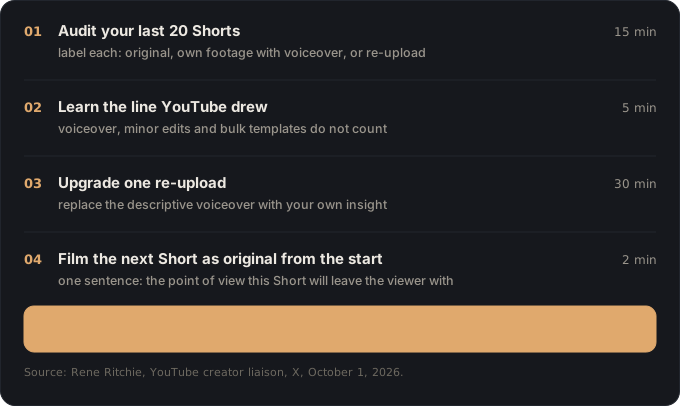
1. Audit your last 20 Shorts (15 minutes)
Do this: open YouTube Studio, go to Content and filter by Shorts. For each of your last 20, answer one question: does this Short contain footage or audio you did not create? Write yes or no next to each one. Then, for any where you answered no, ask a second question: does the Short add commentary, analysis or storytelling, or does it just show your footage with a voiceover describing it? Mark those too.
You end up with: a list sorted into three groups: (1) re-uploads of others’ content, (2) your own footage with only a descriptive voiceover, and (3) genuinely original Shorts. Groups 1 and 2 are the ones this change affects.
Why: Ritchie’s announcement targets channels “primarily aggregating or re-uploading other creators’ clips without significant changes.” But he specified that voiceover narration alone does not make a clip original, which means group 2 also falls under the same logic.
Omar: 12 of his 20 are clips from his own vlogs with a voiceover. 4 use other creators’ footage. 4 are Shorts he filmed separately for the platform. The first 16 are at risk.
2. Learn the line (5 minutes)
Do this: write down Ritchie’s exact words: “voice-over narration, minor technical edits and template-based bulk changes do not make a reused clip original.” Then write one sentence that describes what your Shorts do that is not on that list.
You end up with: a one-line test you can apply before publishing any Short from now on. Something like: “does this Short contain analysis or storytelling that only I could add, or is it just footage with a description on top?”
Why: the line is not about whether you own the footage. It is about whether you added a point of view. A clip of a market in Marrakech with a voiceover saying “here is a market I found in Marrakech” is not original. The same clip with you explaining why this specific market is different from others you have visited, with your framing and conclusion, is.
Omar: his test becomes: “could a travel aggregator account have posted this without me?” If yes, it is not original.
3. Upgrade one re-upload into an original (30 minutes)
Do this: take one Short from group 1 or 2. Watch it back. Write down the one thing you know about what is on screen that the viewer cannot see for themselves. Film yourself saying it, or write it on screen. Replace the descriptive voiceover with that insight. Re-upload as a new Short.
You end up with: one genuinely original Short, and a clear sense of how much work the upgrade takes.
Why: the exercise is diagnostic. If you can add commentary without effort, do it going forward. If you struggle to say anything beyond describing the footage, the topic needed more thought before filming, not after. Our guide to finding YouTube video ideas people actually want applies to Shorts too: the point of view comes first, the footage second.
Omar: he picks his most-viewed re-upload Short, a clip of a night market. The voiceover says “this is the night market near my hostel in Chiang Mai.” He re-films with himself explaining that night markets in northern Thailand close by 10pm, not midnight like Bangkok, something he had to learn the hard way. Same footage, different Short.
4. Film the next Short as an original from the start (every Short from now on)
Do this: before filming a Short, write one sentence: the insight or point of view this Short will leave the viewer with. If you cannot write that sentence, do not start filming. Shoot the footage after you know what you are going to say about it.
You end up with: a pre-shoot brief for every Short, one sentence long. It replaces the re-upload audit entirely going forward.
Why: the difference between a re-upload and an original is usually decided before the camera turns on. A clip cut from a longer video tends to show what happened. A Short planned from scratch tends to show what you think about what happened. YouTube’s change makes that distinction matter in recommendations. The hook examples guide shows how to open a Short that has a point of view from its first second, rather than working up to one.
Omar: his next Short is not a clip from a vlog. It is 40 seconds he filmed to answer one question a subscriber left: “how do you find accommodation in a city the same day you arrive?” He answers it in the footage, then links to the vlog where the full story played out.
If it went wrong, it’s one of these
“I only re-post my own clips, not other creators’ content. Am I affected?” Possibly. Ritchie’s announcement targets channels primarily re-uploading other creators’ content, but his definition of “original” (not just voiceover or minor edits) applies regardless of who owns the footage. If your Shorts are clips of your own long-form videos with a descriptive voiceover, they may be caught too.
“My Shorts reach dropped in early October. How do I know if this is why?” Open YouTube Studio, go to Analytics and look at the Shorts feed line in your traffic sources. A drop in impressions starting around October 1 points at the recommendation change. A drop in views with stable impressions is a click-through problem: look at the thumbnail and the first second instead.
“I react to other creators’ clips. Does that count as original?” Reaction content that adds genuine commentary and analysis has always sat close to the line under YouTube’s reused-content policy. Ritchie’s definition helps: if your reaction adds analysis and storytelling rather than just a facial expression, it is more likely to qualify. But stay aware of where the line is.
“I applied this and my Shorts reach is still down.” YouTube gave no timeline for re-evaluating channels already affected. Keep the new approach consistent for at least a month before drawing conclusions. If impressions are recovering but views are flat, the hook needs work: see the Shorts feedback tool for a step you can run before publishing.
Where Vanpelt Studio fits (if you want help)
The Vanpelt Studio desktop app includes a short finder that goes through the footage you shot for a long-form video and surfaces the parts that did not make the final cut. Those are clips with your perspective already in them, filmed from angles the main edit passed on. Run the brief from step 4 before you open the app: the one sentence you want the Short to leave the viewer with tells you which clip to build around.
Sources
- Rene Ritchie (YouTube creator liaison), X post, October 1, 2026: the announcement of the Shorts recommendation change.
- MediaPost, YouTube Alters Shorts Algorithm For Originality, October 5, 2026.
- Search Engine Journal, YouTube To Cut Reach Of Channels Reposting Barely Changed Clips.