Sep 23, 2026 · by Baptiste, founder of Vanpelt Studio
YouTube video ideas: how to find ones people already want (plus 22 formats with examples)
This is a recipe for finding YouTube video ideas that people already want, instead of ideas that only sound good to you at midnight. It takes about two hours. You need a notebook or a spreadsheet, a browser, and a rough sense of what you’d like to make videos about. You finish with three ideas you could shoot this month, each with written evidence that someone wants it, and a bank of spares for later.
When you need it: you’re starting a channel and staring at a blank page, or you have a channel and keep asking “what do I make next?” the night before you meant to film. If you just want a list, skip to the 22 idea formats further down. They’re more useful once you’ve done the first three steps, because a format only works when it’s pointed at a real question from a real viewer.
One example runs through every step. Priya has zero videos. She rents a small studio flat with one north-facing window, she loves houseplants, and she has killed a lot of them. She wants a channel but has no idea what her first video should be. We’ll follow her from that blank page to three ideas she can film.
First, what a video idea actually is
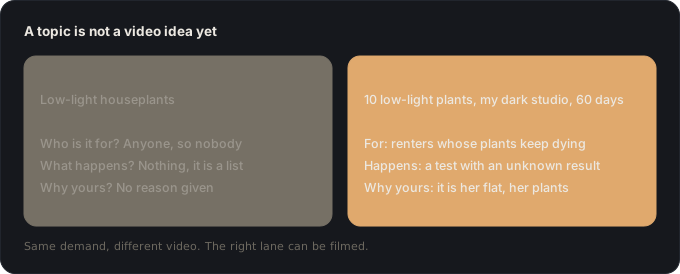
Most “ideas” on a beginner’s list are topics. “Low-light houseplants” is a topic. You can’t film a topic, and nobody clicks on one. A video idea has three things a topic doesn’t: a specific viewer, a question that viewer already has, and something that happens on screen on the way to the answer.
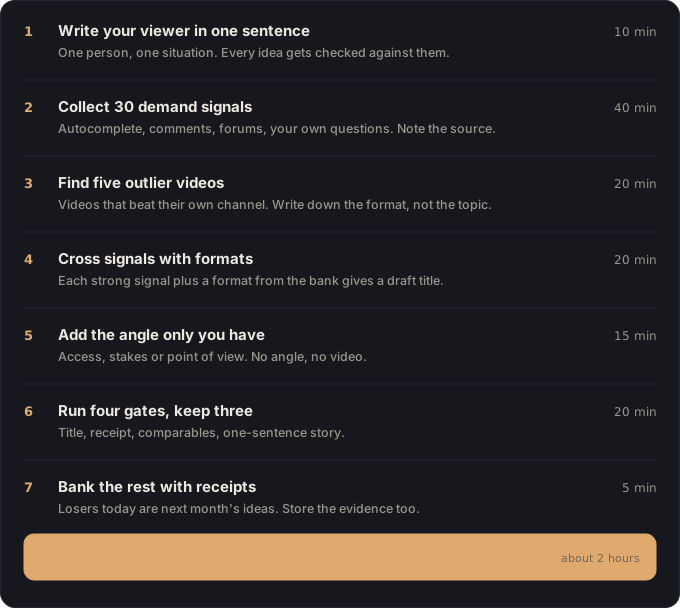
The recipe below builds all three parts in order: the viewer first, then the question (from evidence, not guessing), then the thing that happens (from a proven format and your own angle).
Step 1: write your viewer in one sentence (10 minutes)
Open a blank page and write one sentence describing a single person in a single situation. Not an age bracket, not “people interested in X”. A person with a problem you understand.
Priya’s first attempt was “plant lovers”. Too broad: that’s a topic wearing a hat. Her second: “A renter in a small, dim flat who keeps buying plants that die within two months and feels a bit stupid about it.” That one works. She can picture this person, and she used to be this person.
Output: one sentence at the top of your page. Every idea from here on gets checked against it.
Why this comes first: YouTube recommends by matching videos to viewers who were satisfied by similar videos. A video aimed at everyone gives that system nobody in particular to match it to. The free lesson Serve one viewer, not everyone goes deeper. It’s also the honest answer to “what’s the best niche for YouTube?”: the best niche is a viewer you understand well enough to make twenty videos for, not a category with the biggest numbers.
Step 2: collect 30 demand signals (40 minutes)
A demand signal is a question or phrase you can prove a real person typed or said. Collect 30 of them, and next to each one write where you found it. That note is the receipt, and it’s the part people skip.
Work through these sources in order, spending about ten minutes on each:
- YouTube search suggestions. Type your viewer’s problem into the YouTube search bar and stop before hitting enter. Write down the suggestions. Then add a letter after your phrase (“north facing window plants a”, ”… b”) and write down those too. Suggestions come from what people search, so each one is a small receipt.
- Comments on bigger channels in your space. Open five popular videos your viewer would watch and read the comments sorted by top. Copy every question, complaint or “can you do one on…” you see.
- Forums and communities. A subreddit, a Facebook group, a Discord, a Q&A site. Search for your viewer’s situation and note the questions that come up again and again.
- Your own questions. What did you wish someone had explained to you when you were your viewer? Those count, but mark them as “mine” so you know they’re the weakest receipts.
If your channel already has viewers, add a fifth source: the Research tab in YouTube Studio, which shows what your audience searched for and flags content gaps. The lesson Find ideas your audience already wants walks through it.
Priya’s list after 40 minutes had 31 lines. A few of them:
- “plants for north facing window” (YouTube suggestion)
- “why are my pothos leaves turning yellow” (YouTube suggestion)
- “does any of this work if you get no direct sun?” (comment on a big plant channel, lots of replies)
- “is a grow light worth it in a small apartment” (asked three separate times in a houseplant forum)
- “what to do with plants when you go away for two weeks” (forum)
- “how did I kill a snake plant, they’re supposed to be unkillable” (mine)
Output: 30 lines, each with its source. Don’t judge them yet.
Step 3: find five outlier videos (20 minutes)
Now look at what already worked, but not the way most people do. Big channels get views because they’re big. You want outliers: videos that did far better than the other videos on the same channel.
Search your viewer’s main problems on YouTube. When a result looks promising, open the channel, look at its recent uploads, and compare. A video sitting at several times the channel’s usual view count is an outlier. Something about that idea pulled people in beyond the channel’s normal audience, and that’s exactly what you’re looking for.
For each outlier, write down the format, not the topic. “A plant video did well” teaches you nothing. “A 30-day test with a result at the end did well” does.
Priya found five outliers on small and mid-sized plant channels. Her notes:
- A three-month test of plants in a windowless bathroom (format: long test with an unknown result)
- “Every plant I killed this year” (format: failure post-mortem)
- Cheap versus expensive grow lights, side by side (format: head-to-head)
- “Beginner mistakes I made with my first 20 plants” (format: mistakes list)
- Rescuing a half-dead fiddle leaf fig (format: transformation)
Output: five lines, each naming a format and, in a few words, why you think it pulled.
Why formats: the topic of an outlier is taken. Its shape is free to borrow, and the shape is usually what made people click. If you want to study how outliers phrase their titles and openings, this library of hook and title templates is sorted by pattern and niche.
Step 4: cross signals with formats (20 minutes)
Take your ten strongest signals from step 2 (strongest means the best receipts: repeated questions beat one-off ones). For each, pick a format from your outlier list or from the bank below, and write a rough title. Don’t polish. Aim for ten drafts.
Priya’s ten:
- Do “low-light” plants survive a north-facing studio? A 60-day test
- Every plant I killed in my dark flat, and what actually killed it
- Is a $30 grow light worth it in a small apartment?
- The 10 best low-light plants
- Pothos yellow leaves, explained
- What happens to my plants when I leave for two weeks (test)
- 7 mistakes I made as a renter with houseplants
- Rescuing the dying plants from my building’s recycling area
- My tiny-flat plant setup, and why everything is where it is
- Snake plants are not unkillable: how I proved it
Output: ten draft titles, each tied to a signal and a format.
Step 5: add the angle only you have (15 minutes)
Every validated topic is visible to other creators too. What makes your version worth watching is something they can’t copy. Next to each draft title, write one line answering: what do I bring to this that another channel doesn’t? There are three kinds of answer:
- Access: a place, a job, a situation or a thing you have and others don’t.
- Stakes: something real you could lose or win on camera.
- Point of view: an opinion you’d defend that the popular videos don’t share.
Priya’s dark north-facing flat is her access. Her own plants are her stakes. Her point of view is that most plant advice quietly assumes a sunny window. That gave most of her drafts a strong line. Two got nothing: “The 10 best low-light plants” (anyone can make that list, and plenty have) and “Pothos yellow leaves, explained” (she isn’t an expert yet). Both lost their spot.
Output: one “only me” line per idea. Ideas with a blank line drop out.
The quick test: could a competitor film this exact video from your notes? If yes, dig further or drop it. The free lesson The video only you can make covers this in depth.
Step 6: run four gates, keep three (20 minutes)
Now put each surviving idea through four quick checks, about two to three minutes each. An idea that fails two gates goes back in the bank.
- The title gate. Write the title you’d actually publish. If you can’t write an honest one that you’d click, the idea is under-cooked. (Why the title comes first.)
- The receipt gate. Point at the signal from step 2. A question asked many times beats one asked once.
- The comparables gate. Search the idea. If ten strong recent videos already cover your exact angle, you need a different angle. If similar formats on other topics do well, that’s a good sign.
- The story gate. Say the video in one sentence with a want, an obstacle and a change. “A video about my plants” fails. “I want to know if the plants sold as low-light survive my dark flat, the light is worse than any care label assumes, and in 60 days I’ll find out which ones make it” passes. (What a story actually is.)
The full version of these gates is in the lesson Validate an idea before you shoot.
Priya’s three survivors:
- A 60-day test: Do “low-light” plants survive a north-facing studio? Strong receipts (the no-direct-sun comment, the window-direction searches), few comparables in exactly her conditions, and a result nobody knows yet, including her.
- A failure post-mortem: Every plant I killed in my dark flat, and what actually killed it. Proven format from her outliers, and it’s pure access: nobody else has her dead plants.
- An “is it worth it” test: Is a $30 grow light worth it in a small apartment? The question was asked three separate times in one forum, and it pairs naturally with the 60-day test as a follow-up.
The two-week-holiday test failed the title gate (she couldn’t make it sound interesting without inventing drama) and the story gate. The recycling-area rescue was fun but had no receipt at all. Both went to the bank.
Output: three ideas, each with a publishable working title, a receipt and a one-sentence story.
Step 7: bank the rest with their receipts (5 minutes)
Copy every idea that didn’t make the cut into one list, with its source and the gate it failed. Don’t delete anything. An idea that fails today because you lack the gear, the expertise or the audience often passes in three months.
Priya’s bank started with seven entries. “Pothos yellow leaves” sits there with a note: revisit after the 60-day test, when I’ll have my own yellow leaves to show.
Output: a dated idea bank you’ll come back to next time, so you never start from a blank page again. The lesson Build an idea bank that never runs dry shows how to keep it useful instead of a graveyard.
22 YouTube video idea formats, with examples
Here’s the bank of formats to borrow from in step 4. Each one has an example from a different niche and a note on who it suits. A format is a shape, not an idea: it only becomes a video idea when you point it at a signal from step 2 and add your angle from step 5.
Tests and experiments
- The timed challenge. “I gave myself 30 days to learn to draw hands.” Suits beginners, because your progress is the story.
- The head-to-head. “Cheap vs expensive hiking boots after 200 km.” Suits gear, tech and review channels.
- The “does it work?” test. “I followed the viral sourdough shortcut for a week.” Suits anyone who’s a bit skeptical by nature.
- The budget constraint. “A full week of work lunches for $25.” Suits cooking, DIY, travel and frugal living.
- The long-term follow-up. “My van insulation, one winter later.” Suits anyone who has already made a video about something they still use.
Teaching
- The mistakes list. “7 mistakes I made in my first year of running.” Suits beginners, because honest experience is authority you already have.
- The complete walkthrough of one narrow task. “How to repot a monstera without killing it, start to finish.” Suits search-driven channels. Narrow beats broad.
- What I wish I knew. “What I wish I knew before my first solo trip to Japan.” Suits anyone who has recently been through something their viewer is about to face.
- The explainer with proof. “Why your bread comes out flat, shown with four loaves.” Suits people who can demonstrate, not just tell.
- The setup tour with reasons. “My $300 home office, and why each thing is there.” Suits desk, studio, kitchen and workshop channels.
- The roadmap. “If I started guitar again tomorrow, here’s my first 8 weeks.” Suits people a few steps ahead of their viewer.
Stories and journeys
- The attempt with real stakes. “Can I sell 10 paintings at my first craft market?” Suits anyone willing to risk failing on camera.
- The transformation. “Turning a $40 thrift-store dresser into something I’d actually buy.” Suits makers, renovators, stylists and gardeners.
- A week in a specific life. “What I eat during a week of night shifts as a nurse.” Suits people with a job or situation most viewers never see.
- The failure post-mortem. “My first online shop made $14. Here’s what went wrong.” Suits anyone willing to be honest about what didn’t work.
- The series episode. “Building a cabin, part 3: the roof.” Suits long projects. Each episode makes a viewer want the next.
Opinions and verdicts
- The honest ranking. “Every budget microphone I’ve owned, ranked.” Suits people who’ve tried a lot of one kind of thing.
- The contrarian take, with evidence. “Why I stopped using a standing desk.” Suits people with a real opinion and the experience to back it.
- The “is it worth it?” verdict. “Is an e-reader worth it if you read five books a year?” Suits product, hobby and money channels.
- The expert breakdown. “A chef breaks down five viral recipes.” Suits people with real expertise in something the audience already watches.
Audience-led
- The answered question. “You asked how I afford to travel, so here are the actual numbers.” Suits channels with comments to answer, even a few.
- The viewer review. “I review your beginner photos: 10 submissions.” Suits teaching channels once they have a small audience.
A note on trends: “topics trending on YouTube” are the most contested ideas there are, because everyone sees the same trend at the same time. A trend is worth chasing when it hits your viewer’s real problem and you have an angle. Otherwise, a patient format from this list, pointed at a question people keep asking, tends to be the better bet. This roundup of 2026’s platform-level shifts covers the trends that actually change what solo creators should make.
Where the app fits (if you want help)
Everything above works with a notebook and a browser. If you’d like help with the slow parts, the Vanpelt Studio desktop app has an ideas side built around the same steps:
- A demand check. Give it your niche and it searches the web through the AI provider you picked (only if that provider can search) and comes back with subjects that have shown real audience pull. Each one comes with receipts you can click: real videos, not the model’s memory.
- A format library. Each format explains why it works on viewers, the structure it needs to be executed well, and the ways it usually fails.
- A pre-shoot check that tests one idea before you commit a shoot day to it.
- A channel-fit check that asks whether a new idea serves the same viewer as your last few videos.
- An idea chat that interviews you to find the angle only you can bring, which is step 5 done as a conversation.
It won’t predict views and it doesn’t connect to your YouTube account. It speeds up the evidence-gathering and asks the awkward questions, and you still make the call.
If it went wrong, it’s one of these
- “I don’t have a niche yet.” Skip the niche and write the viewer. Pick a person you used to be, two or three years ago, with a problem you’ve since solved. That’s a viewer you understand, and a niche forms around them over time.
- “Every idea I find is already covered.” Covered is not the same as closed. Check whether the existing videos serve your viewer in their situation. Priya’s “low-light” topic had plenty of videos, and very few were filmed in a flat as dark as hers. If it really is saturated, narrow the viewer, not the topic.
- “My list is all topics.” Run each line through the three questions from the figure above: who is it for, what happens, why yours. If you can’t answer “what happens”, add a test, a deadline or a comparison from the format bank.
- “The search suggestions show nothing.” Your phrase is too narrow, or you’re using your words instead of your viewer’s. Go up one level (“low light plants” instead of “north facing studio plants”) and lean on comments and forums, where people describe problems in their own words.
- “I have fifty ideas and can’t choose.” Pick the one with the strongest receipt that you can shoot within two weeks. A good idea you film beats a great one you keep planning.
- “My first videos on validated ideas still flopped.” An idea gets the click. The video still has to hold people. The next skills are the script and planning what to shoot, so the finished video pays off what the title promised.
The whole recipe on one line
Viewer (one sentence) → 30 signals with receipts → 5 outliers, read for format → 10 drafts → one “only me” line each → four gates → 3 ideas to shoot, the rest banked. The first time takes an evening. After that, the bank means you’re never starting from a blank page again.
The free Ideas and audience module covers each step in more depth: five lessons, no signup, like everything on this site.
Sources
- YouTube Help, Explore trends on YouTube: the Research tab, viewers’ searches and content gaps as demand evidence.