Story & structure · Lesson 1
What a story actually is (and why topic videos die)
The difference between a video about something and a video where something happens, and why the second one holds viewers when the first one bleeds them.
Here are two videos shot from the same weekend. “Restoring an old workbench”: twenty minutes of competent footage about sanding, gluing, finishing. And: “This $40 workbench was hiding something”, the same weekend, except now there’s a discovery under the paint, a decision about whether the restoration is even worth continuing, and an ending where the maker admits the bench changed what they thought about buying junk. The first is a topic. The second is a story. The first gets sampled and abandoned; the second gets finished.
The difference isn’t production value, energy, or “storytelling sauce” sprinkled in the edit. It’s structural, and you can learn it.
A story is a change, not a subject
A topic video is about something: a place, a build, a technique. It can be arbitrarily well-shot and still die, because “about” makes no promise of motion: every minute is interchangeable with every other minute, so leaving at minute four costs the viewer nothing.
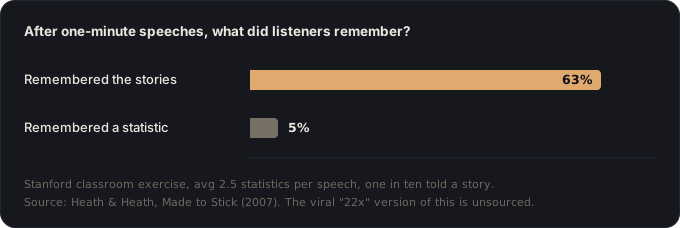
A story is something happening: a person wants something, something resists, and by the end the situation (or the person) is different. That shape isn’t a film-school affectation; it’s what human attention is built to track. The research here is blunt:
A story must first sustain attention (a scarce resource in the brain) by developing tension. Character-driven stories with emotional content result in better understanding and recall weeks later.
Paul J. Zak, “Why Your Brain Loves Good Storytelling,” Harvard Business Review (2014)
Tension (an open question moving toward resolution) is the mechanism. The viewer stays because leaving now means never learning how it turns out. A topic can’t generate that debt; a change in progress can’t help generating it.
The three ingredients, in creator terms
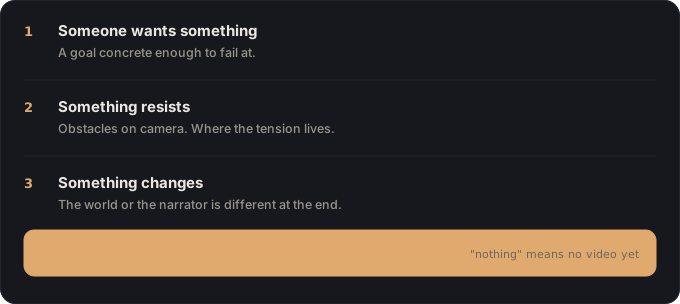
You don’t need a screenwriting degree. Every watchable YouTube story runs on three things you can check for before you shoot.
Someone wants something. A goal concrete enough to fail at: finish the build before the deadline, find out if the cheap tool survives, fix the thing everyone said was unfixable. “Showing you my process” is not a want: nothing is being pursued.
Something resists. Obstacles, surprises, a doubt, a budget, the weather. Resistance is where the tension lives; it’s why the beam that doesn’t fit is worth more screen time than ten cuts that went fine. A video where everything works is a demo. A video where it might not work is a story.
Something changes. The ending must leave the world or the narrator measurably different from minute one: the bench restored and the opinion revised. Change is what makes an ending feel earned instead of just being where the footage ran out.
Point a camera at those three and structure starts assembling itself. Miss all three and no amount of jump cuts will resurrect it.
Why topic videos feel safe (and die anyway)
Creators default to topic videos because they’re low-risk to shoot: no promise, so nothing can fail to pay off. But the risk doesn’t disappear. It moves to the feed, where a video that promises no change can’t write a title that promises one either, and to the retention graph, where interchangeable minutes produce the long steady bleed that tells the algorithm nobody needed to see the end.
The fix costs one question at the planning stage: “what changes in this video?” If the honest answer is “nothing. I just show the thing,” you don’t have a video yet; you have a subject waiting for a story. Find the want, film the resistance, land the change. Our storytelling mechanics library has twelve of these moves with real examples if you want to see the range.
The story check
- You can name what the narrator (or subject) wants in one sentence.
- Something concrete resists it, and that resistance is on camera, not summarized.
- Something is different at the end: the world, the plan, or your mind.
- A viewer at minute four would lose something real by leaving.
- The title promises the change, not the topic.
🎬 Video script
- Cold open on the two workbench titles side by side: same footage, different animal. “One of these gets finished. Here’s why.”
- Put Zak’s finding on screen: attention runs on tension. Not gear, not pacing: tension.
- Break down want / resistance / change with one relatable example per ingredient.
- Autopsy a real topic-video retention graph: the long bleed of interchangeable minutes.
- Close: “Before you shoot, ask what changes. If the answer is nothing, don’t press record yet.”
Sources
- Paul J. Zak, Why Your Brain Loves Good Storytelling, Harvard Business Review (2014): tension sustains attention; character-driven stories improve recall.
- YouTube Help, Measure key moments for audience retention: how interchangeable minutes read in the retention report.
Key takeaways
- A topic is a subject; a story is a change, something must be different at the end.
- Viewers stay for tension (a question in motion), not for information.
- If nothing is at risk and nobody changes, you have a lecture with b-roll.