Hooks & intros · Lesson 1
The first 30 seconds decide everything
Most of your audience leaves in the first half-minute. Here's what the retention cliff is telling you, and how to survive it.
Pull up the retention graph on any video you’ve made and look at the left edge. It doesn’t slope. It falls off a cliff. A big chunk of the people who clicked are gone before you’ve finished saying hello, and the line never recovers what it loses there. Everything you did after that (the research, the b-roll, the edit) was shown to a room that had already emptied out.
This isn’t a you problem. It’s the shape of every video on the platform. But it does mean the opening is the single most leveraged thirty seconds of work you will do, and most creators spend them on the exact things that make the cliff steeper.
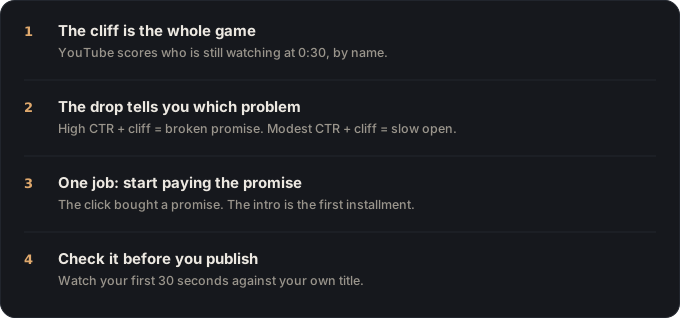
The cliff is the whole game
YouTube doesn’t hide how much the opening matters. It scores your intro as one specific number: the share of viewers still watching after the first 30 seconds. That’s the metric. Not “was your intro nice”: did they stay past the half-minute mark, or not.
YouTube measures your entire opening as a single number: the percentage of your audience still watching after the first 30 seconds.
YouTube Help, Audience retention
Think about what that means. Before a viewer has seen your point, your value, or your personality, they’ve already made the stay-or-go decision, and YouTube is watching them make it. A strong 30-second hold tells the algorithm the click was honest and the content delivered. A weak one tells it to stop showing your video around. The cliff isn’t just lost viewers; it’s lost reach.
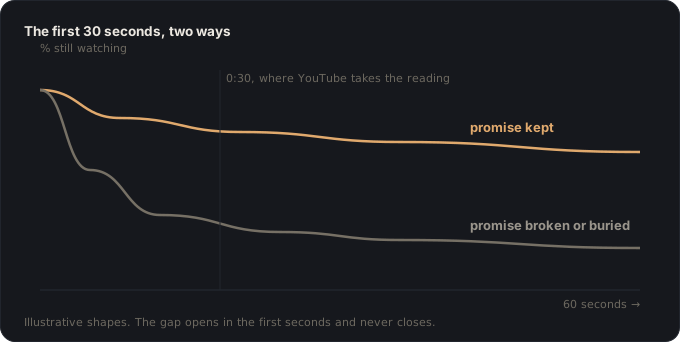
What the drop is actually telling you
When people leave in the first few seconds, it’s almost never because the video is bad. They haven’t seen enough of it to judge. They’re leaving for one of two reasons, and they’re worth separating because the fixes are different.
The first is a mismatch. The title and thumbnail made a promise, the opening didn’t start paying it off, and the viewer felt the bait-and-switch instantly. YouTube’s own advice for a weak intro is telling: before you touch the content, “consider changing your video thumbnail and title to better reflect your video content.” The opening and the packaging have to agree.
The second is a slow start: the throat-clearing. The channel intro, the “hey guys welcome back,” the ninety seconds of context before anything happens. Nothing is wrong, exactly. There’s just no reason to stay yet, and “yet” is all it takes.
There’s a third shape worth learning to spot: a strong first three seconds followed by a cliff somewhere between fifteen and forty-five seconds. That’s neither a mismatch nor a slow start. It’s an opening that worked and then went unpaid, and the Hook Book is about that specific failure.
The one job of an intro
Here’s the reframe that fixes most openings: your intro is not there to introduce the video. It’s there to buy the next thirty seconds. That’s it. It makes one promise interesting enough that leaving would cost the viewer something: an answer, a payoff, a “wait, what?”, and then it starts delivering fast enough that staying feels rewarded.
Everything that doesn’t do that job is a candidate for the cut. The logo sting, the “before we get started,” the slow pan over your desk. Not because they’re bad, but because they spend the most valuable seconds you have on something other than the one job.
Run this before you publish
- You open on the payoff, not the preamble.
- The promise your title and thumbnail made is visible in the first 15 seconds.
- No “hey guys, welcome back, don’t forget to subscribe” pre-roll.
- Your first sentence would work as a comment. It opens a loop.
- You say out loud, early, why this video is worth staying for.
- It still lands at 1.5× speed and on mute.
If all six pass, you’ve done the one thing that decides whether the rest of the video gets seen at all.
🎬 Video script
- Cold open on your own retention graph, full-frame. Put your finger on the first-30-seconds cliff: “This is where I lost half of you. Let me show you why.”
- Cut to a slow intro (yours or a stock one) playing in real time: let it drag on camera until it’s uncomfortable.
- Land the YouTube stat as a full-screen graphic: your intro is the 30-second hold.
- Split screen: a mismatched title/opening vs. one that pays off the promise in the first line.
- Close on the reframe: “Your intro has one job, earn the next thirty seconds. Everything else is negotiable. Next: the five openings that actually do it.”
Sources
- YouTube Help, Measure key moments for audience retention: the “intro” metric (viewers still watching after 30 seconds) and YouTube’s guidance to match the thumbnail/title to the content.
- Retention Rabbit, The 2025 State of YouTube Audience Retention: a benchmark across 10,000+ videos showing the largest single drop falls in the opening seconds.
Key takeaways
- Your steepest drop is in the first 15-30 seconds, win there or nothing else matters.
- Open on the payoff, not the preamble.
- The intro's only job is to earn the next thirty seconds.