Hooks & intros · Lesson 2
The 5 hooks that actually work
Five opening patterns you can reach for on any video, and when to use each.
A hook isn’t a gimmick you bolt onto the front of a video. It’s a single move, and once you see the move you can run it five different ways. The move is this: open a gap between what the viewer knows and what they suddenly want to know, then make them feel that closing it is worth their next few minutes.
That’s not a metaphor. It’s how curiosity actually works.
Curiosity is a form of cognitively induced deprivation that arises from the perception of a gap in one’s knowledge. Open the gap, and the mind treats closing it as a need, not a nicety.
George Loewenstein, “The Psychology of Curiosity” (1994)
Every hook below opens that gap. They differ only in how. Learn the five and you’ll never stare at a blank timeline wondering how to start again.
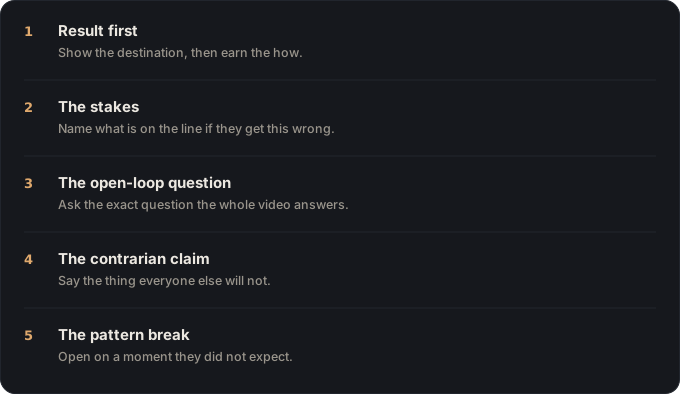
1. Result first
Show the destination, then make them earn the road to it. Open on the finished thing (the transformation, the number, the “after”) and the viewer stays to find out how you got there. “I turned $100 into this in thirty days” over a shot of the result. The gap is the entire method, and you’re holding it.
Use it when the payoff is visual or surprising, and the how is genuinely non-obvious.
2. The stakes
Name what’s on the line. Not what the video is about: what it costs to get wrong. “Most people lose their first thousand subscribers to a mistake they make in the first week.” Now the viewer isn’t curious, they’re invested, because you’ve made the topic about them.
Use it when your audience has a fear or a goal you can name in one sentence.
3. The open-loop question
Ask the exact question the whole video answers: then don’t answer it yet. “Why do some channels blow up at 300 subscribers and others stall at 30,000?” The gap is explicit; the viewer stays because you promised to close it. This is the purest form of the move, and it works on almost anything.
Use it when you’re not sure which hook to reach for. It’s the default that rarely misses.
4. The contrarian claim
Say the thing everyone in your niche won’t. “Posting more often is killing your channel.” A claim that cuts against the received wisdom opens a gap and a small argument: the viewer stays partly to see if you’re right and partly to see if you can defend it.
Use it when you actually have the goods. A contrarian hook you can’t back up is a bait-and-switch, and the retention cliff punishes those hardest.
5. The pattern break
Open on something they didn’t expect to see. A jarring visual, a mid-action moment, a jump-cut into the loudest ten seconds of the video. This one works below language, before the viewer has read your title in their memory, the screen has already refused to be background noise.
Use it when you have a genuinely arresting shot, or when the topic is dry and needs energy borrowed from the edit.
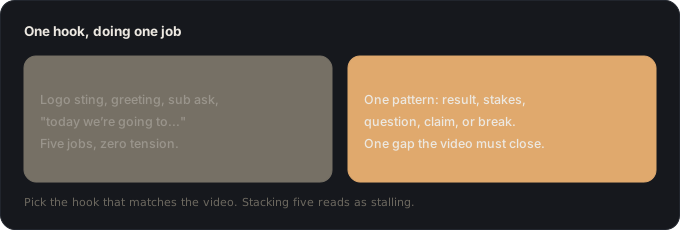
Pick one. Don’t stack five.
The mistake isn’t choosing the wrong hook. It’s choosing all of them. A cold open, then a stakes line, then a question, then the channel intro, and now ninety seconds are gone and no single gap ever got opened cleanly. One hook, opened sharply, held just long enough to start paying off. Then get moving.
A fast test for whether your hook is doing the job: would your first line survive as a comment? If someone posted it under a video, would it get replies, or scrolled past? A hook that would earn a reply opens a real gap. A hook that would get scrolled past is throat-clearing wearing a hook’s clothes.
Each of these five gets taken apart properly in the Hook Book: what each one genuinely fits, where it backfires, and what to say in the fifteen seconds after it, which is the part that decides whether the hook actually held.
Want a running start? The hook library has dozens of these templates sorted by pattern and niche, each with a real example you can click through. Next up, the cold open: the single most reliable way to run “result first.”
Pick-your-hook checklist
- The hook opens one clear gap: a question the viewer now needs closed.
- It’s about the viewer’s payoff, not your video’s topic.
- You can defend it. Nothing promised that the video doesn’t deliver.
- It’s one hook, not four stacked on top of each other.
- Your first line would earn a reply as a comment.
🎬 Video script
- Open with the move itself: state one great open-loop question to camera, pause, then say “That’s a hook. Here are five ways to make one.”
- Take each pattern in turn: say the pattern name as a full-screen card, then read a real example in your own niche.
- For the contrarian one, actually make the claim you believe and hold the tension for a beat.
- Demo the pattern break by hard-cutting your own footage mid-sentence, then explaining what just happened.
- Close on the comment test: “If your first line wouldn’t earn a reply, it’s not a hook yet. Write one that would.”
Sources
- George Loewenstein, The Psychology of Curiosity: A Review and Reinterpretation, Psychological Bulletin 116 (1994): the information-gap theory of curiosity.
- YouTube Help, Measure key moments for audience retention: why the opening decides whether the rest is seen.
Key takeaways
- Every strong hook opens a loop the viewer needs closed.
- Match the hook to the video, not to a trend.
- If your first line works as a comment, it works as a hook.