Titles & packaging · Lesson 4
Title formats that keep working
Six durable title shapes, why each one pulls, and the discipline that keeps a format from becoming a fill-in-the-blank crutch.
Every few months a new list of “viral title templates” makes the rounds, and most of it ages like milk because it copies surface features of whatever worked last quarter. But underneath the churn there are a handful of title shapes that have pulled clicks for a decade, because each one mechanically opens the promise-gap from lesson one: a specific outcome, felt stakes, an addressee.
Learn the shapes, not the strings. A format only works when it’s carrying a real promise. It’s a container, and an empty container is just a cliché with your name on it.
Keep it short enough to survive the feed
One structural rule before the shapes, because it governs all of them:
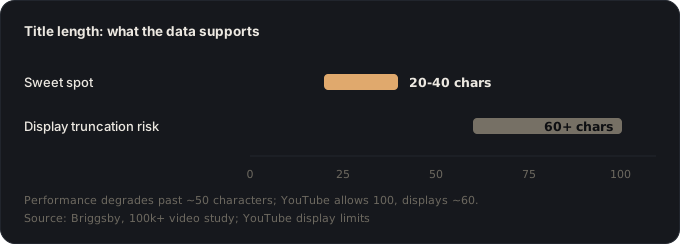
Performance gets incrementally worse beyond 50 characters: succinct video titles outperform longer, more cumbersome ones, with a sweet spot around 20-40 characters.
Justin Briggs, “Reverse Engineering YouTube Search” (Briggsby study of 100k+ videos)
YouTube gives you 100 characters, and truncates display around 60 in most surfaces. Treat the limit as a trap: whatever matters must live in the first 40, because that may be all anyone sees. If your promise arrives after a colon at character 55, the feed will amputate it.
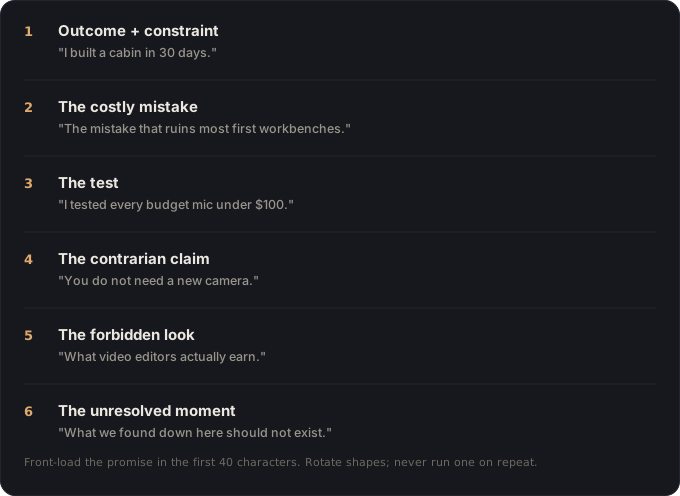
The six durable shapes
1. Outcome + constraint. “I built a cabin in 30 days.” “Editing a video using only my phone.” The constraint (time, money, tools) is what generates the stakes: remove it and you have a topic. The tighter and more concrete the constraint, the harder the pull.
2. The costly mistake. “The mistake that ruins most first workbenches.” “I wasted $3,000 so you don’t have to.” Loss-framed promises pull harder than gain-framed ones because avoiding pain is urgent. The addressee is built in: someone about to make the same mistake.
3. The test. “I tested every budget mic under $100.” “30 days of cold showers: honest results.” Promises a judgment the viewer would otherwise have to buy or suffer for themselves. The word tested (or tried, ranked) signals the payoff is empirical, not opinion.
4. The contrarian claim. “You don’t need a new camera.” “Everything you know about sharpening is wrong.” Opens the gap by attacking something the viewer currently believes: clicked to be confirmed or to argue. The video must actually land the claim, or you’ve bought a click with a promise you can’t keep.
5. The forbidden look. “What video editors actually earn.” “Inside the studio nobody’s allowed to film.” Promises access: information or places the viewer assumes are hidden. Works because the stakes are curiosity itself; fails instantly if the “inside” turns out to be the same public info repackaged.
6. The unresolved moment. “What we found down here shouldn’t exist.” “The email that ended my biggest sponsorship.” Narrative mid-point as title: the story is already in motion and only the video resolves it. The strongest shape for storytelling channels, and the easiest to tip into empty mystery, so keep the what visible.
Rotate, and re-anchor every time
Two disciplines keep formats from rotting. Rotation: if five consecutive uploads are all “I tested X,” your packaging becomes wallpaper to your own subscribers, the shapes work partly by contrast with each other. Re-anchoring: before reaching for a shape, write the promise in plain words first (“this video proves cheap mics are fine”), then pick the container that fits it. Format-first titling produces those hollow, mad-libs titles the viewer smells immediately: the shape’s rhythm with nothing inside.
The final check is always the pair: whichever shape you pick has to split the labor with the thumbnail rather than caption it.
The format check
- The promise existed in plain words before you chose a shape for it.
- The core promise lands inside the first 40 characters.
- The constraint, number, or claim in the title is concrete and true.
- This shape differs from your last few uploads.
- The title still works next to the thumbnail without repeating it.
🎬 Video script
- Open on a “viral title template” listicle, then show three dead videos that used them verbatim: templates copy strings; this is about shapes.
- Put the Briggsby short-title finding on screen; show a 90-character title truncating in a real feed.
- Walk the six shapes fast with one recurring example video re-titled into each shape.
- Show the failure mode: format-first mad-libs titling versus promise-first, on the same video.
- Close: “Write the promise plain, pick the container that fits, keep it under 40 where it counts.”
Sources
- Justin Briggs, Reverse Engineering YouTube Search: title-length findings across 100k+ videos; shorter titles outperform, with degradation past ~50 characters.
- YouTube Help, Thumbnail & title tips: official guidance to keep titles concise and front-load what matters.
Key takeaways
- Formats are containers for a promise. They never replace having one.
- Shorter wins, front-load the promise in the first 40 characters.
- Rotate shapes; a channel where every title is the same format trains viewers to skim past it.