Titles & packaging · Lesson 5
Test the title before you publish
Three pre-publish tests that catch weak titles for free, and how to use YouTube's built-in A/B testing once the video is live.
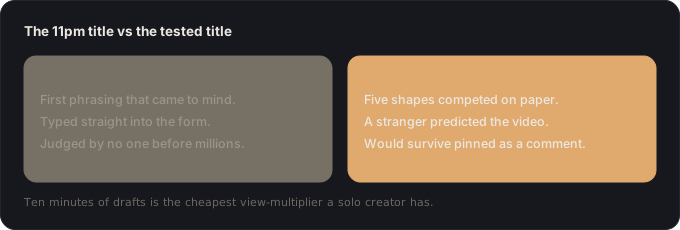
By this point in the module you know what a strong title is made of. This lesson is about a habit: never shipping the first one you thought of. The gap between “the title I typed in the upload form at 11pm” and “the strongest of five deliberate candidates” is often the single cheapest view-multiplier available to a solo creator. It costs ten minutes and no gear.
Testing happens in two places: before publish, where you test the promise, and after publish, where YouTube itself can test the packaging.
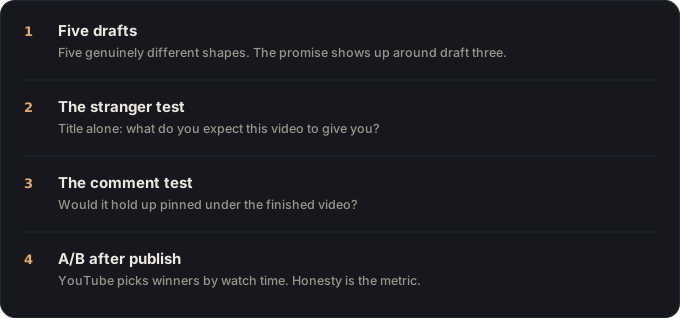
Before publish: five drafts and two cheap tests
The five-draft rule. Write five genuinely different candidates: different shapes, not five word-orders of one idea. The first draft is almost always a description; the promise usually shows up around draft three, once the obvious phrasing is used up. This is also the honest version of what big channels do with entire packaging teams: generate options, then choose, instead of ratifying the first idea.
The stranger test. Show someone the title alone (no thumbnail, no explanation) and ask one question: “What do you expect this video to give you?” If their answer isn’t the promise you meant to make, the title failed before any algorithm saw it. Their misreading is data: it’s exactly how the feed will misread it.
The comment test. Would the title hold up pinned as a comment under the finished video: true, specific, not embarrassing? This catches over-promising while it’s still free to fix, and it forces the payoff moment to actually exist. If checking the title against the footage makes you wince, the problem is upstream: either the title or the video has to move.
After publish: let YouTube run the experiment
Once the video is live, you don’t have to argue about taste. YouTube has a built-in experiment for exactly this.
With the “A/B test titles & thumbnails” feature you can test up to three titles and thumbnails per video. At the end of the test, the combination with the highest watch time share is shown to all viewers.
YouTube Help, “A/B test titles & thumbnails”
Two details in that sentence matter more than the feature itself. First, it tests combinations: the platform treats title and thumbnail as one unit, the same way viewers do. Second, the winner is chosen by watch time, not click-through. A bait title that wins clicks and loses viewers loses the test. YouTube built its own experiment to reward the kept promise, which should tell you everything about which game you’re in.
Practical notes: the feature lives in YouTube Studio on desktop (you’ll need advanced features enabled), title testing rolled out globally through late 2025, and tests need meaningful traffic to conclude, on a small channel, run them on your bigger videos and let them cook for days, not hours. And don’t burn tests on trivia: test different promises against each other, not comma placement.
The re-title lever most creators forget
The A/B tool also unlocks the retroactive move: your back catalog. A video that underperformed at launch with a description-title is a free experiment waiting to happen: the footage already exists, the audience already proved they’ll watch this topic elsewhere, and a re-packaged promise can restart impressions on something you shot a year ago. Old videos with strong watch-through but weak CTR are the best candidates: the video kept a promise the title never made.
The pre-publish check
- Five distinct candidates exist; the shipped one beat four rivals.
- A stranger reading only the title predicted the video you actually made.
- The title survives the comment test against the finished footage.
- The final pick was made next to the thumbnail, as a pair.
- Bigger videos get an A/B test after launch: promises versus promises, judged by watch time.
🎬 Video script
- Open on the upload form at 11pm, typing the first title that comes to mind, publish. Freeze: “This ten-second decision just priced twenty hours of work.”
- Run the five-draft rule live on a real video; watch the description become a promise around draft three.
- Do the stranger test on camera: hand someone the title, ask what they expect, react to the miss.
- Demo YouTube’s A/B tool, underlining the scoring rule: winners by watch time, not clicks. Honesty is literally the metric.
- Close: “Five drafts, two questions, one experiment. Never ship the first title again.”
Sources
- YouTube Help, A/B test titles & thumbnails, up to three variants per video; winners selected on watch time share; desktop Studio with advanced features.
- YouTube Help, Impressions & click-through-rate FAQs: how to read CTR movements when you re-title, and why CTR alone is a misleading scoreboard.
Key takeaways
- Never publish the only title you wrote, draft five, ship the strongest.
- Test the promise before publish with people; test the packaging after publish with YouTube's A/B tool.
- YouTube picks A/B winners by watch time, not clicks, one more reason honest promises win.