Thumbnails that get the click · Lesson 5
Testing & iterating your thumbnail
YouTube now A/B tests thumbnails for you, and it optimises for more than clicks. How to use it, and how to read the result without fooling yourself.
Every rule in this module, one subject, the right emotion, three words, gets you a good guess. It’s still a guess. The only way to know whether a thumbnail works is to watch what real strangers do with it. The good news: YouTube will now run that test for you, for free.
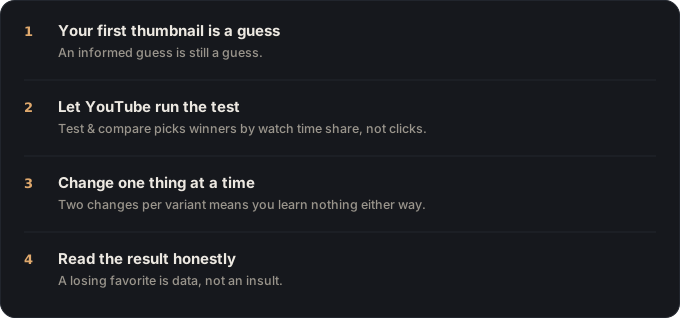
Your first thumbnail is a guess
You are the worst-positioned person to judge your own thumbnail, because you already know what the video is about. Everything looks clear to you. The person who matters, a first-timer scrolling with zero context, is exactly the person you can’t see inside your own head.
So treat the thumbnail you publish as a hypothesis, not a verdict. The work isn’t picking the “right” one. It’s setting up a way to find out.
Let YouTube run the test
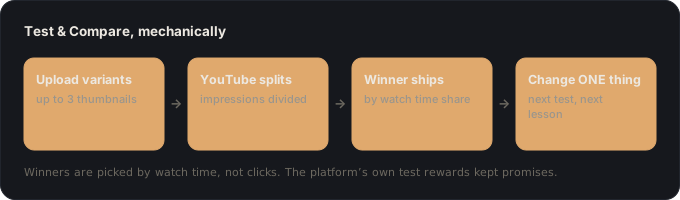
YouTube has a built-in tool for this called Test & Compare, in YouTube Studio on desktop. It’s now available to creators in the YouTube Partner Program, and it does the hard part for you: upload up to three thumbnail variants, and YouTube splits impressions between them across real audiences and reports a winner. No spreadsheets, no manual swaps, no guessing whether the sample was fair.
Here’s the part most creators miss, and it should change how you design.
YouTube’s Test & Compare picks the winner by watched time per impression, not by raw click-through rate. The thumbnail it crowns is the one that brings viewers who actually stay.
YouTube, via Social Media Today (2025)
That’s a smarter target than clicks, and it protects you from your own worst instinct. A shocking, slightly-misleading thumbnail can win on CTR and lose on watch time, because the people it tricks into clicking bounce immediately. Optimising for watched-time-per-impression rewards the honest hook: the thumbnail that pulls the right viewer, not just any viewer. Design for that.
Change one thing at a time
The point of a test is learning what moved the number. You lose that the moment you change the face, the text, and the background all at once. If variant two wins but differs in three ways, you’ve learned that something worked, not what, so you can’t carry it to the next video.
Pick one variable per test. Swap only the expression. Or only the text. Or only the background. A disciplined test that isolates one change teaches you something reusable on every future thumbnail. A messy one just tells you “this particular thumbnail did better,” which is worth almost nothing.
Read the result without fooling yourself
Two traps sink most testing instincts.
The first is reacting to the first hour. Early impressions are a small, skewed sample, often your most loyal subscribers, not the cold audience that decides a video’s fate. A variant that looks like it’s losing at hour one can overtake by hour twelve. Native Test & Compare runs for up to 14 days and tells you when it has enough data to call it. For a manual read, give each variant a comparable few thousand impressions before you judge.
The second is recency bias: deciding a rule works because of the last single video it appeared on. One video’s performance is shaped by dozens of things besides the thumbnail, the topic, the day, what else was in the feed. Trust patterns across several videos, not one result. Testing is a practice, not a one-time verdict.
🎬 Video script
- Cold open: “Your thumbnail isn’t finished when you upload. That’s when the test starts.”
- Screen-record Test & Compare in Studio, start to finish, uploading three variants.
- Land the key insight on screen: “It optimises for watch time per impression, not clicks.” Explain why that kills clickbait.
- The one-variable rule: a bad test (changed everything) vs a good one (changed only the face).
- Close on the two traps: don’t judge hour one, don’t judge one video. Show a CTR graph settling over time.
Sources
- Social Media Today, YouTube announces rollout plan for thumbnail A/B testing (watch-time-per-impression metric, rollout).
- Tubefilter, YouTube’s Test & Compare for titles and thumbnails (2025 expansion, up to 3 variants, 14-day tests).
Key takeaways
- You're the worst judge of your own thumbnail. Real viewers are the only test that counts.
- Use YouTube's native Test & Compare (up to 3 variants); it optimises for watch time per impression, not raw clicks.
- Change one thing at a time, and judge patterns across videos, not the first hour of one.