Story & structure · Lesson 3
Stakes: why should anyone care?
Stakes are the answer to "so what?", what they're made of, why "nothing bad can happen" kills videos, and how to raise them honestly.
Every unwatchable video shares a diagnosis, and it isn’t pacing, gear, or charisma. It’s that the viewer, consciously or not, asked “so what?” and got no answer. The build finishes or it doesn’t. The trip happens or it doesn’t. Nothing rides on the outcome, so attention (which is expensive) goes somewhere it’s needed.
Stakes are the answer to “so what?”. They’re the second ingredient from lesson one, and they’re the one solo creators most consistently leave implicit, because they know why the project matters and forget the viewer doesn’t.
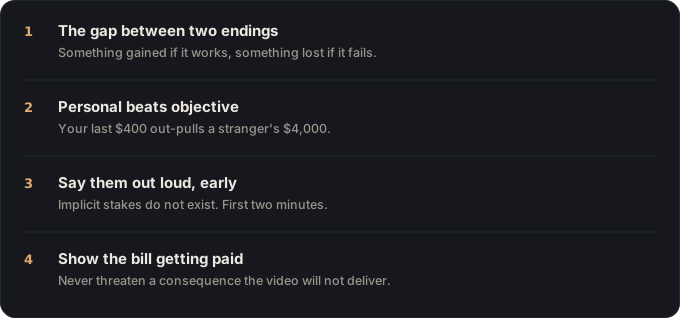
What stakes are made of
Stakes are the gap between the two endings. If the attempt succeeds, something is gained; if it fails, something is lost, and both somethings have to be felt by the person on camera. Money, obviously. But also: time (“this took every weekend for two months”), reputation (“I told everyone this would work”), a belief (“if this fails, cheap tools really are a scam”), a door (“if this video flops, I’m going back to tutorials”).
The psychology of why this holds attention is the same gap machinery that powers hooks:
Curiosity is a form of cognitively induced deprivation that arises from the perception of a gap in one’s knowledge.
George Loewenstein, “The Psychology of Curiosity” (1994)
An outcome without stakes is a fact the viewer is missing, and missing facts are painless. An outcome with stakes is a resolution the viewer is deprived of, which one of two futures happens to this person?, and deprivation demands closing. Same footage, entirely different pull.
Personal beats objective
Creators reflexively reach for objective stakes (bigger numbers, rarer items, harder challenges) and hit a ceiling, because scale you can’t feel isn’t stakes, it’s trivia. A stranger’s $4,000 means nothing; your last $400, on camera, visibly meaning something to you, is unbearable to look away from. The viewer doesn’t need the stakes to be large. They need them to be real and owned: this specific person has told me what this outcome costs them, and I believe it.
This is the great equalizer for small channels. You can’t out-spend big creators, but stakes are manufactured from honesty, not budget: the beginner attempting something at the edge of their ability, stated plainly, out-stakes a professional cruising through something safe.
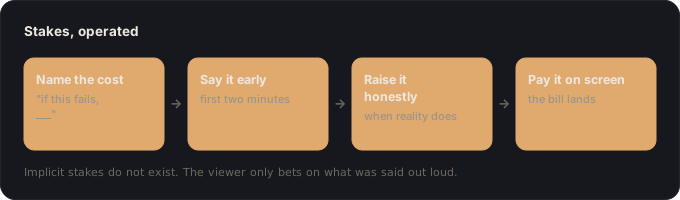
Say them out loud, early
Implicit stakes don’t exist. The viewer will not infer that the deadline matters or that you’ve failed at this twice before: the resistance is real, but off camera it’s worth nothing. So the stakes get stated, in plain words, inside the first two minutes: “if this doesn’t work, X.” That sentence belongs in beat two of the seven-beat structure, and it’s the sentence your title has been promising all along: titles with stakes are just stakes compressed to sixty characters.
Two honesty rules, because stakes are a promise like everything else in packaging. Don’t invent consequences you won’t show. If the video ends and the threatened cost never materializes on screen (no reaction, no reckoning, no changed plan) the viewer files it as clickbait’s quieter cousin, and your next stakes get discounted. Don’t re-raise artificially. Announcing higher stakes mid-video (“now it’s REALLY serious”) without a new event to justify them reads as manipulation. Stakes rise when the complication raises them. That’s beat four’s job, not the narrator’s voice.
The stakes check
- You can complete “if this fails, ___” with something concrete and personal.
- That sentence is said on camera in the first two minutes.
- The stakes are owned: the person on screen visibly cares, and says why.
- The ending shows the consequence landing: the gain enjoyed or the loss felt.
- Nothing was threatened that the video doesn’t deliver.
🎬 Video script
- Open on two identical clips of a knife hovering over a $200 whetstone: one narrated flat, one after the line “I saved three months for this.” Ask which one you can’t look away from.
- Put Loewenstein on screen: no gap, no deprivation, no attention. Stakes are gap-manufacturing.
- Run the personal-beats-objective argument with a small-channel example out-staking a big one.
- Show the two dishonest moves (phantom consequences and artificial re-raising) and their cost.
- Close: “Say what it costs, mean it, and show the bill getting paid. That’s stakes.”
Sources
- George Loewenstein, The Psychology of Curiosity, Psychological Bulletin 116 (1994): the information-gap account of curiosity that stakes exploit.
- Paul J. Zak, Why Your Brain Loves Good Storytelling, Harvard Business Review (2014): tension, sustained by something at risk, is what holds narrative attention.
Key takeaways
- Stakes are what the outcome costs or pays, no cost, no reason to care.
- Personal stakes beat objective ones; $40 that matters beats $4,000 that doesn't.
- State the stakes early, out loud, and never promise consequences you won't show.