Story & structure · Lesson 4
Setups and payoffs
The plant-and-pay mechanic that makes endings feel earned, how to seed it on a beat sheet, and how to spot the orphaned setups bleeding your videos.
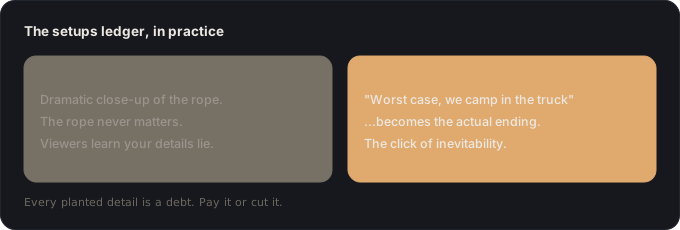
There’s a moment in well-made videos that viewers can’t name but always feel: something from minute two comes back at minute eighteen, the tool dismissed as junk saves the build, the offhand “worst case we camp in the truck” becomes the ending. It lands with a click of inevitability, and the video suddenly feels written instead of assembled, even if it’s a vlog shot on a phone.
That mechanic has a name older than film. Chekhov gave it its bluntest form:
One must never place a loaded rifle on the stage if it isn’t going to go off.
Anton Chekhov, on dramatic economy (1889)
YouTube inverts the emphasis. Chekhov warns against setups that never pay; the long-form creator’s bigger problem is payoffs that were never set up: endings that resolve things the viewer was never taught to want resolved. Both failures have the same shape: a debt ledger that doesn’t balance.
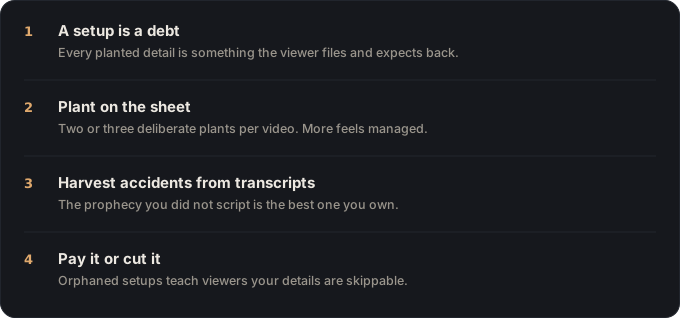
Setups are debts, payoffs are payments
A setup is any detail the video asks the viewer to hold: an object shown deliberately, a fear stated out loud, a rule established (“if the temperature drops below freezing, this finish fails”). Each one is a small debt the video takes on: the viewer files it and, below awareness, expects it to matter.
A payoff is that debt paid: the detail returns and does something, resolves, reverses, or explains. The click of a good payoff is the viewer’s filing system being proven right: that’s why I was shown the rifle.
This ledger is why setups and payoffs are a retention mechanic, not a screenwriting nicety. Every open setup is one more unresolved thread pulling the viewer toward the end: the same gap-machinery as stakes, but distributed in small denominations across the whole runtime. A video with three planted debts outstanding at minute ten is structurally harder to leave than one with none.
Plant on the sheet, harvest in the footage
Deliberate setups get planned on the beat sheet: if the resolution turns on the cheap chisel, the sheet says “beat 2: show the chisel, dismiss it.” Two or three planned plants per video is plenty: more and the viewer feels managed.
But the best setups usually aren’t planned. They’re found. The camera catches you saying “this’ll definitely be fine” two hours before it very much isn’t. That accidental prophecy is worth more than any scripted plant, because it’s verifiably real. This is a transcript-level search problem: the payoff exists in the ending, and somewhere in six hours of footage is the moment that set it up. Skimming what was said across every clip: rather than scrubbing video at 1.5x: is how you find them; it’s the same read-the-transcripts-first discipline the next lesson builds on.
The two failure modes
Orphaned setups. The dramatic close-up of the rope that never matters, the “I’m worried about the weather” that stays sunny. One orphan is noise; a channel-wide habit of them quietly trains your audience that your details are skippable, which is another way of saying your videos become skippable. In the edit, the rule is Chekhov’s: pay it or cut it. The shot you love that sets up nothing is costing more than its ten seconds.
Unearned payoffs. The twin failure: a reveal the viewer wasn’t prepared to care about. “Turns out the motor was the wrong voltage all along” lands as a shrug if voltage was never established as a thing that could be wrong. When a payoff tests flat, the fix is almost never at the ending. It’s a missing thirty-second setup somewhere in the first act. Endings are built early.
The ledger check
- Every deliberate plant in the first third returns and does something by the end.
- The ending’s biggest reveal was set up: the viewer had the pieces to care.
- At least one setup is harvested from the footage, not the script (search what you actually said).
- Anything planted-looking that pays nothing is cut.
- No payoff depends on information the viewer was never given.
🎬 Video script
- Open on the minute-two/minute-eighteen trick in a real video, freeze on the return: “Feel that click? That was planted sixteen minutes ago.”
- Chekhov’s rifle on screen; flip it: YouTube’s bigger sin is the payoff nobody loaded.
- Run the ledger metaphor over a beat sheet: debts opened, debts paid, and what each open debt does to leaving.
- Autopsy both failures: an orphaned setup, then an unearned reveal, and fix each one.
- Close: “Plant it early, pay it late, cut what you can’t pay. The ending starts in minute two.”
Sources
- Anton Chekhov, letter on dramatic economy (1889): the loaded-rifle principle, via S. Shchukin’s Memoirs (1911).
- George Loewenstein, The Psychology of Curiosity, Psychological Bulletin 116 (1994): open loops as information-gaps; setups are the gap distributed across the runtime.
Key takeaways
- Every setup is a small debt; every payoff is that debt paid, the pairing is what makes structure feel intentional.
- Plant setups on the beat sheet, but harvest them from the footage, the best ones are accidents you kept.
- An orphaned setup (planted, never paid) quietly teaches viewers your details don't matter.