Hooks & intros · Lesson 3
Cold opens: don't bury the payoff
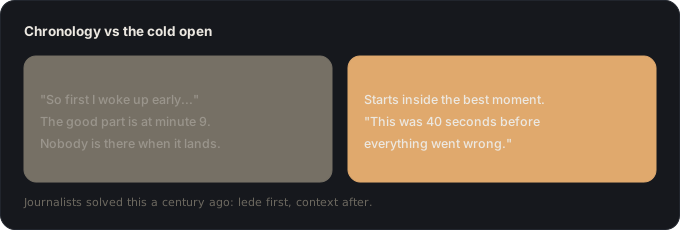
Show the destination first, then back-fill the context. The cold open that front-loads the payoff.
Most intros are written in the order the creator experienced the video: first the setup, then the context, then (eventually) the good part. That’s the natural order to make a video in. It’s the worst possible order to open one with, because the viewer deciding whether to stay hasn’t earned the patience for your setup yet. You’re spending their curiosity on background before you’ve given them a reason to be curious.
A cold open flips it. You take the best moment: the result, the turn, the “wait, what?”, and you put it first. Everything the viewer needs to understand it comes after, once they’ve already decided the video is worth understanding.
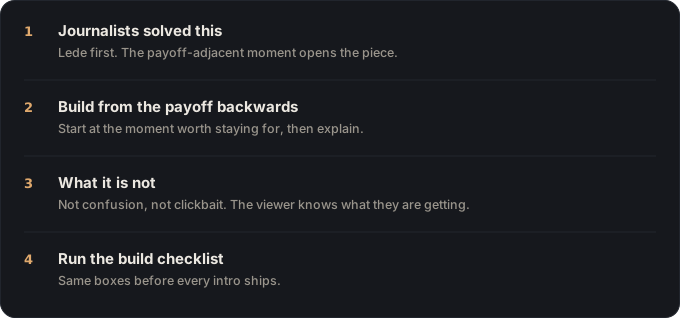
Journalists solved this a century ago
This isn’t a YouTube trick. It’s the oldest structure in mass communication.
The inverted pyramid puts the most vital information first. It comes from the telegraph era. You led with what mattered most, because the line could cut out at any moment and the reader still had to get the point.
Purdue OWL, on the inverted pyramid
Your video has a line that cuts out at any moment too. It’s called the close button, and viewers are hovering over it for the whole first thirty seconds. Lead like a journalist: the most important thing, first. The “who, what, why” of your video belongs in the opening, not three minutes in once you’ve “set it up.”
How to build one
Find the single most compelling ten seconds of your finished video: the payoff, the reveal, the strongest line. That’s your cold open. Then structure the opening in three quick beats:
- The payoff. Show or state the destination. “This edit took my retention from 30% to 55%.” Or just play the best moment raw.
- The gap. Make explicit what they don’t yet know. “Here’s exactly what I changed, and why it works on any video.”
- Go. Start delivering. Not “but first,” not the channel intro. The first real step, immediately.
That’s it. Notice there’s no room in those three beats for a logo sting or a “hey guys.” There isn’t time, and that’s the point.
What a cold open is not
It’s not spoiling the whole video. You’re showing the destination, not the map: the result creates the gap (“how did they do that?”), it doesn’t close it. Show the finished thing; withhold the method.
And it’s not a fake-out. A cold open is a promise, and the retention cliff is brutal to broken ones. If you open on a dramatic moment that turns out to be unrelated clickbait, the viewer feels it the second the video pivots, and they leave harder than if you’d never hooked them. The payoff you open on has to be a payoff the video actually delivers.
The cold open is just one narrative move. The storytelling mechanics library breaks down the rest (open loops, escalating stakes, the promise-payoff contract) each with a real example.
For the long version of this one move, the Hook Book gives it a chapter: why spoiling the ending costs you nothing, and why the beat straight after a cold open has to be proof that the result is real, not the story of how you got into this.
The cold-open build checklist
- The first ten seconds show the payoff, not the setup.
- Nothing precedes it, no logo, no “welcome back,” no throat-clearing.
- The opening names, or shows, what the viewer doesn’t yet know.
- You start delivering by the 20-second mark.
- The moment you opened on is one the video genuinely pays off.
🎬 Video script
- Literally open this video with a cold open about cold opens: play your single best clip, then cut to yourself. “That’s where most creators would end. Watch what happens when you start there instead.”
- Show a normal intro and a cold-open version of the same video side by side, first ten seconds each.
- Put the three beats on screen as cards (payoff, gap, go) and narrate a real example through them.
- Show the inverted pyramid as a graphic, then rotate it into a video timeline.
- Close: “Take the best ten seconds of your next video and make them the first ten. Then never bury a payoff again.”
Sources
- Purdue OWL, The Inverted Pyramid: leading with the most vital information.
- YouTube Help, Measure key moments for audience retention. YouTube’s guidance to modify the first 30 seconds when the intro underperforms.
Key takeaways
- Show the result, then earn the how.
- Context can wait; curiosity can't.
- A cold open makes a promise the rest of the video pays off.