Story & structure · Lesson 2
The 7-beat structure of long-form YouTube
The skeleton most watchable long-form videos share, beat by beat, and how to hang your footage on it without feeling formulaic.
Screenwriting discovered something decades ago that YouTube keeps re-learning one burned-out channel at a time: structure isn’t the enemy of creativity, it’s the thing that makes ten hours of footage feel inevitable instead of assembled. Blake Snyder’s Save the Cat made the argument at feature scale: every working screenplay, he showed, lands the same fifteen beats, not because writers copy each other but because audience attention has a shape. Long-form YouTube has a shape too. It’s shorter, faster, and more honest about its own promises, and it compresses to seven beats.
We keep a full beat-sheet template on the blog; this lesson is the why behind each beat, so you can bend the skeleton without breaking it.
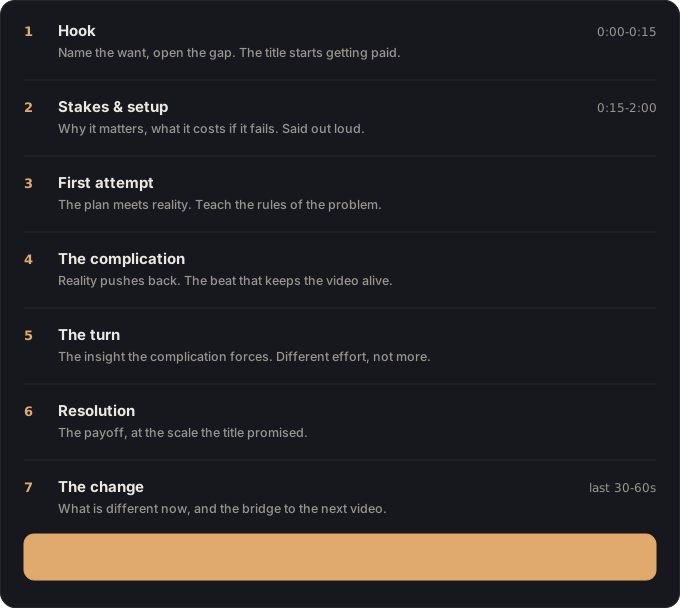
The seven beats
1. Hook (0:00-0:15). Name the want, open the gap, make the promise your title already made start paying out. The platform grades this beat by name:
The Intro metric shows the percentage of your audience still watching after the first 30 seconds. YouTube’s guidance: the opening must match the expectation set by the thumbnail and title, and keep the audience interested.
YouTube Help, “Measure key moments for audience retention”
2. Stakes & setup (0:15-2:00). Why this matters and what’s at risk: the difference between watching a build and watching a bet. Establish the world fast; every second of setup is on borrowed attention.
3. First attempt (the plan meets reality). The approach that should work, tried honestly. Its job is to teach the viewer the rules of this problem, so the coming complication means something.
4. The complication. Reality pushes back: the part doesn’t fit, the assumption breaks, the weather turns. This is the beat creators are most tempted to cut for looking unprepared, and it’s the beat that keeps the video alive, because it re-opens the question the first attempt almost closed.
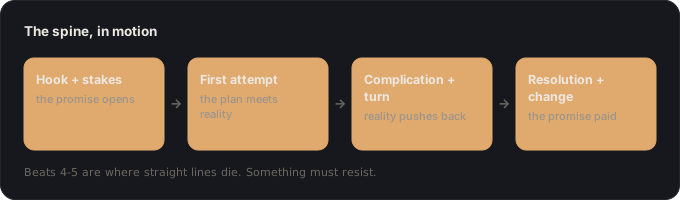
5. The turn. The insight, decision, or sacrifice the complication forces. Not more effort: different effort. If beats 4 and 5 are missing, the video is a straight line, and straight lines are what the long slow retention bleed looks like.
6. Resolution. The payoff, delivered at the scale promised: the reveal shot, the number, the verdict. Every setup you planted pays here.
7. The change (last 30-60s). What’s different now, and the bridge to the next video. Not “thanks for watching”: the earned conclusion that makes the click feel justified in hindsight, which is what turns a viewer into a subscriber.
Beats are moments, not topics
The template fails when beats are filled with subjects instead of moments. “Talk about the build process” looks like a beat and isn’t one. It doesn’t tell you what to point the camera at, and it could sit in five different videos unchanged. “The moment the beam doesn’t fit and I re-cut it on camera” is a beat: you know what to shoot and you’ll know when you’ve got it. The test for every line of your beat sheet: could this only be describing this video? If not, rewrite until it can.
This is also why the skeleton doesn’t produce formulaic videos any more than skeletons produce identical people. The beats fix the spacing of tension, where questions open and close across the runtime. Everything a viewer actually experiences (voice, subject, texture, humor) lives on top.
Structure is cheapest before you shoot
The order of operations matters more than the template. A missing beat discovered on a beat sheet costs one sentence. The same hole discovered the evening after the shoot costs a 20-minute pickup. Discovered on day three of editing, it usually costs the video: you’ll cut around it, feel the sag, and never quite know why. So write the seven beats before you press record, and check the footage against them the evening you get home, while a fix is still cheap. That check is the whole final lesson of this module.
The beat-sheet check
- All seven beats exist, each as a moment you could point a camera at.
- No beat could be pasted into a different video unchanged.
- Beats 4 and 5 exist: something goes wrong, and it forces different effort, not just more.
- The resolution pays the title’s promise at the scale it was made.
- The sheet was written before the shoot, not reverse-engineered in the edit.
🎬 Video script
- Open on a wall of sticky notes collapsing into seven: “Every watchable long-form video you’ve seen this month runs on these.”
- Walk the beats over one continuous example, showing the retention graph each beat protects.
- Linger on beats 4-5: pull up a real “straight line” video and its slow bleed.
- Do the moments-not-topics test live, rewriting a topic beat into a filmable moment.
- Close: “A hole costs a sentence today, a pickup tomorrow, and the video next week. Write the seven beats first.”
Sources
- YouTube Help, Measure key moments for audience retention: the Intro metric and YouTube’s expectation-match guidance.
- Blake Snyder, Save the Cat! The Last Book on Screenwriting You’ll Ever Need (2005): the case that audience attention has a structural shape; our seven beats are the long-form-YouTube compression of it.
Key takeaways
- Structure is load-bearing, beats are promises spaced across the runtime.
- Each beat has a job; a beat that could apply to five videos is a topic, not a moment.
- Fix structure at the beat-sheet stage, when a hole costs a sentence instead of a reshoot.