Retention & pacing · Lesson 4
Fixing the mid-video slump
The sag between a strong open and a good ending has three specific causes, the closed-question plateau, the list without an arc, and the hidden second act. Each has a structural fix.
There’s a retention shape so common it deserves its own name: strong hold through the open, a respectable finish among those who stayed, and a long, demoralizing slide through minutes four to twelve. The slump. Creators usually respond by making the middle busier: more b-roll, faster cuts, a mid-roll “but wait.” The slide barely moves, because busy-ness treats the middle as an energy problem when it’s almost always an information problem: the opening question has stopped pulling, and no new one has taken its place.
YouTube’s own analytics vocabulary points at the same conclusion:
Dips highlight moments in your video that were either skipped or where viewers stopped watching entirely. Review your dips to understand why audiences lost interest in a particular segment.
YouTube Help, “Measure key moments for audience retention”
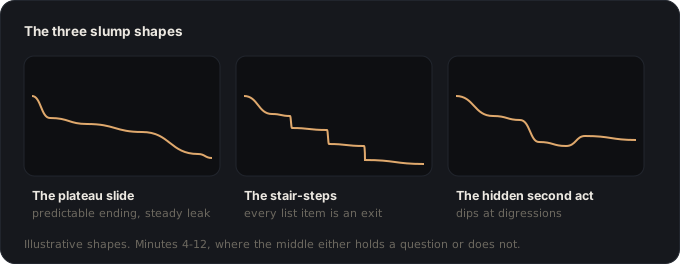
The mid-video slump is a dip stretched into a region, and like any dip, it has a diagnosable cause. In practice it’s one of three shapes.
Shape 1: the closed-question plateau
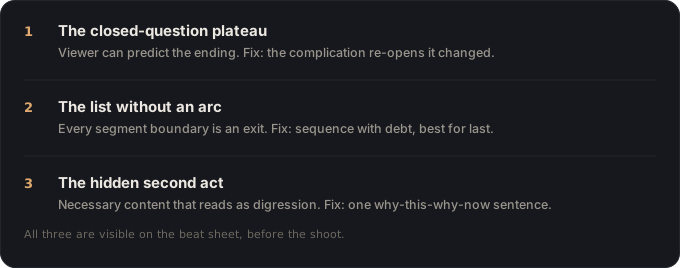
The opening promised a question, and by minute four the viewer can predict the answer: the build is clearly going to work, the test is clearly going to conclude “it’s fine.” Nothing is technically wrong; the video is just finished in the viewer’s head, and they leave with the confidence of someone who’s read the last page. The tell: a smooth, steady slide with no sharp dips, pure informational silence.
The fix is the complication. Beat 4 exists precisely for this: reality pushes back, the predictable path breaks, and the question re-opens changed, no longer “will it work” but “what will it cost to make it work.” If your shoots keep producing middles with no complication, that’s a planning smell: the video was conceived as a demonstration, not a story where something resists.
Shape 2: the list without an arc
Tip 4 of 9. Location 3 of 6. Interchangeable segments in interchangeable order, which means every segment boundary is a clean exit, and the graph shows stair-steps down at each one. The viewer isn’t bored; they’re done, several times over, and each “done” is an invitation to leave.
The fix is sequencing with debt. Order the list so it builds: cheapest to costliest, common to catastrophic, with the best item explicitly promised for last, and referenced early (“number one on this list genuinely changed how I shoot”). That’s a planted setup doing retention work: an open debt that survives every segment boundary. Rankings out-retain unordered lists for exactly this reason: the countdown is an arc.
Shape 3: the hidden second act
The middle content is genuinely necessary (context, process, the how) but the viewer can’t see why it’s necessary, so it reads as a digression between the promise and the payoff. The tell: dips at the transitions into explanatory segments, then recovery when the main thread returns.
The fix is connective tissue, not cuts. One sentence at each seam that prices the segment in the story’s currency: “this next part is why the ending is even possible,” “you need to see the numbers, because the twist only lands if you know what normal looks like.” Ten seconds of why this, why now buys minutes of patience. If a segment can’t be priced that way (if there’s honestly no sentence connecting it to the promise) it isn’t second act, it’s a different video, and it should be cut regardless of how much it cost to shoot.
Catch it before it’s a graph
Every one of these shapes is visible on the beat sheet, before the shoot: a plan whose middle beats are all demonstration and no resistance; a list with no order and no held-back best; a process section with no stated reason to exist. That’s the cheapest possible place to fix a slump, and it’s a core part of the pre-edit story check: reading the middle beats and asking “what question is open here?”
The slump check
- Minutes 4-12 always have a named open question, and it isn’t still the opening one, unchanged.
- A complication exists, and it re-opens the question changed.
- Lists are sequenced with the best last and promised early.
- Every explanatory segment is priced in one why-this-why-now sentence at its seam.
- The middle was slump-checked on the beat sheet, not discovered in analytics.
🎬 Video script
- Open on the shape itself: a real curve with the minutes-4-to-12 slide highlighted. “You’ve seen this graph. It has three causes, and busier editing fixes none of them.”
- YouTube’s dips definition on screen; the slump is a dip stretched into a region.
- Walk the three shapes with a real example each (plateau, stair-step list, hidden second act) reading each curve live.
- Fix each one structurally: inject the complication, re-sequence the list, write the connective sentence.
- Close: “The middle needs its own question. Give it one on the beat sheet, and the graph flattens on its own.”
Sources
- YouTube Help, Measure key moments for audience retention: dips: skipped or abandoned moments, and YouTube’s guidance to review them segment by segment.
- Paul J. Zak, Why Your Brain Loves Good Storytelling, Harvard Business Review (2014): attention follows tension; the slump is tension’s absence, not energy’s.
Key takeaways
- The slump is structural: the middle is where the opening question stops pulling and the ending isn't visible yet.
- Diagnose which of three shapes you have (plateau, list, or hidden second act) before fixing anything.
- The cure is a middle question of its own: the complication, not more content.