Retention & pacing · Lesson 3
Pattern interrupts that don't feel gimmicky
Why attention drifts on schedule, what a pattern interrupt actually is, and the difference between interrupts that serve the story and the zoom-and-sound-effect noise viewers have learned to ignore.
Somewhere around 2019, YouTube collectively discovered the pattern interrupt, and the results are all over your feed: the punch-in zoom every seven seconds, the record-scratch, the b-roll flash that has nothing to do with the sentence. It works (briefly, bluntly) because the human attention system is a change detector. And it stops working the moment it becomes the pattern, which on most channels takes about four videos.
This lesson is about the version that keeps working: interrupts that break the viewer’s prediction and serve the story, so the reset comes with a reason to stay.
Why attention drifts on schedule
Attention isn’t a spotlight you hold; it’s a prediction machine that goes quiet when its predictions keep coming true. A steady rhythm (same framing, same voice cadence, same information density) becomes predictable, prediction becomes certainty, and certainty is the cue to check your phone. The mechanism underneath is the same information-gap machinery this course keeps returning to:
Curiosity is a form of cognitively induced deprivation that arises from the perception of a gap in one’s knowledge.
George Loewenstein, “The Psychology of Curiosity” (1994)
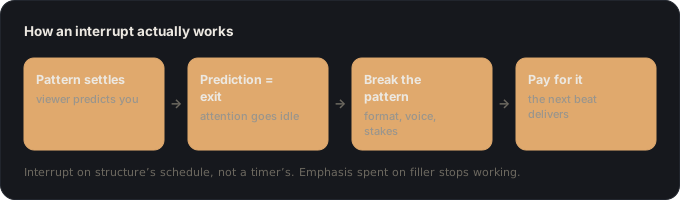
No perceived gap, no deprivation, no attention. A pattern interrupt, properly understood, is any move that re-opens a gap the viewer thought was closed. It breaks the prediction and forces the attention system back online to build a new one. The zoom does this cosmetically, once. A mid-sentence “wait. That can’t be right” does it structurally, every time it’s honest.
Structural beats cosmetic
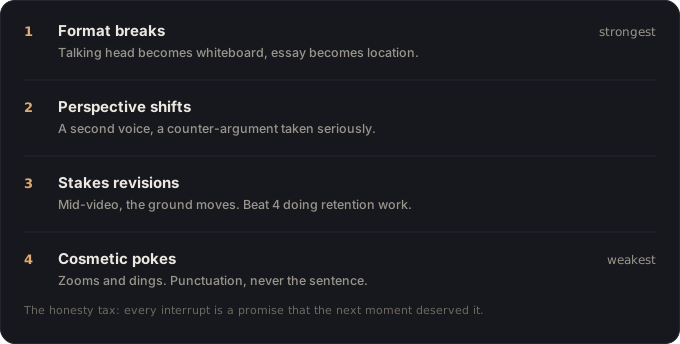
Rank interrupts by how much new prediction they force:
Format breaks: the talking-head becomes a whiteboard, the essay becomes an on-location shot, the narrator suddenly addresses an objection to camera. The viewer’s whole model of “what kind of minute is this” resets.
Perspective shifts: a second voice, a counter-argument taken seriously, the same event reshown from the other side. New source, new gap: what does this view know that the last one didn’t?
Stakes revisions: mid-video, the ground moves: “and then I checked the receipts, and the problem was three times worse.” This is beat 4 of the structure doing its retention job: the complication is the platform-grade pattern interrupt.
Cosmetic pokes: zooms, sound effects, inserted memes. Real but weak, with the shortest habituation clock and the highest gimmick tax. Use as punctuation, never as the sentence.
The graph shows the difference. Cosmetic interrupts smooth the slope a little, then nothing. Structural interrupts create the top moments and spikes YouTube labels (stretches nobody leaves and moments people rewatch) because they change what the video is for a beat, not just how it sounds.
The honesty tax
One rule keeps interrupts from rotting your channel: the interrupt must be spent on something. Emphasis is a currency. If the dramatic pause, the zoom, the “okay, this is important” all land on filler, viewers learn (fast and permanently) that your emphasis means nothing, and then the real payoff arrives to a desensitized room. It’s the clickbait contract at micro scale: every attention-grab is a small promise that this was worth re-focusing for. Keep those promises and interrupts compound; break them and you’re the channel that zoomed wolf.
Placement follows the pacing rhythm: you don’t need an interrupt every N seconds. You need one wherever a long beat risks going informationally quiet, and at the seams where one question closes before the next opens. Interrupt on structure’s schedule, not a timer’s.
The interrupt check
- Each interrupt breaks a real prediction: format, perspective, or stakes, not just volume.
- Whatever follows the interrupt is worth the re-focus it demanded.
- Cosmetic pokes are punctuation, not load-bearing retention strategy.
- Interrupts sit at structural seams and quiet stretches, not on a timer.
- Watching two of your videos back to back, the interrupts don’t repeat into a new pattern.
🎬 Video script
- Open by doing the cliché (zoom, record scratch) then deadpan: “That bought me four seconds. Here’s what buys minutes.”
- Loewenstein on screen: attention follows gaps; an interrupt is a gap re-opened.
- Demo the ranking live: same segment saved four ways (zoom, format break, second voice, stakes revision) with honest commentary on which held you.
- Show the honesty tax: a channel that spent its emphasis on filler, and what its real payoff lands like.
- Close: “Break the pattern where the story needs it, and always pay for the attention you take.”
Sources
- George Loewenstein, The Psychology of Curiosity, Psychological Bulletin 116 (1994): the information-gap account behind prediction, habituation, and re-opened attention.
- YouTube Help, Measure key moments for audience retention: spikes and top moments: the report’s fingerprint of structural interrupts that landed.
Key takeaways
- Attention habituates to any steady pattern, the interrupt resets it by breaking the expected.
- The best interrupts are structural (perspective, location, format), not cosmetic (zooms, dings).
- Every interrupt must serve the open question, or it trains viewers to ignore your emphasis.