Retention & pacing · Lesson 2
Pacing: the invisible rhythm
Pacing isn't speed. It's the rhythm of questions opening and closing. Why fast-cut videos still bleed viewers, and how to pace by information instead of energy.
Ask a struggling creator to “fix the pacing” and they’ll do the same thing every time: cut faster. Tighter jump cuts, louder music, more zooms. And the retention curve barely moves, because the video wasn’t slow, it was empty. Pacing isn’t the speed of the edit. It’s the rhythm at which the video opens questions and pays them off, and a video with no open question is unwatchable at any cuts-per-minute.
The neuroscience of narrative attention says exactly this:
A story must first sustain attention (a scarce resource in the brain) by developing tension. Most second-by-second variation in immersion is driven by the emotional resonance the narrative builds.
Paul J. Zak, “Why Your Brain Loves Good Storytelling,” Harvard Business Review (2014)
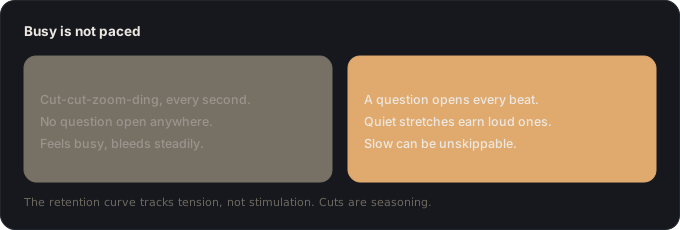
Second-by-second immersion (the thing your retention curve measures) tracks tension, not stimulation. Which is why a slow, quiet clip of someone listening for a knock in an engine can hold 90% while a machine-gun-edited montage bleeds out: the first has an open question, the second has only energy.
Information pacing vs energy pacing
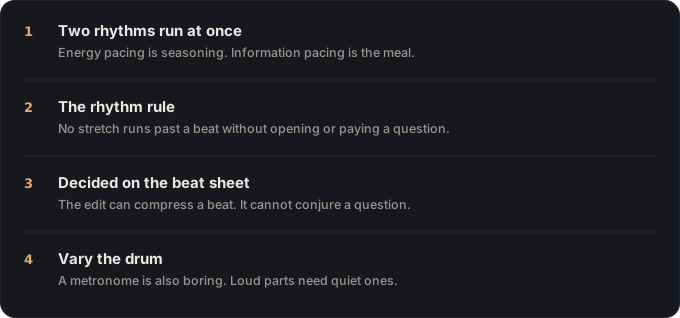
Think of every video as running two rhythms at once. Energy pacing is the surface: cut rate, music, motion, volume. Information pacing is the structure: when a question opens, how long it’s held, when it closes, what opens next. Energy pacing is seasoning. Information pacing is the meal.
The failure mode of modern YouTube is maxed-out energy over flat information: a video that feels busy while nothing is ever at stake, promised, or resolved. Viewers can’t articulate why they left (“it just didn’t hold me”), but the graph shows it as a steady, featureless slide. The reverse (strong information pacing with calm energy) is how essayists and documentary channels hold hour-long watch times with three cuts a minute.
The rhythm rule
Practical version: no stretch of the video should run longer than one beat without either opening a new question or paying one off. That’s the drum the whole video marches to. Within a beat, energy can do what it likes, but at every beat boundary, the information state must change: a payoff lands (a planted setup returns), or a new gap opens (stakes rise, a complication hits).
This is why pacing is decided on the beat sheet, before the shoot, not in the edit. The edit can compress a beat that runs long; it cannot conjure a question the footage never opened. When a video “drags in the middle” the timeline usually isn’t too slow: the middle beats are informationally silent, and no amount of trimming makes silence interesting.
Vary the rhythm, don’t flatten it
One more layer: a metronome is also boring. If every beat runs the same length with the same energy, predictability itself becomes the exit cue: the viewer’s brain learns the pattern and stops leaning in. Strong videos vary beat length deliberately: a long, patient build into a complication, then two fast payoffs back to back; a quiet stretch because the next reveal wants contrast. Treat your energy curve the way a composer treats dynamics: the loud parts only work because of the quiet ones. (The deliberate version of breaking your own pattern is the pattern interrupt, next lesson.)
The pacing check
- Every beat boundary changes the information state: new question opened or one paid off.
- No stretch runs past a beat with nothing promised and nothing resolved.
- The edit’s energy varies: the video has loud and quiet, fast and patient.
- Any “drags here” note is answered structurally first: what question should be open in this stretch?
- Fast cutting is never used as a substitute for an open question.
🎬 Video script
- Open on two clips: a frantic montage bleeding viewers vs a slow single-shot holding 90%. “One of these is well-paced. It’s not the fast one.”
- Put Zak on screen: immersion tracks tension, second by second. The graph measures questions, not cuts.
- Explain the two rhythms with a live example: same segment scored as energy vs information.
- Demonstrate the rhythm rule on a beat sheet, finding the informationally-silent middle beat.
- Close: “Cut speed is seasoning. Open a question every beat, pay one off every beat, and vary the drum.”
Sources
- Paul J. Zak, Why Your Brain Loves Good Storytelling, Harvard Business Review (2014): attention is sustained by tension; immersion varies second-by-second with it.
- YouTube Help, Measure key moments for audience retention: the slope and dips this lesson’s rhythm rule protects.
Key takeaways
- Pacing is the rhythm of tension (questions opening and closing) not cutting speed.
- A segment can be fast and dead, or slow and gripping; the open question decides.
- Pace on the beat sheet: no stretch longer than a beat without a new question or a payoff.