Ideas & audience · Lesson 2
The video only you can make
The algorithm is word of mouth at scale, and word of mouth only spreads what's distinct. How to find the version of a proven topic that nobody else can ship.
Last lesson found demand. This one earns your claim to it, because a validated topic is, by definition, a topic other channels can see too, and the version of it that wins is rarely the most polished. It’s the most distinct. That’s not craft romanticism; it’s how the discovery system actually behaves, in the words of the man who runs it:
It’s automating word of mouth. The system understands what viewers with similar interests have watched and enjoyed, and recommends based on what satisfied them. It’s not pushing videos out, it’s pulling for each viewer.
Todd Beaupré, YouTube’s growth & discovery lead (Creator Insider, 2025)
Sit with the metaphor, because it’s load-bearing. Word of mouth has never spread the generic version of anything. Nobody has ever told a friend “you should watch this video that covers the standard information competently.” What gets repeated (by people and, per Beaupré, by the system modeled on them) is the video with the thing in it: the angle, the access, the honesty, the specific disaster. Differentiation isn’t a branding exercise on top of your idea. It’s the mechanism by which recommendation happens.
Where “only you” actually lives
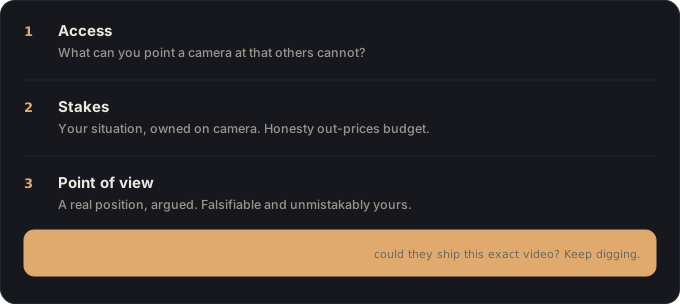
Creators hear “differentiate” and reach for production value: better camera, harder edit. Wrong shelf. A better-shot version of the same video is the same video. The durable differentiators are things a competitor can’t copy by spending more:
Access. What can you point a camera at that others can’t? Your workshop, your client calls, your town, your kid’s science fair, fifteen years of your niche’s history in your head. The footage-first creators sitting on hard drives of un-mined material often have this and don’t know it: the video only they can make is already shot, waiting to be found.
Stakes. Stakes are manufactured from honesty, not budget, and they’re inherently yours. “I tested the top five budget mics” is a commodity; “I have $300 left in the channel budget and this purchase decides whether I keep going” cannot be cloned, because the competitor doesn’t have your situation.
Point of view. A real position, argued: the tool everyone loves is overrated, the technique everyone skips matters most, the trend is a trap. A point of view is a contrarian claim you actually land: risky, falsifiable, and unmistakably one person’s. Channels with no opinions produce videos with no reason to be chosen.
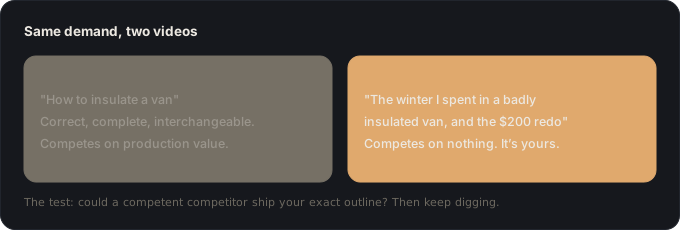
The test that keeps you honest: hand your outline to a competent competitor. Could they ship this exact video? If yes (if nothing in it requires your access, your stakes, or your position) you haven’t found your version yet. Keep the topic; dig for the angle.
Same demand, different owner
Practical shape of the move: take the validated search from lesson one and run it through the three shelves. “How to insulate a van” becomes: the winter I spent in a badly insulated van and what I’d pay to redo (access + stakes), or everyone insulates vans wrong and the moisture math proves it (point of view). The demand stays (you’re still the answer to the search) but the video now has an owner. That’s also, not coincidentally, the version whose title can make a real promise and whose story has something at risk: differentiation and storytelling are the same excavation from two directions.
The only-you check
- The idea names its differentiator explicitly: access, stakes, or point of view, which one?
- A competent competitor could not ship this exact video from your outline.
- The differentiator is in the packaging, not discovered at minute six.
- The angle sharpens the demand instead of abandoning it: the searcher still gets their answer.
- Production value is not doing the differentiation work.
🎬 Video script
- Open on four thumbnails for the same validated topic, three interchangeable, one unmistakable: “Same demand. One owner.”
- Beaupré’s word-of-mouth line on screen: nobody recommends the generic version, humans or systems.
- Walk the three shelves with a real example each; run the competitor test on camera and fail it honestly once.
- Transform one commodity idea live through access, then stakes, then point of view.
- Close: “Demand is shared. Find the version with your fingerprints on it.”
Sources
- Todd Beaupré via Creator Insider / Search Engine Journal, “YouTube Algorithm Myths Debunked” (2025): recommendations as automated word of mouth; the system pulls for viewers rather than pushing videos.
- YouTube Blog, On YouTube’s recommendation system: satisfaction signals (surveys, shares, likes) drive recommendations; satisfaction favors the distinct, not the adequate.
Key takeaways
- Recommendations are "automated word of mouth", and word of mouth doesn't spread the generic version.
- Differentiation lives in access, stakes, and point of view, not in production value.
- 'Only you' is testable: could a competitor ship this exact video from your outline? If yes, keep digging.