Ideas & audience · Lesson 1
Find ideas your audience already wants
YouTube literally publishes a list of what your audience is searching for and can't find. How to mine the Research tab, read content gaps, and stop ideating from a blank page.
The blank page is the most overrated tool in YouTube ideation. Creators sit down to “brainstorm what to make next” as if demand were unknowable, while, one tab over, YouTube Studio maintains an actual list of what their audience searched for in the last 28 days, what viewers across the platform are searching for, and (the good part) which of those searches returned results too thin or too stale to satisfy anyone.
That last category has an official name:
A content gap happens when viewers can’t find enough quality search results for a specific search on YouTube: topics that don’t produce many results, or where most of the content is outdated or lower quality.
YouTube Help, “Explore trends on YouTube” (the Research tab)
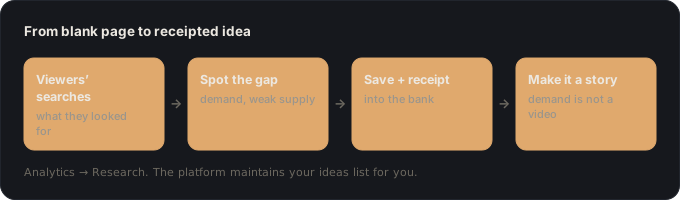
Read that as a market signal, because that’s what it is: proven demand, weak supply. Someone typed the words; nobody adequately answered. For a small channel this is the single highest-percentage shot available. You’re not competing to out-rank a saturated result page, you’re filling a hole the platform itself has flagged.
How to actually mine the tab
In YouTube Studio: Analytics → Research (YouTube has shuffled the naming between Research and Trends; it lives in Analytics either way). Three practices separate creators who get value from it from those who skim it once:
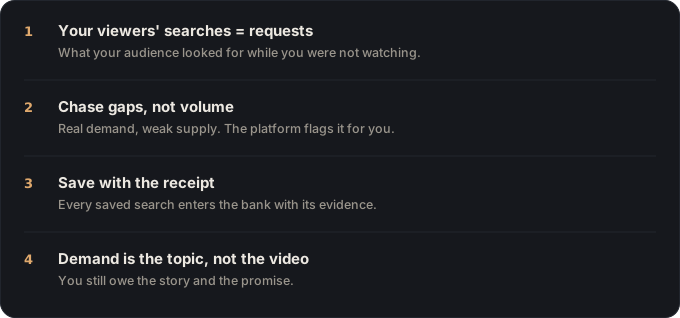
Read “Your viewers’ searches” as your audience talking. This isn’t platform-wide noise. It’s what the people who already watch you went looking for. When a search shows up there that you haven’t covered, that’s your existing audience requesting a video in the most honest way possible: by searching for it when you weren’t looking.
Chase gaps, not volume. The biggest search terms are the most contested SERPs: the same trap as head-term titles. The gap markers are where the asymmetry lives. On desktop, the tab shows relative search volume; a medium-volume search flagged as a gap beats a huge one with forty strong results.
Save what you find. The tab lets you save searches and topics: treat those saves as the top of your idea bank, stamped with the evidence that made them worth saving.
Demand is the topic, not the video
Here’s where research-driven ideation goes wrong: creators find a validated search and ship the search phrase as a video, a topic, flatly covered. The gap told you people want an answer; it didn’t relieve you of making something happen on the way to it. “How to insulate a van” is the demand. The video only you can make of it: the one where your build, your mistakes, your winter test carry the answer, is the next lesson. Research hands you the what; you still owe the why watch this one.
The other honest caveat: search is one discovery surface among several, and for many channels not the biggest, browse and suggested traffic run on packaging and satisfaction, not query matching. Use the Research tab as a demand detector, not as an SEO ritual. The point isn’t to stuff the phrase into your title; it’s to make the video people were already asking for, then package it like it matters.
The demand check
- The idea traces to something real: a viewers’-search entry, a flagged gap, or a repeated comment request.
- It’s a gap, not just a volume king. You can name why existing results underserve it.
- The saved search sits in your idea bank with its evidence attached.
- The demand phrase became a story, not a topic: something happens in the video.
- The eventual title makes a promise, not a keyword match.
🎬 Video script
- Open on the blank-page brainstorm, then hard-cut to the Research tab: “Your audience already wrote your ideas list. You just haven’t read it.”
- Show YouTube’s own content-gap definition on screen; translate it: proven demand, weak supply.
- Live-mine the tab on a real channel: viewers’ searches → one gap worth taking → save it.
- Show the failure mode: the search phrase shipped as a flat topic video, and its retention slide.
- Close: “Research finds the what. The next lesson is the why-you.”
Sources
- YouTube Help, Explore trends on YouTube: the Research/Trends tab: your viewers’ searches, content gaps, relative search volume, saved topics.
- YouTube Blog, On YouTube’s recommendation system: search is one surface; recommendations run on satisfaction signals, not keyword matching.
Key takeaways
- Ideation from a blank page is optional. Studio's Research tab shows what your audience searched in the last 28 days.
- A content gap is a pre-validated idea: real demand, weak supply.
- Demand tells you the topic; you still owe the viewer a story and a promise.