Aug 24, 2026 · by Baptiste, founder of Vanpelt Studio
Five YouTube trends that actually matter in late 2026 (with the data)
“Trend” articles in this niche usually mean vibes: whatever three big channels did last month, projected onto everyone. This one is numbers. Five shifts, each anchored to a source you can check, each ending in the only question that matters here: what should a solo long-form creator do about it?
1. YouTube is now the biggest thing on television
Not “big on phones”: television. In Nielsen’s May 2026 Gauge, YouTube took 13.8% of all US TV watch time: a platform record, and the largest share of any media company, ahead of Disney (10%) and NBCUniversal (8.4%), while streaming overall hit a record 48.6% of TV viewing. YouTube’s own operational number agrees: viewers watch over a billion hours of YouTube on TV screens daily.
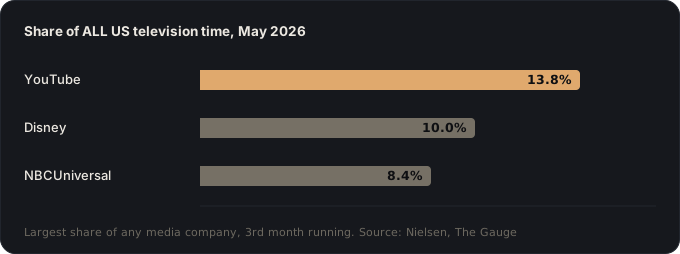
What to do about it: treat the living room as a first-class destination. Longer videos get sessions, not snacks; thumbnails and text must read from ten feet as well as from a phone; and lean-back viewing rewards exactly the structure-first, session-chaining craft this whole site teaches. The “TV-ification” of YouTube is a straight-up gift to long-form storytellers.
2. Talk formats won the platform’s newest billion
YouTube passed 1 billion monthly podcast viewers (announced February 2025), and the format is fusing with trend #1: living-room podcast watch time hit ~700 million hours monthly by late 2025, up from ~400 million a year earlier. In the US, YouTube is now the single most-preferred podcast service: ahead of Spotify and Apple.
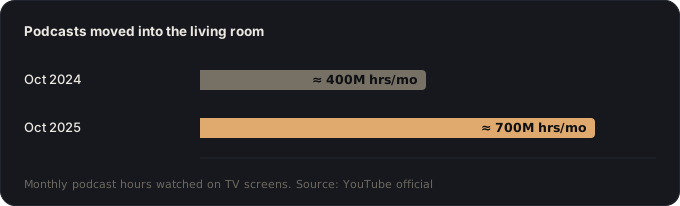
What to do about it: you don’t need to launch a podcast to collect this. The lesson is that audiences increasingly choose long, personality-led, conversation-paced content on TV screens, which validates talking-head formats generally, provided the delivery is one-person-scale and the pacing earns the runtime. If your niche has a conversation format in it, the demand curve is publicly visible.
3. The Partner Program gates are rising
Announced August 2026, effective February 1, 2027: new YPP applicants will need 8,000 watch hours in a year or 20 million Shorts views in 90 days (roughly double today’s bar) and Shorts revenue sharing gains its own gate of 10 million qualified views per 90 days. Existing members are grandfathered, and YouTube says it expects total payouts to rise in 2027.
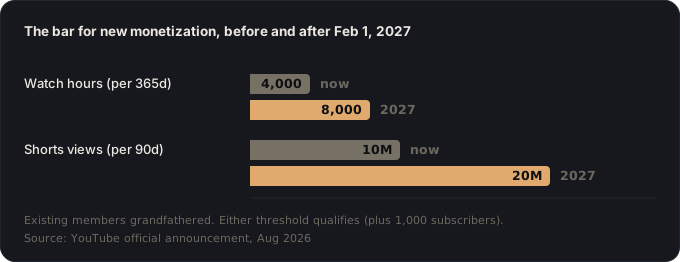
What to do about it: two reads, both actionable. If you’re not yet monetized: the cheapest entry in history is the next five months, current thresholds apply until February. If you are: the moat behind you just deepened, and the direction of the change (watch hours, not views) tells you what the platform is buying, sustained watch time, the exact thing retention-first craft produces.
4. Shorts are enormous, and settling into their real job
YouTube now processes over 200 billion Shorts views daily, and the monetization architecture has matured: a 45% creator pool, Premium Lite revenue, Shopping bonuses, real money, but structurally thinner per view than long-form’s 55% watch-page share, and about to sit behind that 10M-views gate.
What to do about it: the data supports a settled strategy rather than panic in either direction. Shorts are the platform’s largest discovery surface; long-form is where the relationship and the revenue live. Cut Shorts from your long-form (the hooks, the payoffs, the spikes viewers rewatched) as trailers pointing home: a funnel, not a second channel competing for your production week.
5. The money went transparent, and institutional
Two disclosures that would have been unthinkable five years ago: Alphabet broke out YouTube’s $60B+ 2025 revenue for the first time (bigger than Netflix), and YouTube stated it paid creators and partners $100B over four years. Numbers that public are aimed at Wall Street and Madison Avenue. They mark the creator economy’s shift from experiment to reporting line.
What to do about it: expect the professionalization to keep flowing downhill to you, sponsors with standardized processes and real budgets, better tooling, and higher table stakes for polish at the business layer (rates, disclosure, deliverables) even while the craft bar stays where it always was: videos people finish. The creators who win institutionalization treat their channel like the small media company the data says it is.
The through-line, if you want one sentence: every 2026 number (TV screens, podcasts, watch-hour gates, transparent billions) pays the same skill: holding attention in long-form. The platform spent the year telling you what it values. It’s the thing this course teaches.
Sources
- Nielsen, The Gauge, May 2026. YouTube’s record 13.8% of US TV watch time; streaming at 48.6%.
- YouTube Blog, Celebrating 1 billion monthly podcast users and How podcasts took over the living room: the podcast and living-room figures.
- YouTube Blog, Changes to the YouTube Partner Program (Aug 2026): the 2027 thresholds, 200B daily Shorts views, 1B+ daily TV hours.
- Alphabet, Q4/FY 2025 earnings; CNBC: the $60B breakout and $100B creator payouts.