Filming basics · Lesson 3
Talk to one person
The lens is a person, not an audience. The delivery shift that fixes stage voice, where to actually look, and why the one-viewer habit builds the relationship your channel runs on.
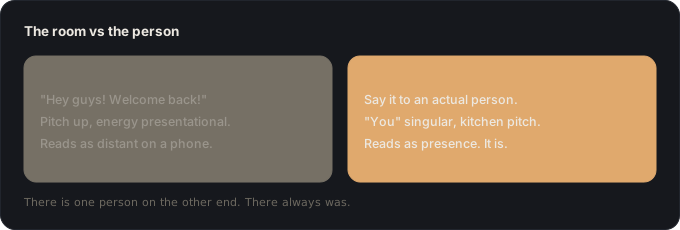
Watch a first video from almost any creator and you’ll hear it instantly: the voice goes up half an octave, the energy goes presentational, and they address “everyone” (hey guys, welcome back to the channel) like a wedding MC working a room. It feels professional to do. It reads as distant to watch. Because on the other end of the lens there is no room: there’s one person, alone with their phone, experiencing your video as something much closer to a conversation than a broadcast.
Media researchers named this dynamic seventy years ago:
Broadcast media give the audience the illusion of a face-to-face relationship with the performer (a para-social relationship) and audiences respond to the performer as if present in an intimate, one-to-one exchange.
Horton & Wohl, “Mass Communication and Para-Social Interaction,” Psychiatry 19 (1956)
That’s the physics your delivery either works with or against. The viewer’s brain is running a face-to-face simulation; stage voice breaks it, and regular viewers: the loyal core YouTube itself tracks, are precisely the people for whom that simulated relationship is the product. They come back because it’s you, and “you” is only available at conversation scale.
The one-person fix
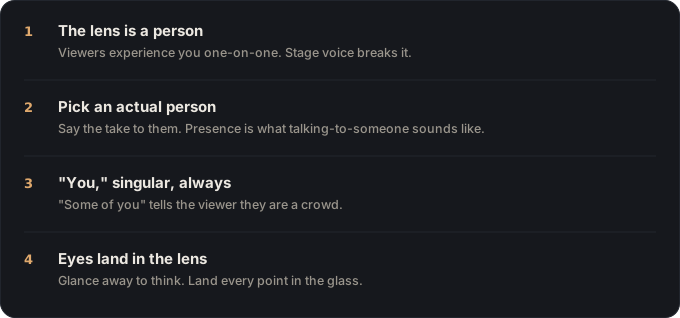
The technique costs nothing: pick an actual person and talk to them. Not “my audience”: a name. A friend who’d care about this video, the viewer you wrote down, whoever asked the question that spawned the idea. Before the take, say the beat to them in your head; then say it to the lens the same way. Voice drops to natural pitch, pace stops performing, and the word choice goes ear-native automatically: most of what reads as “camera presence” is just what talking-to-someone sounds like when the someone is real to you.
The language follows: “you,” singular, always. “Some of you,” “those of you who,” “everybody”: each one tells the viewer they’re in a crowd, and crowds don’t lean in. Same channel-level rule as addressing one viewer in packaging, applied at delivery scale.
Where to look
Into the lens, because the lens is their eyes. Looking at yourself on the flip screen reads as exactly what it is (checking yourself out mid-sentence), and looking at notes beside the camera produces the newscaster drift. Two working tricks: a tiny arrow sticker next to the lens as an eyeline anchor, and for tier-2 improvised beats, glancing away to think is fine (humans do that) as long as the landing of each point comes back to the lens. Connection is made at sentence-ends.
And when the delivery stiffens mid-shoot (it will) the reset is the person, not the take count: stop, actually picture them, say the beat to them off-camera once, roll. It works for the same reason re-anchoring beats re-polishing: you’re restoring the target, not rehearsing the words.
Kill the broadcast furniture
The openers and closers are where broadcast habits nest: hey guys welcome back, as always, don’t forget to like and subscribe delivered in the same breath as hello. Beyond burning your most expensive seconds, they’re relationship-wrong: nobody greets a friend with a station ident. Open the way you’d open to the person, with the thing itself. Ask for the subscribe after you’ve delivered something, the way you’d recommend anything to a friend: once, plainly, because it’s warranted.
The one-person check
- A specific person is named before every session: takes are said to them.
- “You” is singular throughout; no “some of you / everybody.”
- Eyes land in the lens at the end of every point.
- Zero broadcast furniture: no stage greeting, no reflex asks.
- Played back, the take sounds like the kitchen, not the stage.
🎬 Video script
- Open with the same 20 seconds delivered as stage voice, then to-one-person, no explanation between. “Same words. Which one would you keep watching?”
- Horton & Wohl on screen: the one-to-one illusion is the medium’s native mode, named in 1956.
- Demonstrate the pick-a-person reset mid-shoot, honestly, on a stiffening take.
- Show the eyeline mechanics: lens vs flip screen vs notes, and the sticker trick.
- Close: “It’s one person on the other end. It always was. Talk to them.”
Sources
- Donald Horton & R. Richard Wohl, Mass Communication and Para-Social Interaction, Psychiatry 19 (1956): the one-to-one illusion at the heart of broadcast media.
- YouTube Help, Understand new, casual, & regular viewers: the loyal-viewer segment the parasocial relationship builds.
Key takeaways
- Viewers experience you one-on-one, deliver to one person, not an imagined audience.
- Look into the lens for connection; it's the viewer's eyes, not a sensor.
- Stage voice ("hey guys, welcome back") announces performance; kitchen voice builds the relationship.