Scripting · Lesson 1
Write for the ear, not the eye
Scripts fail on camera because written English and spoken English are different languages. The mechanics of ear-first writing, and the read-aloud pass that catches everything.
Every creator who’s scripted a video has met the ghost: sentences that looked sharp on the page and came out of your mouth sounding like a hostage statement. The usual self-diagnosis is “I’m bad on camera.” Almost always wrong. The real problem is that written English and spoken English are different languages, and you drafted in the wrong one.
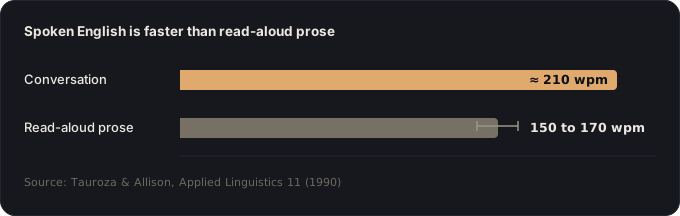
The difference isn’t a vibe. It’s been measured:
Natural conversation runs around 210 words per minute; scripted radio monologue runs closer to 150-170. Speech and prepared text are structurally different registers, and listeners hear the difference immediately.
Tauroza & Allison, “Speech rates in British English,” Applied Linguistics 11 (1990)
Spoken language is faster, looser, and more redundant than prose: shorter clauses, more contractions, ideas repeated in different words, sentences that would embarrass an editor and sound completely natural in a kitchen. When you write “the eye version” (long subordinate clauses, formal transitions, zero contractions) your delivery has two options: read it stiffly, or trip over it. Both read as inauthentic, and authenticity is what narrative attention runs on.
The ear-first mechanics
One idea per breath. If a sentence can’t be said in one comfortable breath, it’s two sentences. The page tolerates 40-word constructions; the lungs don’t, and neither does a listener who can’t rewind by glancing up a line.
Contractions, always. “Do not” and “it is” are the fastest stiffness tells in the format. If you wouldn’t say the uncontracted form to a friend, don’t script it.
Active voice, concrete subjects. “The bracket snapped” beats “it was discovered that the bracket had snapped.” The ear tracks actors doing things; passives make listeners reconstruct who did what, and reconstruction is where attention leaks.
Planned redundancy. Prose treats repetition as a flaw; speech needs it. A listener can’t re-read, so the load-bearing idea gets said twice, differently: once plainly, once in an image. That’s not padding; it’s the format’s error correction.
Spoken punctuation. The dash and the ellipsis are your friends; the semicolon is not. Write the pauses you’ll actually take: the script is a performance document, not an essay.
The read-aloud pass
The one non-negotiable: before the script is “done,” read the whole thing out loud, at performance energy, and edit where your mouth stumbles. Not skimmed under your breath at your desk: performed. Every stumble, every sentence you unconsciously rephrase mid-read, every place you run out of air: that’s the ear-version trying to escape the eye-version. The rewrite rule is mechanical: whatever your mouth actually said is the better draft, transcribe the stumble-fix, don’t restore the prose.
This pass costs ten minutes and catches more stiffness than any amount of on-camera effort, because delivery can’t fix language that was never speakable. Charisma is mostly a script property.
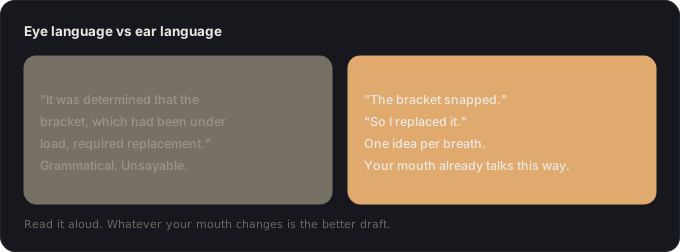
Write it like you’d say it: then structure it
The trap on the other side: “just talk naturally” as a writing philosophy produces rambling, and rambling dies in the retention graph. The skill this module builds is the pair: language loose enough to say, structure tight enough to hold. Ear-first wording rides on beat-sheet bones: next lesson is exactly how much of the skeleton to script and how much to improvise.
The ear check
- Every sentence fits in one comfortable breath.
- Contractions throughout; no “do not / it is / we will” stiffness.
- Active voice with concrete subjects doing things.
- Load-bearing ideas said twice, differently, on purpose.
- The full script survived a performed read-aloud pass, and the stumble-fixes got transcribed.
🎬 Video script
- Open with the same paragraph performed twice: eye-version, then ear-version. “Same information. One of these people seems likable.”
- Put the Tauroza & Allison rates on screen: speech and prose are measurably different registers.
- Walk the five mechanics, rewriting one stiff paragraph live through all of them.
- Do the read-aloud pass on camera, stumble included, and transcribe the fix in real time.
- Close: “You’re not bad on camera. Stop handing yourself the wrong language.”
Sources
- Tauroza & Allison, Speech rates in British English, Applied Linguistics 11 (1990): measured register differences between conversation and prepared monologue.
- Paul J. Zak, Why Your Brain Loves Good Storytelling, Harvard Business Review (2014): attention rides on authentic, human-scale delivery.
Key takeaways
- Written English and spoken English differ measurably, a page-perfect script reads as stiff on camera.
- Ear-first mechanics: short sentences, active voice, contractions, one idea per breath.
- The read-aloud pass is non-negotiable; your mouth finds what your eye approves.