Ideas & audience · Lesson 4
Serve one viewer, not everyone
YouTube segments your audience into new, casual, and regular viewers, and recommends by matching viewers to videos. Why a sharply defined viewer grows faster than a broad one, and how to write yours down.
The scariest-feeling decision in content strategy is narrowing your audience, because it reads like turning viewers away. The math runs the other way, and it’s worth seeing why through the machine’s eyes. YouTube’s recommendation system doesn’t broadcast; it matches, for every viewer session it asks what would satisfy this person, right now, using what similar viewers watched and enjoyed. A video with a sharp intended viewer gives that matchmaking something to grip: clear satisfied-viewer clusters, clear lookalikes to pull for. A video “for anyone interested in productivity” offers the matcher a smear, and gets matched to no one in particular, which is precisely how it performs.
“Niche down” is the folk version of this advice, and it’s half-wrong in an important way: the unit isn’t a topic, it’s a person in a situation. “Woodworking” is a topic. “The apartment woodworker with no garage, afraid of annoying the neighbors” is a viewer, and that one sentence generates ideas, titles, and stakes that “woodworking content” never will.
YouTube already thinks in viewers, not demographics
Open your Audience tab and look at how the platform itself slices your channel:
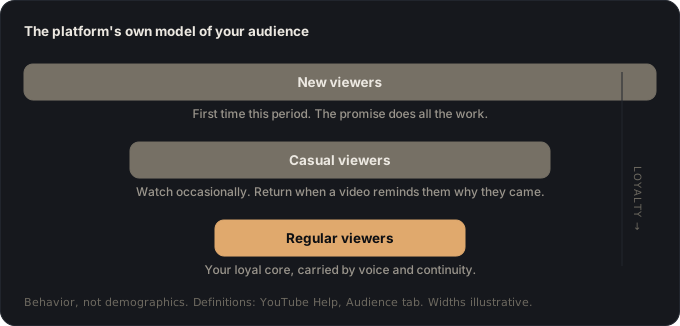
Your monthly audience is split into three groups based on watch behavior: new viewers (watched your channel for the first time in this period), casual viewers (watch occasionally), and regular viewers (watching consistently, your most loyal audience).
YouTube Help, “Understand new, casual, & regular viewers”
Behavior, not demographics: the platform’s native model of your audience is relationship depth, and the three groups are won differently. New viewers arrive through packaging on a proven demand: they don’t know you, so the promise does all the work. Casual viewers return when a video reminds them why they came. This is where kept promises compound into trust. Regulars are carried by voice and continuity: they click because it’s you, and they’re the ones your endings hand off to the next video. A healthy channel feeds all three; a defined viewer is what keeps those three groups the same kind of person at different depths, rather than three unrelated audiences diluting each other’s signal.
Write the viewer down
Do this literally: one paragraph, pinned wherever you plan videos: who they are, the situation they’re in, what they’re trying to do, what they’re afraid of, what they’ve already tried. Not a demographic (“males 25-34”): a predicament. Then use it as the standing filter:
- Ideas: would this person click this? The validation gates all sharpen when “anyone” becomes them.
- Titles: the addressee slot fills itself. You know who the promise is to.
- The occasional off-profile video: allowed, consciously, as an experiment, not as drift you notice three months later when your casual viewers quietly stopped returning.
The paradox to trust: the sharper the address, the wider the reach. Viewers outside the definition still watch: a video that lands hard for someone is simply a better video, and word of mouth, human or automated, spreads things that landed hard. “For everyone” isn’t a bigger address. It’s no address.
The one-viewer check
- The viewer exists in writing: person, situation, goal, fear, not a demographic.
- Every planned idea passes “would they click, watch, finish?”
- New/casual/regular numbers get read monthly as relationship health, not vanity.
- Off-profile videos are labeled experiments in advance.
- The channel’s last five videos would all be recommended to the same person without embarrassment.
🎬 Video script
- Open on two channel trailers: one “for everyone who loves creativity,” one addressed to a specific predicament. Ask which one you’d subscribe to, and note you’re not even in its audience.
- Show the matchmaking logic: recommendation as pulling-for-a-viewer; a smear can’t be matched.
- Put YouTube’s new/casual/regular segmentation on screen; walk how each group is won.
- Write a viewer paragraph live for a real channel, then filter its last five ideas through it: watch two fail.
- Close: “Address someone. The width comes from the depth.”
Sources
- YouTube Help, Understand new, casual, & regular viewers and Understand your YouTube audience: the platform’s behavior-based audience segmentation.
- YouTube Help, How YouTube recommendations work: recommendations personalize per viewer from watch history and satisfaction signals; matching, not broadcasting.
Key takeaways
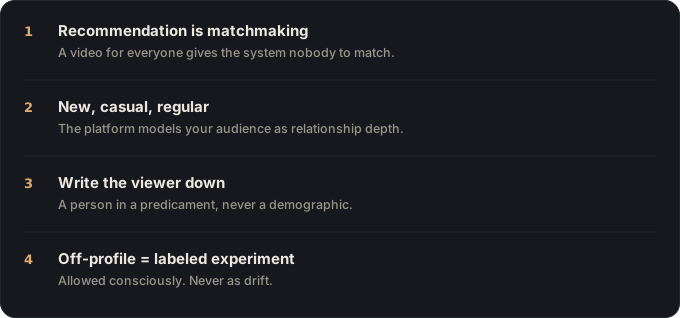
- Recommendation is matchmaking, a video "for everyone" gives the system nobody to match it to.
- YouTube itself segments your audience: new, casual, and regular viewers behave differently and are won differently.
- Write the viewer down (one person, one situation) and check every idea against them.