Aug 24, 2026 · by Baptiste, founder of Vanpelt Studio
How YouTube actually pays creators in 2026, the revenue model, with sources
Most explanations of YouTube money are either folklore (“the algorithm pays per subscriber”) or a decade out of date. The actual model is unusually public for a platform this size: the splits are documented, the thresholds are published, and as of this year we even know what the whole machine earns. So here it is, sourced: how the money flows, what changed in 2025-2026, and what’s about to change in 2027.
The machine you’re plugged into
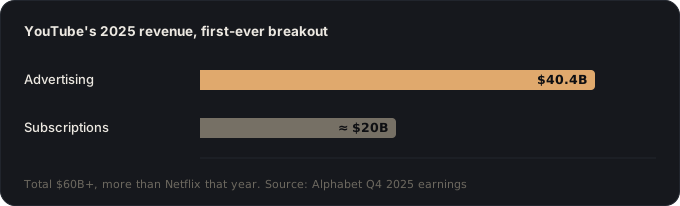
For years YouTube’s revenue was a semi-secret inside Alphabet’s earnings. That ended in February 2026, when Alphabet broke out the number for the first time: YouTube generated more than $60 billion in 2025, roughly $40.4 billion from advertising (up ~12% from $36.1B in 2024) and around $20 billion from subscriptions (Premium, Music, YouTube TV). For scale: that’s more total revenue than Netflix booked the same year.
The creator-facing number is just as concrete. At its Made on YouTube event in September 2025, the company said it has paid out over $100 billion to creators, artists, and media companies over the past four years. That’s the pool you’re operating in, not a tip jar, a media economy.
The splits, exactly
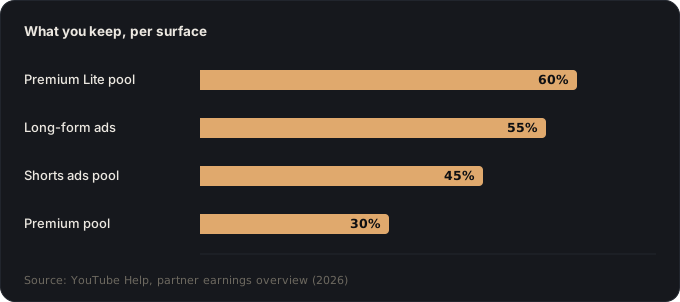
The Partner Program’s terms are published, and there are really four numbers to know:
Long-form ads: you keep 55%. Ads on regular watch-page videos pay the channel 55% of net ad revenue. This remains the best-paid surface on the platform, and it’s not close.
Shorts ads: a 45% pool. Shorts ad revenue works differently: ad money from the Shorts feed goes into a creator pool (after music licensing costs), gets allocated by each channel’s share of qualified Shorts views, and creators keep 45% of their allocation.
Premium: a 30% pool. Premium Lite: a 60% pool. When Premium subscribers watch you, you’re paid from a dedicated pool of net subscription revenue. 30% for full Premium, and 60% for the newer, cheaper Premium Lite tier (now rolled out globally). Distribution follows member watch time, split 55% to long-form and 45% to Shorts.
On top of the shared-revenue surfaces sit the direct streams where the platform’s cut is smaller and the relationship is yours: channel memberships, Super Thanks/Chat, and YouTube Shopping. And the biggest revenue line for many established channels (sponsorships) bypasses the platform split entirely; that one gets its own article.
What “RPM” actually is (and why nobody can tell you yours)
Two acronyms get conflated constantly. CPM is what advertisers pay per thousand ad impressions. RPM is what you receive per thousand video views after every split above: the only number that belongs in your planning.
Here’s the honest part most revenue guides skip: there is no official RPM-by-niche table, and any precise-looking one you find is creator-reported anecdote in a spreadsheet costume. What’s actually documented is what moves RPM: advertiser demand for your audience (finance and B2B viewers cost more to reach than gaming viewers), viewer geography (US/UK/DE impressions out-price most markets several times over), format (long-form watch-page ads vastly out-earn Shorts-pool allocations per view), and seasonality (Q4 ad budgets, January slump). Your own Analytics → Revenue tab is the only trustworthy RPM source that exists: treat it the way you treat every metric: yours-against-yours.
Getting in, and the 2027 gate change
Current YPP thresholds: 1,000 subscribers plus either 4,000 public watch hours in a year or 10 million Shorts views in 90 days. That changes on February 1, 2027. YouTube announced in August 2026 that new applicants will need 8,000 watch hours in 365 days or 20 million Shorts views in 90 days (existing members keep their status). Separately, Shorts revenue sharing will require 10 million qualified Shorts views in the trailing 90 days; below that, Shorts creators are pointed at Shopping bonuses and incentive programs instead.
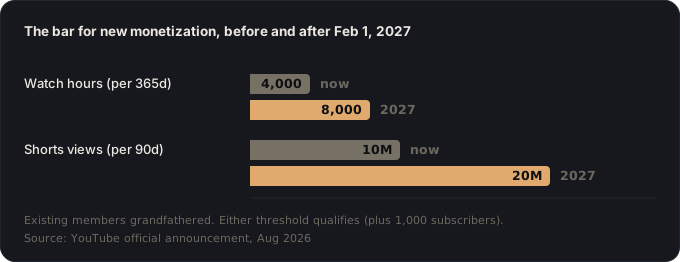
Read the direction of that change: the bar for ad-revenue-sharing is roughly doubling, while YouTube says it expects total creator payouts to rise in 2027. The money isn’t shrinking. It’s concentrating on channels that produce sustained watch time. For a long-form creator, that’s the moat getting deeper behind you, provided you’re in before the gate moves, and it’s one more reason watch-time-shaped craft is the asset the whole model prices.
What a solo creator should actually conclude
The stack ranks itself. Long-form watch-page ads pay 55% into a market of $40B and growing, and the living-room shift is pushing session lengths up, not down. Shorts monetize at pool-allocated 45% with a hard view gate coming; treat them as discovery for the long-form, not as the business. Premium quietly rewards the same thing ads do: being watched longer by people who chose you. Every path through the model, in other words, prices the same input: videos people watch to the end. The revenue model is a retention graph with a dollar sign on it.
Sources
- Alphabet, Q4 & fiscal year 2025 earnings release; coverage: Variety: the $60B+ breakout, $40.4B ads.
- CNBC: $100B paid to creators over four years (Made on YouTube, Sept 2025).
- YouTube Help, YouTube partner earnings overview: the 55% / 45% / 30% / 60% splits.
- YouTube Blog, New opportunities to earn and changes to the YouTube Partner Program (Aug 2026): the Feb 2027 thresholds and Premium Lite rollout.