Editing for retention · Lesson 6
When to stop polishing
Past a threshold, more editing changes nothing a viewer's decision runs on. The done-list, the diminishing-returns curve, and why shipping the next video beats perfecting this one.
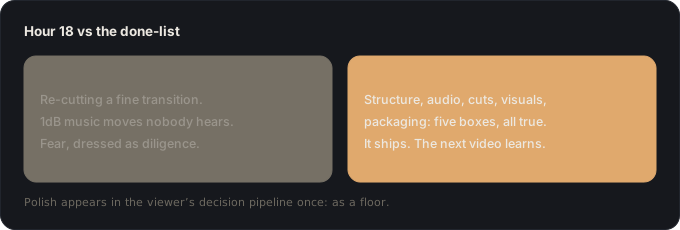
There’s a version of perfectionism that looks exactly like diligence: hour eighteen on a twelve-minute video, re-adjusting music levels nobody will consciously hear, re-cutting a transition that was fine on Tuesday. It feels like craft. Structurally, it’s avoidance: shipping is scary, and polish is a socially acceptable place to hide from it, and it’s worth being honest about what the extra hours actually buy, because the answer is measured in signals you’ve already met.
A viewer’s decisions run through a short pipeline: the packaging earns the click, the open keeps the promise, the structure holds the middle, the payoff lands. Polish appears in that pipeline exactly once, as a floor: bad audio breaks credibility, broken cuts break immersion. Above the floor, the pipeline doesn’t price polish. Hour twenty’s micro-adjustments are invisible to every mechanism that decides your video’s fate, while the next video, unmade, is where every one of those mechanisms could still be moved.
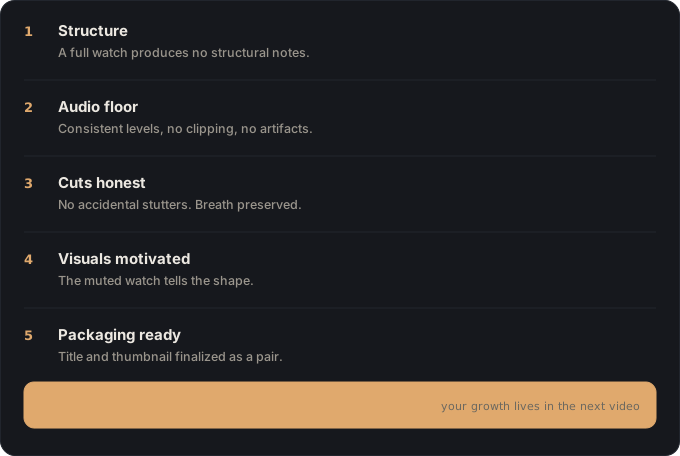
Done is a checklist, not a feeling
“It doesn’t feel done” is not information: feelings about your own video at hour eighteen are the least calibrated instrument you own. Replace the feeling with a list. A video is done when:
- Structure: a full end-to-end watch produces no structural notes, every beat earns its place, the promise pays at scale.
- Audio floor: levels consistent, no clipping, no credibility-breaking artifacts.
- Cuts honest: no accidental jump-cut stutters, breath preserved where it works.
- Visuals motivated: every change maps to meaning; the muted watch tells the shape.
- Packaging ready: thumbnail frame and title finalized as a pair, not improvised at the upload form.
All five true? It ships. The list is deliberately finite. That’s its entire power. Perfectionism survives on undefined “better”; a checklist starves it.
The 80/20 of the remaining anxiety
When the list is done and the anxiety isn’t, aim the leftover energy where the pipeline actually prices it. One more pass on the first 30 seconds: the highest-leverage seconds you own. A/B the packaging after launch instead of re-litigating it before. And bank the itch: the section you keep wanting to re-polish is often a video of its own trying to get out.
Then internalize the growth math: skills compound across videos, not within one. The channel that ships competent-and-done learns packaging, structure, and delivery on a dozen real retention graphs while the perfectionist is still inside video three. Every lesson in this course was learned from published videos: the unpublished ones teach nothing. And should the shipped video underperform, it isn’t dead at 24 hours, but the real recovery is the same either way: the next video, informed by this one’s data.
The stop check
- The five-line done-list is true: structure, audio, cuts, visuals, packaging.
- Post-list anxiety went to the open and the packaging, not to invisible micro-polish.
- The re-polish itch got banked as its own idea where it kept recurring.
- Total edit time gets compared across videos, and trends down at constant quality.
- The next video’s plan exists before this one’s upload finishes processing.
🎬 Video script
- Open on the hour-eighteen editor adjusting 1dB of music: “Name one viewer decision this changes. I’ll wait.”
- Draw the decision pipeline; mark where polish appears (the floor) and where the hours were going (above it).
- Run the done-list on a real edit, on camera, and ship when it’s five-for-five.
- Show the compounding math: two channels, one year, twelve shipped-and-learned vs three perfected.
- Close: “Polish to the floor, ship at the list, and spend the perfectionism on the next video.”
Sources
- YouTube Help, Impressions & click-through-rate FAQs: the decision pipeline runs on packaging and satisfaction, not production micro-polish.
- Search Engine Journal, YouTube Algorithm Myths Debunked: Insights From The Growth Team (2025): videos are evaluated individually and can grow long after upload; shipping and learning beats perfecting.
Key takeaways
- Viewer decisions run on packaging, promise, and structure, polish past competence moves none of them.
- Done is a checklist, not a feeling: structure watched, audio clean, cuts honest, packaging shot.
- Your growth lives in the next video, not the twentieth hour of this one.