Filming basics · Lesson 1
Sound beats picture
Viewers forgive soft footage and punish bad audio, and the research says they distrust what they struggle to hear. Where the money and the effort actually go first.
Every beginner budget conversation starts with the camera, and it’s the wrong end of the problem. Viewers watch soft, noisy, phone-shot footage all day without complaint, but muddy, echoey, clipping audio sends them away in seconds, and not only because it’s unpleasant. The research finding is stranger and more useful than “bad audio is annoying”:
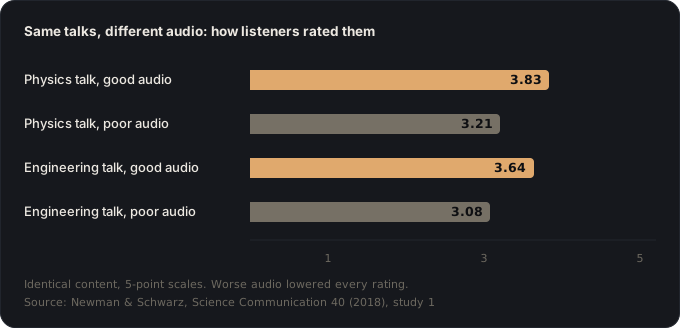
Despite identical content, people evaluated the research (and the researcher) less favorably when the audio quality was low. When you make it difficult for people to process information, it becomes less credible.
Newman & Schwarz, “Good Sound, Good Research,” Science Communication (2018)
Same words, same speaker, worse microphone → the person is judged less competent and the content less true. Audio isn’t a polish layer; it’s the credibility layer. Your stakes said to camera, your point of view argued: all of it is discounted by the exact degree to which it’s hard to hear.
The upgrade order
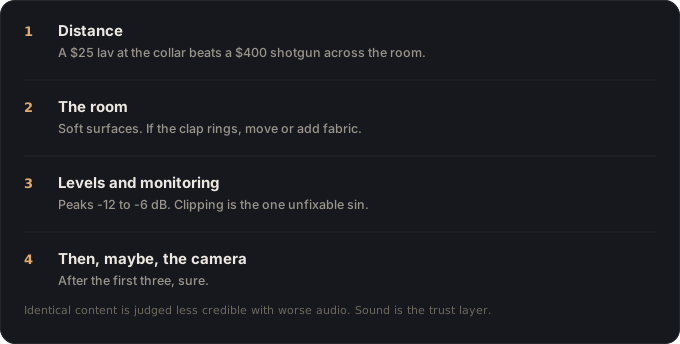
Good news: audio quality is mostly physics you can buy out of cheaply, in a fixed order of returns.
1. Distance. The single biggest variable is mic-to-mouth distance: every halving of it beats a gear upgrade. A $25 lavalier clipped to your collar outperforms a $400 shotgun across the room, every time. Whatever you own, get it close.
2. The room. The second variable is the space: bare walls and hard floors produce the echo that reads as “amateur” faster than any visual tell. You don’t need treatment panels. You need soft stuff: record facing a curtain, put a rug down, shoot in the room with the sofa and books rather than the empty one. The empty-garage echo has killed more first channels than any camera ever saved.
3. Levels and monitoring. Record peaks around -12 to -6 dB so speech never clips: clipping is the one audio sin that can’t be fixed later. And monitor: headphones on, or at minimum a ten-second test clip played back before the real take. Audio disasters (the dead lav, the fridge hum, the wind) are invisible while recording and unmissable in the edit, where they cost a reshoot instead of a retake.
4. Then, maybe, the camera. After all three: sure. But recognize what the camera upgrade actually buys. It’s mostly thumbnail frames and self-confidence, neither of which viewers hear.
The b-roll exception that isn’t
“But my videos are mostly b-roll with voiceover”. That’s not an exception, it’s the proof. A voiceover is an audio-first format: the entire human presence of the video travels through the mic, and the standard is higher, not lower, because there’s no face to carry the emotional load when the sound goes thin. Record voiceover with the same care as on-camera sound: close mic, soft room, monitored levels, and in one continuous session per video, because two rooms’ worth of voiceover spliced together is audible to everyone except the person who recorded it.
The sound check
- The mic is as close as the frame allows: distance solved before gear.
- The room has soft surfaces; the clap test doesn’t ring.
- Peaks around -12 to -6 dB; nothing clips, ever.
- A monitored ten-second test precedes every session; keeper clips get spot-checked the same evening.
- Camera money waits until the first three lines are true.
🎬 Video script
- Open with the same take twice: great audio + mediocre picture, then the reverse. Ask which creator you’d trust with your time.
- Put Newman & Schwarz on screen: hard to hear literally means less believed.
- Run the upgrade order live: lav at collar vs shotgun across the room; empty room vs curtains; a clipped take that no plugin saves.
- Show the monitoring ritual, and one real dead-mic disaster discovered a day too late.
- Close: “Viewers forgive your camera. They never forgive your microphone.”
Sources
- Eryn Newman & Norbert Schwarz, Good Sound, Good Research: How Audio Quality Influences Perceptions of the Research and Researcher, Science Communication 40 (2018): identical content rated less credible with degraded audio.
- YouTube Help, Measure key moments for audience retention: early abandonment: where unlistenable audio shows up first.
Key takeaways
- Audio is the credibility layer, hard-to-hear literally reads as less trustworthy.
- Upgrade order is fixed, get the mic close, kill the room, then think about cameras.
- Monitor while recording; audio disasters are silent until the edit.