Editing for retention · Lesson 3
Cut silence, keep breath
Dead air kills videos; over-cut delivery kills the person in them. Where the line runs between silence that wastes attention and the pauses that carry meaning.
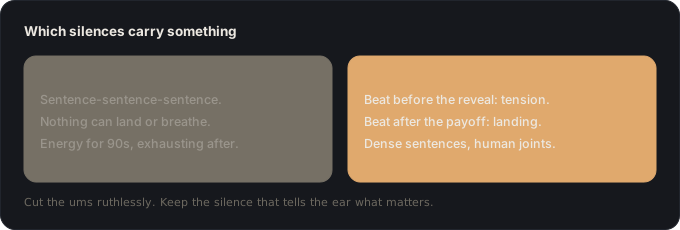
Somewhere between 2012 and now, “tight editing” collapsed into one move: cut every pause. The result is the machine-gun delivery you can hear in half your feed: sentence-sentence-sentence, zero air, a person edited into a text-to-speech engine with a face. It solves dead air, and it creates a subtler problem: when nothing pauses, nothing lands. Emphasis is differential: a beat of silence before a reveal is what tells the ear this one matters, and a video with every gap removed has spent its emphasis budget on nothing.
So the craft question isn’t “how much silence do I cut?” It’s “which silences are carrying something?”
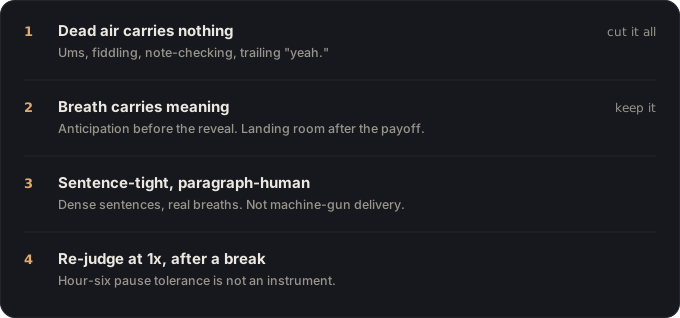
The two kinds of quiet
Dead air carries nothing: the um while you find the word, the three seconds of fiddling before the demonstration starts, the gap where you checked your notes, the trailing “…yeah.” Cut it all, ruthlessly. This is the silence that reads as informational emptiness, and every second of it invites the exit. This is also where your planned cutaways earn their keep: internal trims without the jump-cut stutter.
Breath carries meaning: the pause before the verdict (anticipation, a micro-gap opening), the pause after the payoff (landing room, the viewer’s beat to feel it), the visible thinking when you’re deciding something real on camera (authenticity, the human the parasocial relationship is with), the breath between beats (the paragraph break the ear needs). Cut these and the words remain but the meaning flattens: the reveal arrives unannounced, the payoff evaporates unfelt, and the person becomes a delivery mechanism.
The test, clip by clip: is this silence doing a job? Name the job (anticipation, landing, thought, transition) and the pause stays, usually trimmed, rarely removed. Can’t name one? Dead air. Cut.
Sentence-level tight, paragraph-level human
The practical synthesis: edit within sentences aggressively, false starts, ums, mid-sentence stumbles all go; the stumble-fixed version was the better draft anyway, but protect the joints between thoughts. The rhythm you’re building mirrors how a great speaker actually talks: dense sentences, real breaths. Machine-gun editing gets the first half and amputates the second, which is why it reads as energy for about ninety seconds and as exhausting after four minutes: an unvaried rhythm is itself a pattern the viewer habituates to, and flat-out is still flat.
A calibration that keeps you honest: your pause tolerance collapses after hours in the timeline, silences that feel eternal at 1x on pass six are invisible to a first-time viewer. Two correctives: watch suspect sections at normal speed after a break, and when torn, err on keeping the breath. Retention data punishes dead air; it has never once punished a reveal for landing.
The breath check
- Every kept silence names its job: anticipation, landing, thought, or transition.
- All ums, false starts, and mid-sentence dead air gone: trimmed with cutaways, not jump-cut stutters.
- The reveal has a beat before it; the payoff has a beat after.
- Delivery is sentence-tight and paragraph-human: the machine-gun test fails.
- Suspect pauses re-judged at 1x after a break, not at hour six of the edit.
🎬 Video script
- Open with the same 30 seconds edited both ways (machine-gun, then breath-kept) and let the reveal land in exactly one of them.
- Name the two kinds of quiet, with a rapid montage of dead air everyone should cut.
- Run the is-it-doing-a-job test live on five real pauses; keep two, cut three.
- Show the sentence-tight / paragraph-human synthesis on one paragraph of real delivery.
- Close: “Cut the silence that wastes their time. Keep the silence that tells them what matters.”
Sources
- YouTube Help, Measure key moments for audience retention: dead air reads as dips; landings read as top moments.
- Tauroza & Allison, Speech rates in British English, Applied Linguistics 11 (1990): natural speech is dense sentences with real pauses; the edit should restore that register, not erase it.
Key takeaways
- Cut silence that carries nothing; keep pauses that carry weight, thought, or landing room.
- The machine-gun edit has a cost: cut every gap and nothing can emphasize anything.
- Edit delivery at the sentence level, but protect the human at the paragraph level.