Scripting · Lesson 3
Every sentence buys the next one
Attention is paid one sentence at a time. The micro-level craft of forward pull, open loops, but-therefore logic, and the specificity that keeps a listener leaning in.
Retention graphs make watching look like one decision that erodes. It isn’t. A viewer is deciding to keep watching constantly (below awareness, sentence by sentence) and every line of your script either buys the next line or doesn’t. Structure wins the minutes; this lesson is about winning the seconds, because the seconds are where the minutes are made.
The engine is the same one running your hook and your stakes, operating at its smallest scale:
Curiosity is a form of cognitively induced deprivation that arises from the perception of a gap in one’s knowledge.
George Loewenstein, “The Psychology of Curiosity” (1994)
A sentence buys the next one by leaving something specific unresolved: a micro-gap the following sentence exists to close. Scripts that bleed viewers aren’t usually boring at the topic level; they’re closed at the sentence level. Every line finishes its thought completely, owes nothing, points nowhere. Perfectly informative, zero pull.
But-therefore beats and-then
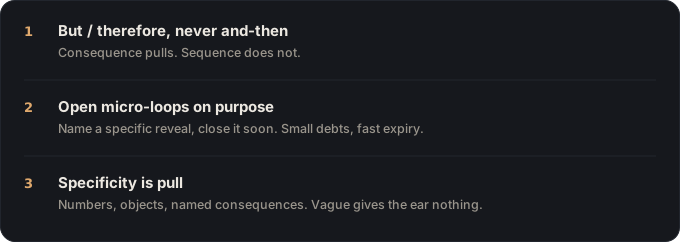
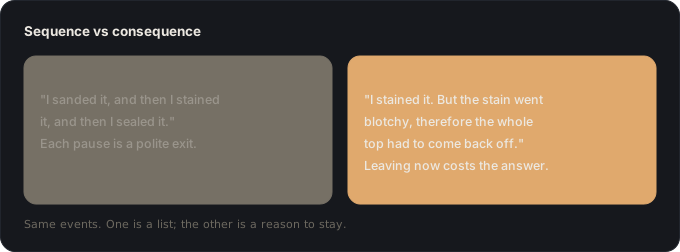
The oldest story-room rule is also the most practical script edit there is. Weak scripts chain with “and then”: this happened, and then this, and then this, a sequence, each event complete, each pause an exit. Strong scripts chain with “but” and “therefore”: this happened, but this got in the way, therefore I had to do this. Consequence, not sequence.
The edit is mechanical enough to run on any draft: read each sentence pair and ask what connects them. If the honest connector is “and then,” the second sentence isn’t earning its place: either find the but (what resisted? what surprised?) or the therefore (what did it force?), or ask why the sentence is there. This is the complication logic fractally applied: what beat 4 does to the video, “but” does to a paragraph.
Open small loops on purpose
The macro version of forward pull is the planted setup; the sentence version is the named-but-unexplained. “Three tools failed the test: one of them cost $400.” “The mistake shows up at minute six, and I didn’t catch it for a week.” You’ve promised a specific reveal without delivering it, and now the listener has a debt only continued attention repays. Two honesty rules carried down from packaging: every micro-loop you open, you close, and soon, not twelve minutes later. Sentence-level loops are small denominations; they expire fast, and a script that opens loops it never closes trains the ear to stop caring, exactly like a channel that zooms on nothing.
Specificity is pull
Vagueness reads as polite on the page and dies on the ear. “This changed everything about my workflow” gives the listener nothing to want next. “This cut my edit time from three days to one afternoon”: now the how is a gap that demands closing. The rule from titles holds at sentence scale: concrete numbers, named consequences, real objects. Every abstract sentence in a script is a sentence the next one has to re-earn attention from scratch; every specific one hands its successor a running start.
Run these three edits (but-therefore, micro-loops, specificity) on a middle-of-video paragraph and watch it change character: same information, but now each line leans forward. That lean, multiplied by every sentence in the script, is what a flat retention slope actually looks like at the craft level.
The sentence check
- No “and then” chains: every sentence pair connects with a but or a therefore.
- Micro-loops open on purpose and close soon; none dangle past their expiry.
- Concrete beats abstract: numbers, objects, named consequences.
- Any sentence that owes nothing and points nowhere gets cut or made to.
- The paragraph read aloud makes a listener ask a question you’re about to answer.
🎬 Video script
- Open reading an and-then paragraph, visibly losing the room; re-read it but-therefore’d. “I changed four words.”
- Loewenstein on screen: gaps drive attention, and gaps are made at sentence scale.
- Run the three edits live on one real paragraph, one pass each.
- Show the expired-loop failure: a promise from minute one paid at minute thirteen, and the dip in between.
- Close: “Nobody decides to watch twelve minutes. They decide to hear one more sentence, seven hundred times.”
Sources
- George Loewenstein, The Psychology of Curiosity, Psychological Bulletin 116 (1994): the information-gap mechanism, here at sentence scale.
- YouTube Help, Measure key moments for audience retention: the slope this sentence-level craft flattens.
Key takeaways
- Viewers don't decide to watch a video. They decide, over and over, to hear one more sentence.
- Replace 'and then' with 'but' and 'therefore': consequence pulls, sequence doesn't.
- Specificity is pull, vague sentences give the listener nothing to want next.