Scripting · Lesson 4
Cut your script by 30%
First drafts run long for predictable reasons. The four cuts, throat-clearing, double explanations, hedges, and the darling that serves you instead of the viewer, and why script cuts beat timeline cuts.
Here’s a sequence every creator knows: write the script, shoot it all, then spend day two of editing discovering which third of the footage shouldn’t exist. The discovery isn’t wrong (the video is better without that third) but the timeline is the most expensive possible place to make it. Every cut you make in the edit is a cut you paid to shoot, light, perform, and transcode. The same cut on paper costs a keystroke.
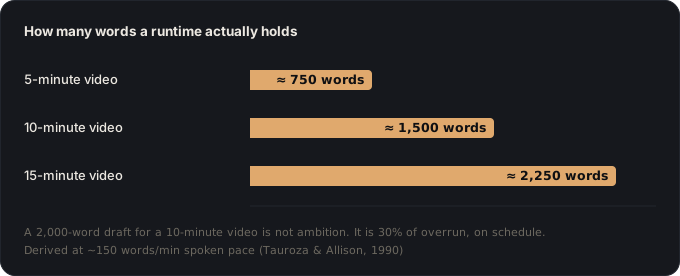
So institutionalize it: draft, then cut 30% before shoot day. The number isn’t magic. It’s a forcing function. First drafts run reliably long, they run long in predictable places, and a hard target stops you negotiating with yourself line by line. Here’s where the 30% hides.
Cut 1: the warmups
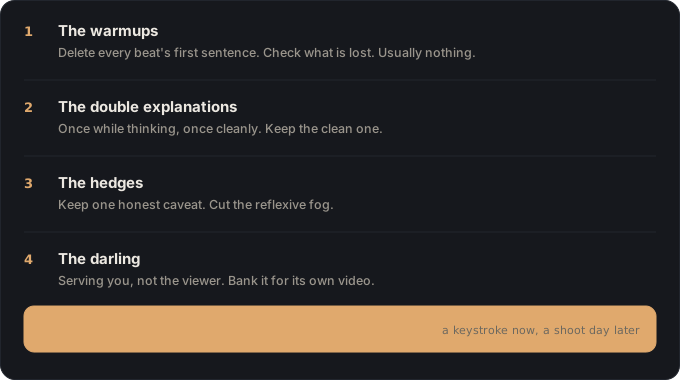
Paragraph one of most beats is the writer clearing their throat: context nobody asked for, “before we get into it,” the meta-explanation of what you’re about to explain. The hook version of this is famous because the intro is where it’s fatal, but the disease is chronic: every beat tends to open with a warmup. The test: delete the beat’s first sentence and reread. If nothing is lost (and it usually isn’t) the second sentence was your real opening. Repeat until deleting hurts.
Cut 2: the double explanations
Drafting brains explain things twice: once while figuring it out, once cleanly after. Both versions survive into the draft because each reads fine alone. Find every concept that gets two treatments and keep the better one, with one deliberate exception: planned redundancy on load-bearing ideas stays, said twice differently, on purpose. The cut is for accidental duplicates: same idea, same angle, four sentences apart, serving only the writer’s process.
Cut 3: the hedges
“Sort of,” “in my experience,” “obviously this depends,” “I could be wrong but”: the qualifier fog that accumulates when a writer is nervous about a claim. One honest qualification on a genuinely uncertain point is credibility; fog on every sentence is just length that reads as weakness. If the claim needs the hedge, keep the hedge and sharpen the claim. If it doesn’t, cut the hedge and make the claim: a point of view is a differentiator, and hedged points of view are neither.
Cut 4: the darling
Every script has one: the section you love that the video doesn’t need. The story that actually happened but proves nothing. The impressive digression. The joke that took twenty minutes. The test is brutal and simple: does the viewer need this to reach the change the video promises, or do you need it?, and the promise is the judge, not your affection. Real darlings don’t die; they go in the idea bank as seeds for the video where they’re not a digression but the point.
Why paper cuts beat timeline cuts
The economics run deeper than saved shoot time. A script cut improves the shoot: fewer beats means more takes and more energy for what remains, and the beat sheet the footage gets checked against is tight before a card is filled, so coverage effort lands only on material that earned it. A timeline cut can only ever remove; a paper cut redistributes. And length itself was never the enemy: long videos hold when every stretch has an open question. The 30% you cut is precisely the material with no question. You’re not making the video shorter so much as making it dense, which is what the retention graph was asking for all along.
The cutting check
- The draft lost 30% on paper before shoot day, by target, not by mood.
- Every beat’s opening survived the delete-the-first-sentence test.
- Duplicates resolved; only deliberate, differently-phrased redundancy remains.
- Hedges: kept where honest, cut where reflexive, claims sharpened either way.
- The darling got named, judged against the promise, and banked if it lost.
🎬 Video script
- Open on a timeline with a third of it grayed out: “I paid a full shoot day for the gray part. The delete key was free.”
- Walk the four cuts on a real first draft, live, with a running word count.
- Do the delete-the-first-sentence test on three beats in a row: two survive it, one doesn’t.
- Kill a darling on camera, honestly reluctant, and bank it for its own video.
- Close: “Cut it where it costs a keystroke. Density is what retention was asking for.”
Sources
- YouTube Help, Measure key moments for audience retention: dips mark skipped material; the four cuts remove it before it’s shot.
- George Loewenstein, The Psychology of Curiosity, Psychological Bulletin 116 (1994): density holds attention because every surviving sentence keeps a gap open.
Key takeaways
- Cut on paper, not the timeline, a script cut costs a keystroke, a timeline cut costs a shoot.
- The four reliable cuts: warmups, double explanations, hedges, and darlings.
- Length isn't the enemy, unearned length is; cut until every sentence buys its place.