Scripting · Lesson 5
From script to shot list
The script says what gets said; the shot list says what gets seen. How to derive one from the other, shoot for the edit, and stop discovering missing footage on the timeline.
A script is only half a video. It’s everything that gets said. The other half is what gets seen, and creators who plan the first half and improvise the second produce a very specific artifact: a timeline where the words are right and the screen is a face, talking, for eleven minutes, with b-roll sprinkled on top as decoration rather than doing any work. The fix is one planning step that takes twenty minutes: walk the script and derive the shot list from it, beat by beat.
Every claim gets a visual answer
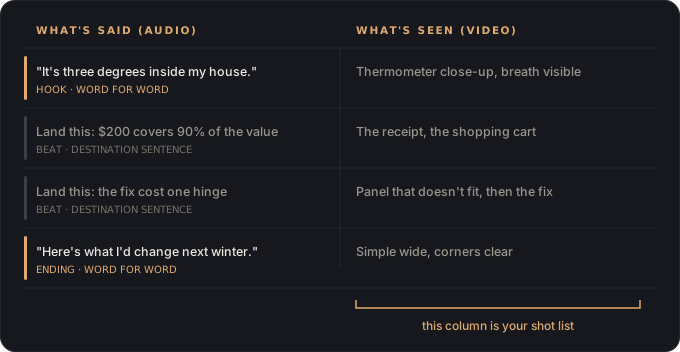
Go through the tiered script beat by beat asking one question: when I say this, what is the viewer looking at? Not “what b-roll do I have”: what does this sentence need on screen to land? Claims need evidence: “the bracket snapped” wants the snapped bracket, in hand or in action. Numbers want the thing counted. Processes want the step shown at the moment it’s described. A sentence whose honest answer is “my face, again” is either a sentence that carries emotion (faces are for emotion: reactions, verdicts, stakes said to camera) or a sentence that just confessed it has no visual, which is worth knowing on paper, while the fix is a plan and not a dip.
The output is deliberately boring: one line per shot (beat 3: close-up, the stripped screw head, tabletop) grouped by beat. It’s not cinematography homework; it’s a manifest of what must be on the card.
Shoot for the edit
Three shot-list habits, all downstream of one idea: the shot list is the edit, pre-decided:
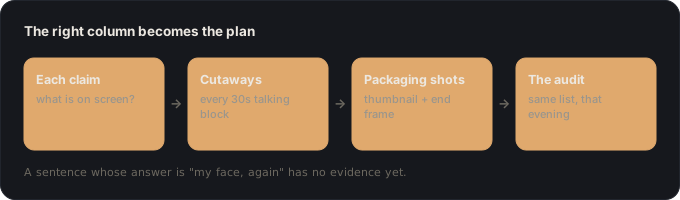
B-roll with a job. Every b-roll line on the list names the sentence it covers. This is the difference between footage that illustrates (“shots of the workshop”) and footage that answers (“the warped board, flat-on, when I say the wood moved”). Illustration gets sprinkled; answers get placed, and the visual change is itself a pattern interrupt arriving exactly where the information needs it.
Cutaways for every long talking stretch. Any beat that’s 30+ seconds of one framing gets a planned second angle or insert, not for style, but because you will want to cut that stretch internally, and without a cutaway every trim is a jump cut you didn’t choose.
The packaging shots, on purpose. The thumbnail frame and the end-screen-safe closing shot go on the list as first-class shots. Hunting the edit for an accidental thumbnail is how packaging ends up compromised by whatever the card happened to catch.
The loop closes the same evening
Here’s what the shot list is really for: it’s the audit column. The evening after the shoot, the footage review runs the card against this exact list (got it, partial, missing) and every “missing” is a named, plannable pickup instead of a day-three surprise. Script → shot list → shoot → check the card against both: that’s the whole pre-production loop this course has been building, and the shot list is the piece that makes the check mechanical rather than a vibe.
One honest caveat: the list is a floor, not a ceiling. The accidental gold: the reaction you didn’t plan, the failure that becomes the complication, outranks anything on paper. Shoot the list and the day; the list is what guarantees you can afford the detours.
The shot-list check
- Every beat answers “what is the viewer looking at?”, no default-to-face stretches.
- Each b-roll line names the sentence it covers.
- Every 30+ second talking stretch has a planned cutaway.
- The thumbnail frame and end-screen shot are on the list as shots.
- The same list runs as the audit column in the evening footage review.
🎬 Video script
- Open on the eleven-minute-face timeline: “The script was great. Nobody planned what you’d look at.”
- Derive a shot list live from three beats of a real script: claim, visual answer, one line each.
- Show b-roll-with-a-job vs decoration: the same sentence covered both ways.
- Flash-forward to the evening review: the card audited against the list, one pickup caught cheap.
- Close: “The script decides what’s said. The shot list decides what’s seen. The card gets checked against both.”
Sources
- YouTube Help, Measure key moments for audience retention: long single-framing stretches and unanswered claims read as dips; the shot list prevents both on paper.
- YouTube Help, Thumbnail & title tips: packaging quality depends on deliberate frames; plan the thumbnail shot, don’t scavenge it.
Key takeaways
- Derive the shot list from the script beat by beat, every spoken claim needs a visual answer.
- Shoot for the edit: b-roll with a job, cutaways for every long talking stretch, the thumbnail frame on purpose.
- The shot list is the checklist the footage gets audited against, close the loop the same evening.