Thumbnails that get the click · Lesson 2
The 3-second rule
A thumbnail has to read in a glance, on a phone. Here's the test the pros use, and the workflow that gets you there.
Most thumbnails fail for one boring reason: they were designed at full size and judged at full size, then shown to the world at the size of a postage stamp. What looks rich and detailed on your monitor turns into an unreadable smudge in a real feed.
The fix is a single habit, and it costs nothing.
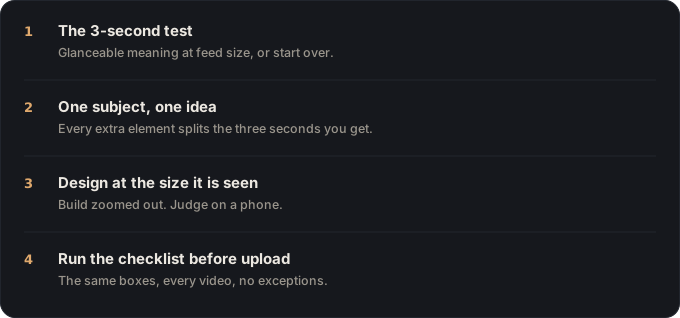
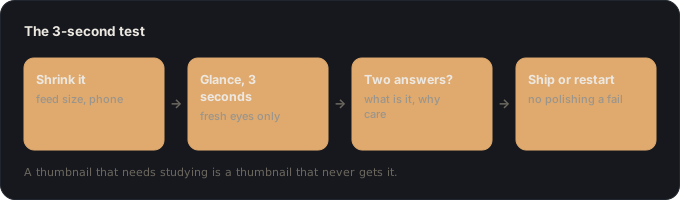
The 3-second test
Here it is. Shrink your thumbnail down to the size it actually appears on a phone, roughly 120 pixels wide, and show it to someone for three seconds. Then take it away and ask: what was it about, and would you have clicked?
If they hesitate, the thumbnail is too busy. Not too ugly, not too plain: too busy. At feed size there is no time to decode a scene. The eye takes in one shape, one face, one word, and moves on. A thumbnail that needs a second look has already lost.
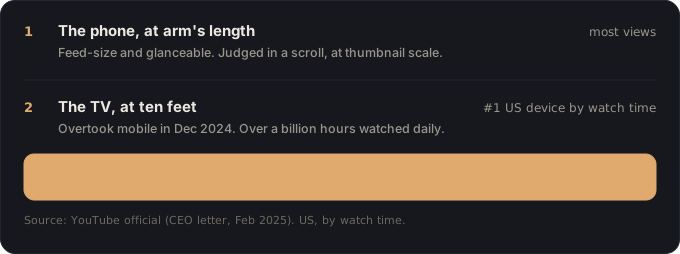
This matters more than it used to, because of where people watch.
Around 69% of YouTube views happen on mobile, where your thumbnail renders barely a couple of centimetres wide.
2025 industry data
You are not designing a poster. You are designing something the size of a fingernail, seen for a heartbeat, next to a dozen competitors. Design for that, or design for nobody.
One subject, one idea
The reason busy thumbnails fail the test is that they try to say two things. A person and a location and a caption and a logo is four messages fighting for one heartbeat of attention. The winner picks one.
Pick the single most clickable element, the thing that makes someone stop, and make it enormous. Everything else is either supporting it or getting cut. If you catch yourself adding a second focal point “so people understand,” that’s the signal to cut, not add. Understanding happens after the click. The thumbnail’s only job is the click.
Design at the size it’s seen
The practical move that changes everything: keep a small preview open while you work. Most design tools let you zoom out or show a thumbnail-sized version. Put it in the corner of your screen and glance at it constantly. If the text is illegible or the subject is lost in the background at that size, you’ll catch it in real time instead of after you’ve published.
Better still, preview it in context. Drop the image into a mock feed, or just look at it on your own phone before you ship. The gap between “great on my monitor” and “invisible on a phone” is where most thumbnails die.
A repeatable checklist
Before you publish, run these five:
- Shrink it to phone size. Still clear? If not, cut something.
- One subject, one idea. Is anything competing?
- Text huge and high-contrast, three or four words at most?
- Would it read from across the room, with the sound off?
- Does it look like your channel, recognisable to a returning viewer?
If all five pass, you have a thumbnail that works at the only size that counts.
Want to go deeper on any of these? The thumbnail design principles library breaks down each mechanic (contrast, faces, text economy, the squint test) with a real example to study.
🎬 Video script
- Cold open: put a detailed thumbnail on screen, then shrink it live to phone size. “See how it just died?”
- Run the 3-second test on camera with a real thumbnail and a real person.
- Land the mobile stat as a full-frame graphic, then hold up a phone: “This is the canvas.”
- Show a busy vs clean thumbnail side by side at feed size.
- Demo the small-preview workflow in your editor.
- Close: “Clear beats clever, every time. Next: why faces and contrast do so much of the work.”
Sources
- Advanced Television, 69% of YouTube viewership on mobile devices (2025).
- YouTube Help, Thumbnail & title tips (clarity, rule of thirds).
- YouTube Blog, Our big bets for 2025: the TV as the number one US device by watch time.
Key takeaways
- If it isn't clear in 3 seconds at phone size, it's too complex. Cut something.
- One subject, one idea. Detail disappears at thumbnail scale.
- Design at the size it's seen: preview it small before you ship it.