Thumbnails that get the click · Lesson 3
Faces, emotion & contrast
Why the brain can't ignore a face, which expressions earn the click, and the one contrast trick that makes any thumbnail pop.
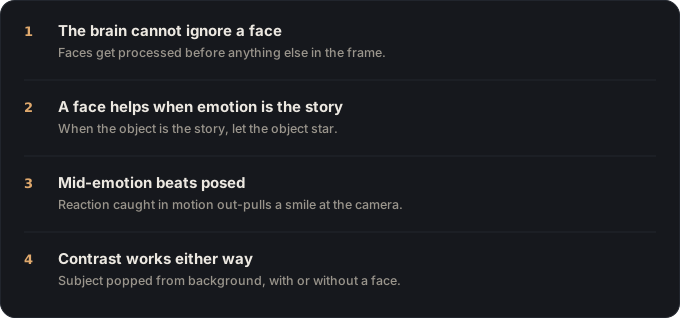
“Just put a face on it” is the most repeated thumbnail advice on YouTube, and it’s half right. Faces do pull attention, but not because of any trick you’re applying. It’s because of how the viewer’s brain is built.
Why the brain can’t ignore a face
Humans have a dedicated piece of visual hardware for faces. It’s called the fusiform face area, and it lets a face skip the brain’s normal object-recognition queue and get processed faster than almost anything else in a frame. It sits right next to the amygdala, the brain’s emotional centre, which is why a face doesn’t just grab the eye, it triggers a feeling.
The fusiform face area lets faces bypass the brain’s usual interpretive channels and be identified more quickly than objects.
Fusiform face area, neuroscience research
That’s the real reason a face works in a feed: you’re borrowing a reflex the viewer can’t switch off. But a reflex is only useful if you point it at something worth seeing. A face slapped on a video that isn’t about a person’s reaction just spends that attention on nothing.
When a face helps, and when it doesn’t
A face earns its place when the video’s hook is a reaction: you tried something, tested something, or are about to see a result, and your expression is genuinely part of the story. A shot of real shock while opening a package, or the moment a result lands, tells the viewer what emotional register to expect before they click.
A face does not help a tutorial whose payoff is a finished product, a before-and-after, or a specific number. There, the result should be the subject. The test is simple: cover the face in your draft. If the video’s promise disappears with it, the face is load-bearing. If it doesn’t, the face is decoration, and decoration competes with your real subject for the same three seconds.
The expressions that earn a click
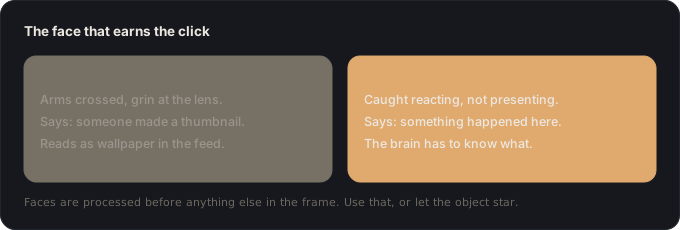
Not all faces perform the same, and the gap isn’t subtle. A neutral, pleasant smile, the headshot expression, reads as generic. It’s the same face on every other thumbnail, and it signals no stakes.
Expressions that signal something is happening win: genuine surprise (wide eyes, open mouth), visible tension (a furrowed brow, a hand near the face), and unmistakable curiosity (looking off-frame at something the viewer can’t see yet). Each one plants a question, what happened, what’s wrong, what is that, and a question is exactly what earns a click. The one thing to avoid is the performed, obviously-fake expression. Audiences spot “posed for the camera” instantly, and a staged thumbnail loses trust before the video starts.
Contrast: the trick that works with or without a face
Separate from expression, the biggest lever on legibility is contrast between your subject and its background, face or no face. A subject that’s the same brightness and colour as what’s behind it dissolves into visual noise at thumbnail scale, where fine edges vanish first.
The fix creators reach for constantly is a rim light: a light behind or to the side of the subject that draws a thin bright edge around them, so they read as a clean shape before the viewer processes any detail. No lighting gear? Get the same effect by choosing a background that fights your subject: a dark, blurred background behind a brightly lit face, or a bright background behind a darker subject. Either direction works. What matters is that the edge is unmistakable at a glance.
If you fix one thing this week, fix the contrast. It’s a five-minute edit that makes every other choice in the thumbnail easier to read.
🎬 Video script
- Cold open: the same reaction thumbnail flat-lit vs rim-lit. “Same photo. One of these you’d click.”
- Explain the fusiform face area simply: “Your brain has a chip just for faces. Thumbnails hijack it.”
- The cover-the-face test on a tutorial thumbnail vs a reaction thumbnail.
- Emotion line-up: neutral smile vs surprise vs curiosity, side by side.
- Live before-and-after adding a rim light or a contrasting background.
- Close: “Face or not, contrast makes it readable. Do that first. Next: text.”
Sources
- Wikipedia, Fusiform face area (the brain’s face-processing region).
- Kanwisher et al., The Fusiform Face Area, Journal of Neuroscience (foundational research).
- Psychology Today, Why we’re wired to read emotions in expressions.
Key takeaways
- Faces work because the brain is wired to notice them first. Use that only when the emotion is real and part of the story.
- Curiosity, surprise, and tension imply a question. A neutral smile implies nothing.
- Separate subject from background with contrast (a rim light, or a dark bg behind a bright face).