Editing for retention · Lesson 4
Visual variety without noise
The screen should change when the information changes, not on a timer. Motivated variety, the b-roll placement rule, and why more graphics isn't more retention.
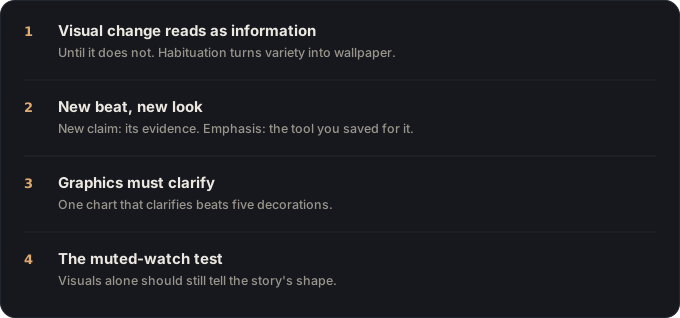
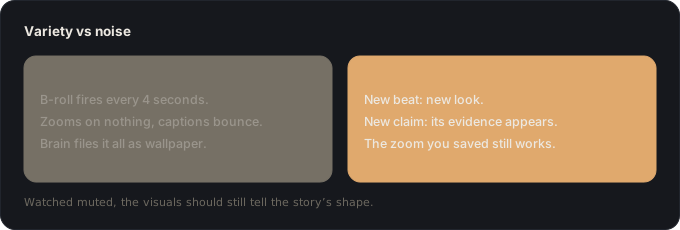
Somewhere in every editing tutorial is the advice “change something on screen every few seconds,” and it produces a very recognizable video: b-roll firing on a metronome, captions bouncing, a zoom every sentence, busy as a casino and, by minute four, exactly as easy to tune out. The advice mistakes the mechanism. Visual change holds attention because the viewer’s brain reads it as new information, and when the screen keeps changing while the information doesn’t, the brain learns the changes are noise and stops attending to them. You haven’t added variety; you’ve taught the audience to ignore your emphasis.
The working rule is one sentence: the screen changes when the meaning changes.
Motivated variety
Run the edit against the information, not the clock. New beat → new look: the beat boundary is a real transition, so mark it, location shift, framing shift, format shift. New claim → its evidence: the b-roll that answers the sentence, placed exactly when the sentence is spoken, not somewhere nearby. Emphasis → the one tool you saved for it: the punch-in on the verdict, the slow push on the reveal, which only read as emphasis because you didn’t spend them on filler.
This is the same economy as breath in delivery: differential signals only work differentially. A zoom means “this matters” only in a video that doesn’t zoom constantly; a cut to b-roll means “look at this” only when b-roll arrives on purpose. Spend visual change like money, because attention treats it as a claim about meaning, and claims you don’t pay off get discounted, on screens as in titles.
The talking-head baseline
For the long talking stretches: the base layer is you, talking to one person, and that’s fine, a competent talking head with real pacing in the language holds better than creators fear. Two motivated tools cover most needs: the two-camera angle cut (or a punch-in from a high-res single camera), used at paragraph boundaries the way the ear expects a breath; and the planned cutaway for internal trims. If a talking stretch still feels dead with those in place, the fix is almost never more visuals. It’s the script: a stretch with no open question can’t be decorated into working.
Graphics that earn the render
Same test for every caption, chart, and diagram: does this clarify something the footage can’t? A number compared over time: chart, absolutely. The three-step structure you’re about to walk: list on screen, great. The word you just said, re-rendered in a bouncing font. That’s decoration wearing information’s clothes. One graphic that genuinely clarifies beats five that decorate, both in viewer trust and in your edit time; polish-pass hours are a budget, and the bouncing captions are spending it on habituation.
The end-to-end test for the whole layer: watch the video muted. The visual changes should still tell the story’s shape: here’s the setup, here’s the evidence, here it turns, here it lands. If the muted video is just rhythmic churn, the variety isn’t variety; it’s texture, and texture doesn’t retain.
The variety check
- Every visual change maps to an information change: new beat, new claim, or earned emphasis.
- The emphasis tools (zoom, push, dramatic cut) appear rarely enough to still mean something.
- B-roll lands on its sentence, not near it.
- Each graphic clarifies something footage can’t; decorations cut.
- Watched muted, the visuals still tell the story’s shape.
🎬 Video script
- Open with the casino edit vs the motivated edit of the same section; play both at 4-minute fatigue, not first-30-seconds novelty.
- State the mechanism: visual change reads as information, until it doesn’t.
- Recut a metronome-b-roll section live so every clip lands on its sentence.
- Run the muted-watch test on both versions; one still makes sense.
- Close: “Change the screen when the meaning changes. Attention will follow the meaning.”
Sources
- YouTube Help, Measure key moments for audience retention: habituated visual churn shows up as the same featureless slope as monotony.
- George Loewenstein, The Psychology of Curiosity, Psychological Bulletin 116 (1994): signals hold attention only while they predict information.
Key takeaways
- Visual change is information to the viewer, spend it when the content turns, not on a timer.
- Unmotivated variety habituates into wallpaper and steals emphasis from the moments that need it.
- One graphic that clarifies beats five that decorate.