Nov 3, 2026 · by Baptiste, founder of Vanpelt Studio
The 2027 YouTube monetization changes, explained for small channels
Part of YouTube updates for creators: official YouTube changes, explained in plain English.
On August 10, 2026, YouTube announced what it called the first significant changes to the YouTube Partner Program (YPP) since 2018. They take effect on February 1, 2027. New channels will need twice the watch hours to join. Shorts revenue sharing gets its own threshold. A new activity test decides who stays in the program. And every channel already in YPP has to accept new terms in YouTube Studio by January 31, 2027, which is 89 days after this article was published.
Most coverage stops at “the thresholds doubled”. This article covers the rest: what changes, what doesn’t, then seven steps a small channel can take before the deadline, each with what to do and what you end up with. One example channel runs through all seven.
When you need this: you’re not in YPP yet and wondering whether you can still get in under the old rules. Or you’re in YPP and saw a banner in Studio about new terms. Or most of your views come from Shorts and you’ve heard Shorts pay is changing. Or you just want to know whether any of this affects a channel your size.
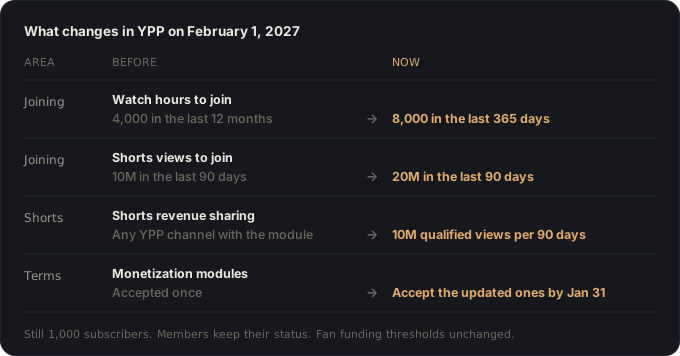
What changes on February 1, 2027
Everything below comes from YouTube’s own announcement and its Help Center page on the changes (both linked under Sources). Where YouTube hasn’t said something, we say so.
Joining YPP: the watch-hour and Shorts bars double
New channels will need 1,000 subscribers plus either 8,000 qualified watch hours in the last 365 days or 20 million qualified Shorts views in the last 90 days. Today it’s 4,000 hours in 12 months or 10 million Shorts views in 90 days. In YouTube’s words: “If you are already in YPP, your status is not impacted by this update.”
Qualified watch hours are the ones from public long-form videos. YouTube’s Help page lists what doesn’t count: private, unlisted and deleted videos, views from ad campaigns, Shorts, and livestreams that were unlisted, deleted or not converted to a video. Shorts views in the Shorts feed don’t count toward the hours.
Channels already in YPP must accept updated terms
YPP is split into modules you accept separately. The updated ones are the Watch Page Monetization Module, the Shorts Monetization Module and, if you use fan funding or Shopping, the Commerce Product Module. You review and accept them in YouTube Studio by January 31, 2027.
If you don’t, YouTube says “you’ll stop earning from the associated monetization features beginning February 1, 2027”. You are not removed from YPP: “Your decision to accept these terms does not impact your channel’s status in the YouTube Partner Program.” You can accept later to get those features back. If your channel is owned and operated by a multi-channel network (MCN), the MCN accepts for you. If you’re an affiliate channel, you accept yourself.
Shorts revenue sharing needs 10 million qualified views
To earn from the Shorts Creator Pool, a channel will need 10 million qualified Shorts views over the last 90 days. YouTube’s Shorts policy page says views are measured “over the 90 day period ending on the 15th day”. Below that, YouTube says you “will not be removed from YPP” and it “will not impact other YPP earnings, including long-form video”. Shorts revenue sharing comes back automatically once you’re above the threshold again.
YouTube’s view of who this hits: “Creators who already earn significant revenue from Shorts are unlikely to be impacted by these changes.” For channels below the threshold, it has promised bonuses for YouTube Shopping, incentives for brand deals and earnings boosts for starting trends, with details to come.
A new test for whether your channel is active
From February 1, 2027, a channel counts as active if it meets any one of these:
- 1,000 qualified watch hours in the past 365 days
- 1 million qualified Shorts views in the last 90 days
- 2 long-form videos or 5 Shorts uploaded every 90 days
A channel that drops below all three gets “an extended 90-day window” to reach the watch-hour or Shorts-view test “to stay in the program”. So for a small channel that has slowed down, the easiest of the three is the upload rule.
What doesn’t change
- Fan funding, Shopping and Creator Partnerships keep their thresholds: 500 subscribers plus either 3,000 qualified watch hours in the last year or 3 million qualified Shorts views in the last 90 days.
- The revenue split: 55% to the creator on long-form, 45% on Shorts.
Two more things were announced alongside the rules. Premium Lite, where creators share a pool of 60% of net subscription revenue (30% for full Premium), is expanding to every country where Premium is offered, and both pools pay out by member watch time and views. And YouTube says “we expect to pay even more to creators in 2027 than we did in 2026”. The money isn’t shrinking. It’s going to channels with sustained watch time.
Seven steps before February 1, 2027
One example runs through every step. Priya runs a budget travel channel. She has 980 subscribers and 3,600 qualified watch hours in the last 12 months. She posts one long video a week and about three Shorts a week, which brought in 600,000 engaged Shorts views in the last 90 days. She’s not in YPP yet, and she’s worried she just missed the old rules.
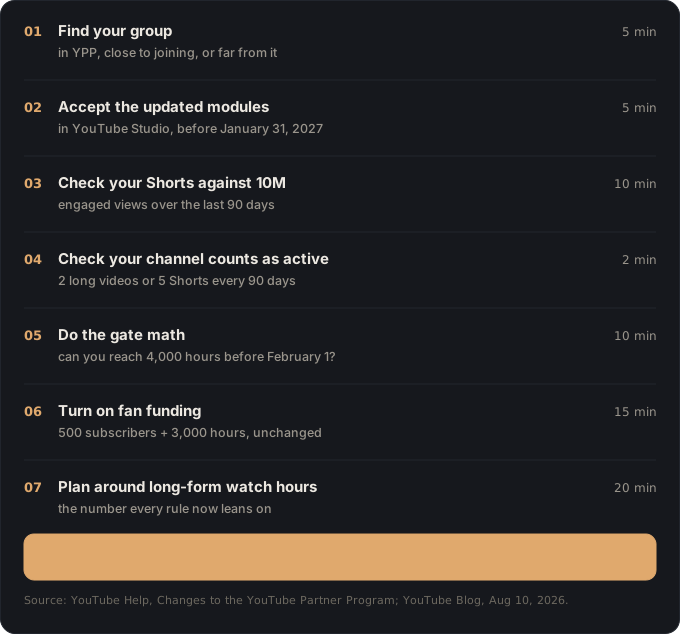
1. Find which group you’re in (5 minutes)
Do this: open YouTube Studio and go to Earn. If you’re in YPP, it shows your monetization modules. If not, it shows your progress toward the thresholds. Write down your subscribers and qualified watch hours, then put yourself in one of three groups:
- In YPP. Steps 2, 3 and 4 are for you. Step 2 has a deadline.
- Close to joining: you could reach 1,000 subscribers and 4,000 hours by about mid-January. Steps 5 and 6.
- Far from it. Steps 6 and 7. The old bar isn’t reachable in time, and the plan is fan funding first.
You end up with: your group, and a short list of the steps that apply to you.
Why: the same announcement asks completely different things of each group. Someone in YPP has a 5-minute task with a deadline. Someone far from joining has nothing to do by January, and a lot to plan.
Priya: 980 subscribers and 3,600 hours. That puts her in close to joining, if her watch time is growing fast enough. Step 5 will tell her.
2. If you’re in YPP, accept the updated modules (5 minutes)
Do this: in YouTube Studio, go to Earn and look for the updated terms. Read each module and accept it: Watch Page, Shorts, and Commerce Product if you use memberships, Super Thanks or Shopping. YouTube lets you accept some and not others, and recommends accepting all of them. Then add a reminder for January 24, 2027 to check that nothing is still waiting.
You end up with: every module accepted, and a reminder a week before the deadline.
Why: this is the only part of the announcement with a hard date, and missing it switches off earnings from those features on February 1. Doing it in November means a Studio glitch or an MCN delay has two months to get sorted.
Priya: she isn’t in YPP yet, so there’s nothing to accept. If she joins before February 1, she’ll check Earn the day she’s approved, in case the updated modules show up separately.
3. Check your Shorts against 10 million (10 minutes)
Do this: in YouTube Studio, open Analytics, switch to advanced mode, filter to Shorts, set the range to the last 90 days and add the Engaged views metric. YouTube hasn’t published a definition of “qualified” Shorts views. It does pay Shorts on eligible engaged views, so engaged views are the closest number you can check. Compare it to 10,000,000, which works out to about 111,000 a day.
You end up with: a yes or no for Shorts revenue sharing after February 1, and a decision on what your Shorts are for.
Why: below 10 million, Shorts stop paying from the Creator Pool but your long-form earnings don’t change. For most small channels, Shorts become a way to get discovered rather than a source of income. That’s worth knowing before you plan the next three months. Our explainer on what counts as a view covers engaged views in more detail.
Priya: 600,000 engaged Shorts views in 90 days, about 6,700 a day. Even inside YPP, her Shorts wouldn’t pay from February 1. She keeps posting them, because they bring new viewers to her long videos, and judges them on that.
4. Check your channel counts as active (2 minutes)
Do this: look at your uploads over the last 90 days. You’re active if you posted at least 2 long-form videos or 5 Shorts in that time, or you have 1,000 qualified watch hours in the last year, or 1 million qualified Shorts views in the last 90 days. If you’re borderline, put two long videos in your calendar for every 90 days, so the upload rule covers you on its own.
You end up with: a yes, and a calendar entry that keeps it a yes.
Why: the activity test is new, and falling below it starts a 90-day window to recover “to stay in the program”. Two long videos a quarter is the cheapest of the three to guarantee, and our publish-schedule myths lesson explains why you don’t need more than a schedule you can keep.
Priya: about 13 long videos in the last 90 days. She’s well clear. If she ever takes a break, the rule she’d watch is 2 videos a quarter.
5. Do the gate math before February 1 (10 minutes)
Do this: the 4,000 hours are counted over a rolling 12 months, so hours from a year ago drop off as new ones come in. The threshold works like a rate: 4,000 hours a year is about 11 hours of watch time a day, and 8,000 is about 22. In Studio Analytics, check two numbers:
- Your watch time per day over the last 28 days.
- Your watch time per day in the same weeks last year. That’s roughly what will drop off.
The difference is how fast your total grows. Divide the hours you’re short by that difference to get the number of days until you qualify. If that lands before about mid-January, apply on the day you qualify. YouTube says applications are usually reviewed in about a month. It hasn’t said which rules apply to an application still under review on February 1, so don’t wait until the last week.
You end up with: a date when you’ll cross 4,000 hours, or a clear answer that you won’t before February 1.
Why: “3,600 out of 4,000” looks almost there, but at a steady pace a rolling total doesn’t grow at all. The daily rate tells you whether you’re actually getting closer.
Priya: her last 28 days averaged 14 hours a day. The same weeks last year averaged 6. Her total grows by about 8 hours a day, so the missing 400 hours take about 50 days: around December 23. She needs 20 more subscribers too, which she gets in about two weeks. She sets a reminder to apply on December 23 and leaves about five weeks for review.
6. Turn on fan funding (15 minutes)
Do this: if you have 500 subscribers and either 3,000 qualified watch hours in the last year or 3 million qualified Shorts views in the last 90 days, apply for the fan-funding level of YPP in Studio’s Earn section, where it’s offered in your country. Turn on one thing first: channel memberships, or Super Thanks on your best-performing videos.
You end up with: your first YouTube income that doesn’t depend on ads, from a bar that didn’t move in 2027.
Why: for a channel far from 8,000 hours, this is the next realistic step. YouTube said plainly that these thresholds are not changing. It doesn’t replace ad revenue. It does get your channel earning, and earning from viewers who chose to support you.
Priya: at 980 subscribers and 3,600 hours, she already qualifies. She applies this week, turns on Super Thanks, and mentions it once at the end of her next video. If she misses December 23, she’s still earning something while she works toward 8,000.
7. Plan around long-form watch hours (20 minutes)
Do this: divide the bar you’re aiming for by 52. For 4,000 hours that’s about 77 hours a week; for 8,000 it’s about 154. Look at your weekly watch time in Studio and pick one lever for the next month:
- Retention: keep people watching longer on each video. Start with how to read your retention graph.
- Series: make videos that send viewers to the next one, so one view turns into three. See compound with series and formats.
- Back catalog: look at older videos that still get views and improve them. See double down on outliers.
You end up with: a weekly watch-hour target, and the one lever you’ll work on this month.
Why: look at what each 2027 rule measures. Joining is measured in long-form watch hours. The activity test counts watch hours or uploads. The Premium and Premium Lite pools pay out by watch time. Shorts, below 10 million views, pay nothing from the Creator Pool. Watch time is what the program pays for now.
Priya: she’s at about 98 hours a week, above the 77 she needs for 4,000 and well short of 154. Her retention graphs all dip around the 2-minute mark, where she talks through her itinerary. For a month, she cuts that segment to 30 seconds and moves it later in the video.
Where Vanpelt Studio fits (if you want help)
Everything above works with YouTube Studio and a calculator. If you’d like help with the watch-time side, the Vanpelt Studio desktop app covers parts of step 7:
- Before you film: list the shots your video promises, shoot them, and see what’s missing while a reshoot is still easy. A video that delivers what the title promises keeps viewers watching.
- After you publish: import the retention CSV from YouTube Studio and it names the moment viewers left and what was on screen at that moment. That’s how you find something like Priya’s 2-minute dip.
It doesn’t connect to your YouTube account and it doesn’t predict views or earnings.
If it went wrong, it’s one of these
When the terms or the thresholds don’t look right
- “I can’t find the updated terms in Studio.” Make sure you’re signed in to the Google account that owns the channel. If your channel is owned and operated by an MCN, the MCN accepts for you, so ask them to confirm it’s done. If it’s still missing in January, contact YouTube Creator Support.
- “I missed January 31.” You’re still in YPP. Earnings from the modules you didn’t accept stop on February 1, and you get them back by accepting in Studio. Do it the day you notice.
- “Studio says 3,800 hours, and a week later it’s 3,700.” That’s the rolling window: last year’s hours dropped off faster than new ones came in. Go back to step 5 and compare your daily rate with last year’s.
- “My Shorts views look like 10 million but I’m not sure they qualify.” YouTube hasn’t published a definition of qualified Shorts views. It pays on eligible engaged views and excludes views such as those from bots and non-original Shorts. Engaged views in advanced mode are the closest check, and our article on original Shorts covers what counts as original.
When the timing is unclear
- “I’ll qualify in late January. Do I get the old rules?” YouTube hasn’t said how an application still under review on February 1 is handled. Apply on the day you qualify, and plan as if the new thresholds apply.
- “I joined at the fan-funding level. Do I need 8,000 hours for ads?” YouTube says channels already in YPP keep their status, and hasn’t spelled out what happens when a fan-funding member moves up to ad revenue after February 1. Assume the new bar until YouTube says otherwise.
- “Does this change what I earn per view?” No. The 55% long-form and 45% Shorts splits stay the same. What changes is who can join, who earns from Shorts, and who counts as active.
The whole recipe on one line
Find your group → accept the modules by January 31 → check Shorts against 10 million → stay active with 2 long videos a quarter → do the gate math as a daily rate → turn on fan funding at 500 and 3,000 → plan around long-form watch hours.
Sources
- YouTube Blog, New opportunities to earn and changes to the YouTube Partner Program, August 10, 2026: the new entry thresholds, the 10 million Shorts views gate, Premium Lite pools and the 2027 payout outlook.
- YouTube Help, Changes to the YouTube Partner Program: the modules to accept by January 31, 2027, what happens if you don’t, the activity test, MCN channels and the unchanged fan-funding thresholds.
- YouTube Help, YouTube Partner Program overview and eligibility: current thresholds, what counts as a qualified watch hour, and review times.
- YouTube Help, YouTube Shorts monetization policies: how the Creator Pool works, the 45% share and the 90-day measurement.
- For the full money picture, see our YouTube revenue model for 2026.