Publishing & SEO · Lesson 4
Publish-schedule myths
Upload-hour numerology, daily-upload pressure, and the missed-week death spiral, what the evidence supports, what it doesn't, and the schedule logic that serves the audience instead of the superstition.
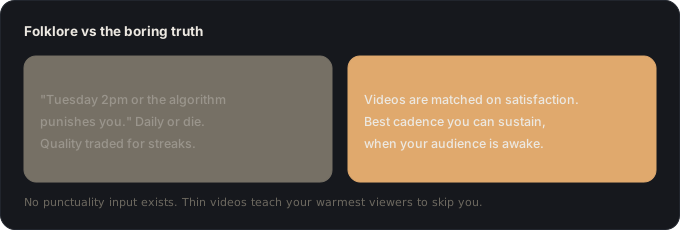
Publish-schedule folklore is the most confident genre of YouTube advice: upload Tuesdays at 2pm EST, daily or die, never miss a week or “the algorithm” notices and punishes you. It’s confident because it’s comfortable: schedules are controllable in a way packaging quality and story craft aren’t. But the system the folklore imagines (a scheduler rewarding punctuality) isn’t the system that exists:
Videos are evaluated individually, matched to interested audiences based on satisfaction signals, not on channel-level averages, upload cadence, or recency alone. Recommendations aren’t limited to recent content.
YouTube’s growth & discovery team, via Search Engine Journal (2025)
There is no punctuality input. What exists is matchmaking on satisfaction, so every scheduling question reduces to one honest form: does this affect the videos or the viewers? Run the three myths through it.
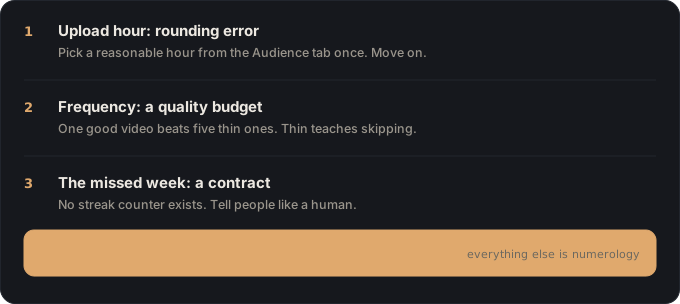
Upload time: a viewer-side rounding error
Posting hour has exactly one real mechanism: your notification-and-feed warm audience sees the video sooner or later in their day. That’s worth something small: publishing an hour before your regulars’ evening beats 3am for the first day’s shape, and nothing more: day one is a packaging report, not a verdict, and a video’s fate over weeks is decided by whether it satisfies the people it’s matched to. Check your Audience tab’s “when your viewers are on YouTube,” pick a reasonable hour, and never think about it again. The difference between good-hour and perfect-hour is noise; the difference between a good thumbnail and a weak one is your channel.
Frequency: a quality budget, not an algorithm offering
“More uploads = more algorithm favor” gets causality backwards. More videos means more chances to be matched, sure, but each video is evaluated on its own satisfaction, so frequency only compounds when quality holds. And quality is a budget: the creator who ships daily by skipping the story check, winging the hook, and publishing the first title is buying quantity with the exact inputs that decide matching. For a solo creator, one genuinely good video a week beats five thin ones, not as philosophy, but as arithmetic: thin videos don’t just underperform, they teach your warm audience to skip you, which taxes every future upload’s day one.
The missed week: a contract issue, not a penalty
Skip a week and nothing algorithmic happens to you. There’s no streak counter. What actually exists is viewer-side: regulars build a checking-in habit around your cadence, and a long silence cools that habit (and a warm audience is your launch-day engine). That’s a relationship contract, and relationship contracts have relationship fixes: keep a sustainable cadence you can actually hold, tell people when life happens, the parasocial audience responds to honesty like friends do, and when a video isn’t ready, ship it next week. The missed-deadline video that needed three more days will outperform the on-time one that needed them and didn’t get them, every single time, because only one of those numbers (satisfaction) is an input.
The schedule that wins is boring: the most videos you can make at full craft, on a cadence you can keep for a year, at an hour your audience is awake. Everything else is numerology.
The schedule check
- Upload hour: picked once from the Audience tab, then ignored.
- Cadence: set by your full-craft capacity, not by folklore pressure.
- No video ships thin to make a date: the date moves, the craft doesn’t.
- Breaks get announced like a human; the habit is protected with honesty.
- Schedule anxiety converted to packaging and story effort, where the leverage is.
🎬 Video script
- Open on the 2pm-Tuesday spreadsheet, then the growth team’s words: videos are matched on satisfaction, not punctuality.
- Run the one honest question: videos or viewers?: through each myth on a whiteboard.
- Show the frequency arithmetic: a real daily-thin channel vs weekly-crafted, twelve weeks of data.
- Handle the missed week on camera: the honest announcement, the video shipped right instead of on time.
- Close: “Make the best videos you can sustain, when your audience is awake. That’s the entire science.”
Sources
- Search Engine Journal, YouTube Algorithm Myths Debunked: Insights From The Growth Team (2025): individual evaluation, no cadence input, long-tail recommendation.
- YouTube Help, Understand new, casual, & regular viewers: the habit-forming regulars a cadence contract actually serves.
Key takeaways
- Posting-time effects are small and viewer-side; packaging and satisfaction dwarf them.
- Cadence is an audience contract and a quality budget, not an algorithm offering.
- The sustainable schedule you keep beats the ambitious one you abandon.