Publishing & SEO · Lesson 1
What the first 24 hours decide
The launch-window panic is mostly myth. YouTube's growth team says so directly. What early data actually tells you, what it doesn't, and the one launch-day job that matters.
Creator folklore treats launch day as a courtroom: the algorithm watches your first 24 hours, delivers a verdict, and a slow start means the video is dead, so creators refresh Studio hourly, panic-tweet at lunch, and conclude by dinner that three weeks of work failed. Almost none of this survives contact with the people who run the system:
The myth that a video is dead if the first 24 hours fail simply isn’t true. Videos are evaluated individually, recommendations aren’t limited to recent content, and videos can gain traction weeks, months, or even years after upload as interest and trends change.
YouTube’s growth & discovery team, via Search Engine Journal, “YouTube Algorithm Myths Debunked” (2025)
The mechanism you already know explains why: recommendation is matchmaking, not broadcasting. The system keeps trying a video against audience segments as long as it keeps finding people it satisfies. There is no bell that rings at hour 24. Delayed growth is common enough to have a folk name (“the sleeper”), and the back-catalog spike (an old video suddenly matched to a new audience) is the whole reason re-titling old videos works.
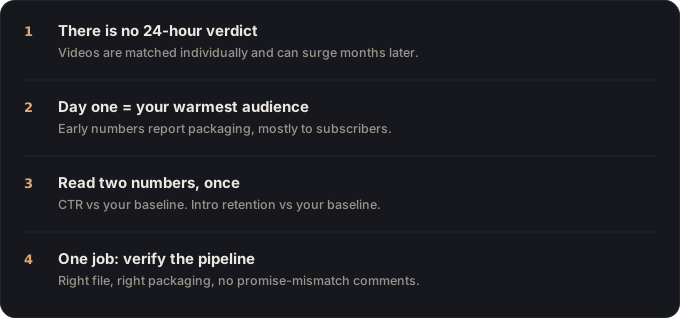
What day one actually tells you
None of that makes launch data meaningless. It makes it specific. Early numbers are a packaging report from your warmest audience: the first impressions go heavily to subscribers and regulars, the people most disposed to click you. So read day one narrowly:
CTR against your own baseline: remembering it runs high on small samples and warm audiences, tells you whether the packaging pulls the people who already like you. Intro retention tells you whether the open keeps the promise. Those two are actionable now: a strong-CTR/cliff-intro combination is a mismatch you can A/B or re-open; weak CTR on your warmest audience is a packaging problem worth testing this week, not mourning.
Total views at hour six? Not a signal. It’s mostly a measure of how big your warm audience is and when they check their feeds, which you already knew yesterday.
The one launch-day job
Give launch day one job and let the rest go: verify the promise pipeline is intact. The title/thumbnail pair reads right on a phone at feed size. The right video actually uploaded, in the right quality, end screen attached. The first comments aren’t reporting a broken promise (“thought this was about X”): the one early signal that does warrant same-day action, because a mis-set expectation is fixable in the title tonight and unfixable in the retention data next week.
Then close the tab. The productive version of launch-day energy is the post-mortem a week later, when the data means something, and the next video, where every lesson from this one compounds. Checking hourly changes nothing except how you feel, and how you feel at hour six is not an instrument.
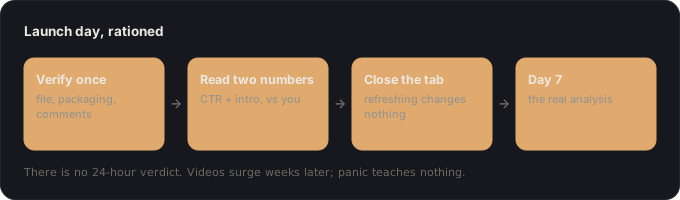
The launch-day check
- CTR and intro retention read against your own baselines; view-count refreshing rationed to zero.
- Packaging verified at phone size, on the platform, after upload.
- Early comments scanned for one thing: promise mismatch.
- Any fix made is a packaging fix, made once, not a panic spiral.
- A calendar reminder exists for the real analysis: seven days out.
🎬 Video script
- Open on the hour-six refresh ritual, then the growth team’s own words on screen: there is no 24-hour verdict.
- Explain the matchmaking mechanism and show a real sleeper: flat for weeks, then the spike.
- Walk what day one does report (warm-audience CTR, intro retention) and act on each once.
- Show the one launch-day job as a two-minute checklist, then literally close the laptop on camera.
- Close: “Day one is a packaging report, not a funeral. Read it once and go plan the next video.”
Sources
- Search Engine Journal, YouTube Algorithm Myths Debunked: Insights From The Growth Team (2025): the growth team on the 24-hour myth and long-tail recommendation.
- YouTube Help, Impressions & click-through-rate FAQs: why early CTR runs warm and small-sample.
Key takeaways
- Straight from YouTube's growth team: videos are not dead after a slow first day, recommendations aren't limited to recent uploads.
- Early data is a packaging report, not a verdict, read CTR and intro retention, ignore the rest.
- The one launch-day job is checking the promise pipeline, not refreshing the view counter.