Editing for retention · Lesson 1
Edit the story before the timeline
The slowest edits start by opening the NLE. The paper edit, selects chosen from transcripts, structure settled before the first cut, and why it saves days.
Open the editor, import six hours of footage, start watching from clip one, “getting a feel for it.” Three days later there’s a nineteen-minute assembly that sags in the middle for reasons that are hard to name, and the fix (moving whole sections, cutting a beat you spent hours polishing) feels like surgery. This is the standard solo editing experience, and almost none of it is an editing problem. It’s a sequencing problem: structure was decided last, on the most expensive surface available.
What is a paper edit?
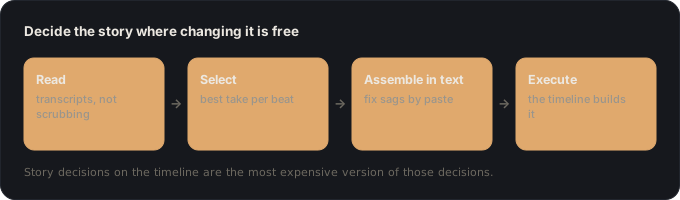
A paper edit is a rough cut made in text instead of on a timeline: you read the transcripts of everything you shot, mark the takes and moments worth keeping, and arrange those selects into the video’s running order in a document, before touching editing software. Documentary editors have worked this way for decades, because reading is faster than scrubbing and structure shows on a page in a way it never does in a player. For a solo creator it’s the single biggest time-saver available: decide the story where changing your mind costs a keystroke, then use the timeline to execute it.
Read, don’t scrub
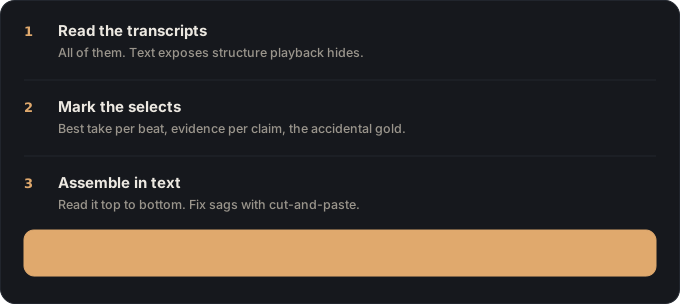
Step one is the move this whole course keeps returning to: get the transcripts and read them. Reading is roughly ten times faster than scrubbing, and (more important for the edit) text exposes structure while playback hides it. On a page, you can see that two takes make the same point, that the best line about the failure comes before the failure happens, that the beat the story needs is sitting in clip 47’s last thirty seconds. In the player, all of that is invisible under the surface of watching.
If you reviewed the footage the evening after the shoot, the raw material for the paper edit already exists: beats marked got-it/partial/missing, keepers named, accidental setups flagged. The paper edit is that review, promoted to a plan.
Mark selects, assemble in text
Concretely: go through the transcripts and mark the selects, the takes and moments that will carry the video. The strongest read of each beat’s destination sentence. The reaction that pays the stakes. The evidence b-roll each claim needs, named by sentence. Then arrange those selects (in a document, not a timeline) into the video’s actual order, and read the whole thing top to bottom as text.
This read is where the expensive discoveries become cheap. The sag shows up as a page you skim. The missing transition shows up as two selects that don’t connect. The structural hole shows up as a beat with no select at all: a pickup, found before a single clip was trimmed. Rearranging the story at this stage is cut-and-paste; the same rearrangement on a built timeline is an afternoon and a fight with your own sunk costs.
Then open the editor
Enter the NLE with the paper edit beside you and the job transforms: you’re not searching six hours of footage for a video. You’re assembling a decided story from a list of named selects. The first assembly goes down in hours, not days, because every decision on the timeline is now a craft decision (where exactly to cut in, how long to hold) rather than a story decision (what is this video?). Story decisions on the timeline are where solo edits go to stall: each one reopens everything downstream of it, which is why the sag fix at assembly stage feels like surgery.
One discipline keeps the system honest: when the timeline does surface a story problem the paper edit missed (it happens; footage plays differently than it reads) go back and fix it on paper, then re-execute. Thirty seconds of text editing, and the timeline follows a plan again instead of becoming an argument with one.
The paper-edit check
- Transcripts read in full before the NLE opens.
- Selects marked and named: best take per beat, evidence per claim.
- The story assembled and read as text, top to bottom, before any cut.
- Sags, gaps, and missing beats fixed in the document, where they’re cheap.
- The timeline executes; it doesn’t explore.
🎬 Video script
- Open on the three-day “getting a feel for it” edit vs the same footage paper-edited first: timelines side by side with day counters.
- Show text exposing what playback hides: the duplicate takes, the out-of-order gold, the missing beat.
- Build a paper edit live from a real shoot’s transcripts: selects, order, the top-to-bottom read.
- Enter the NLE and watch the assembly go down in an afternoon.
- Close: “Decide the story where changing your mind is free. Then cut.”
Sources
- YouTube Help, Measure key moments for audience retention: the sags and dips a paper edit catches before they’re built.
- Paul J. Zak, Why Your Brain Loves Good Storytelling, Harvard Business Review (2014): the tension structure the paper edit is checking for.
Key takeaways
- Structure decisions made on the timeline are the most expensive version of those decisions.
- The paper edit: read transcripts, mark selects, assemble the story in text first.
- Enter the NLE to execute a decided story, not to discover one.