Docs Footage
Drop in everything. It reads all of it.
Point it at the card and every clip comes back transcribed, described and searchable. It runs on your machine, and it happens once rather than every time you go looking for something.
The problem it solves
Raw footage is not information, it is a pile. The only index that exists is your memory of a shoot from last week, and that index degrades daily. Everything downstream, searching, mining a story, finding Shorts, is impossible until the pile is readable.
What it needs first
- Video files. That is genuinely all: point the app at a card or a folder and it does the rest.
- Disk space for the working copy, unless you switch import to move mode. Copy is the default and your originals are never modified either way.
How it works
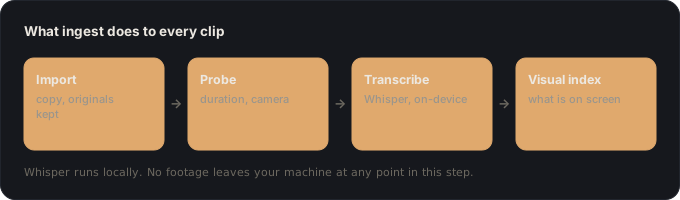
- 1 Import, your wayCopy into a workspace the app owns, or move if you prefer. Originals are never modified either way, and same-volume copies are clones rather than duplicated bytes.
- 2 Transcribe and describe locallyWhisper produces a segmented transcript per clip. A written visual description is built for every clip, including the silent ones, which is what makes B-roll findable at all.
- 3 Everything after this gets easierSearch, the story miner, the short finder and the coverage check all read these indexes. This is the step that pays for the rest.
What you get back
- Owned copies
- Footage is copied into the project workspace, with the original path kept as provenance. Same-volume copies are APFS clones, so they are near-instant and cost no extra disk.
- Technical metadata
- Duration, camera and codec detail read per clip, which is what makes chronology and burst detection possible later.
- A transcript per clip
- Whisper runs locally, on your machine. Segments are timecoded, which is what every later lens uses to point at an exact second.
- A visual index per clip
- A description of what is on screen, built for EVERY clip. It is what makes searching by what you saw, not just what was said, possible.
What it will not do
- Files that cannot be read are reported, never skipped in silence. Each one comes back with a reason: empty, unreadable, unprobeable, or a failed copy, and a retry that re-attempts only the failures.
- Transcription accuracy is Whisper's. Heavy accents, wind and overlapping speech degrade it, and every later lens inherits that.
- No footage leaves your machine at any point in this step. Whisper is local and the visual index is built locally.
What it buys you
- The pile becomes a library, once, instead of being re-searched by hand forever.
- Nothing uploads: transcription and frame extraction happen on your own machine.
- Silent footage is indexed too, so B-roll is as findable as dialogue.
Under the hood
The per-clip visual index is a deliberate, accepted cost: it is built for every clip regardless of whether Whisper finds speech, which is more expensive at ingest and the reason recall works later. Keyframe captioning is rationed separately, only where it earns its keep. Paying once at ingest is the whole trade.
Questions
Does my footage leave my machine?
No. Transcription and frame extraction are local. Only lightweight derived text is ever sent to a model.
Will it modify or move my originals?
Originals are never modified. Import mode decides whether a copy is made or the file is moved, and the app warns clearly when you pick move.
What if I move a drive afterwards?
Clips can go offline and be relinked by folder, the way an NLE does it.
Footage is one lens of Vanpelt Studio.