Docs Shot check
Sort the whole shoot in one pass
Matching footage to a shot list is mostly obvious and occasionally not. Speed confirm does the obvious part automatically and gives you only the genuinely ambiguous clips to judge.
The problem it solves
Reviewing a shoot clip by clip is where an evening goes. Most of the decisions are not decisions at all: the match is either plainly right or plainly wrong. Spending equal attention on all of them is what makes it slow.
What it needs first
- A shot list. Without planned shots there is nothing to check footage against, and the lens says so rather than reporting a meaningless 100 percent.
- Ingested footage with transcripts. The matching reads transcript and caption text, so a card that has not finished ingesting produces a check against half the evidence.
How it works
- 1 Everything is matched firstEach shot on the list is matched against your ingested clips, with a confidence for each candidate.
- 2 Two thresholds do the bulkAbove the upper threshold, matches are confirmed. Below the lower one, they are discarded. You set both, and you see how many fall into each zone before committing.
- 3 Speed confirm the middle bandOnly the ambiguous ones queue up, each with a filmstrip preview so you can judge without opening the clip. Confirm or dismiss, move on. Anything you regret is undoable.
What you get back
- A status per shot
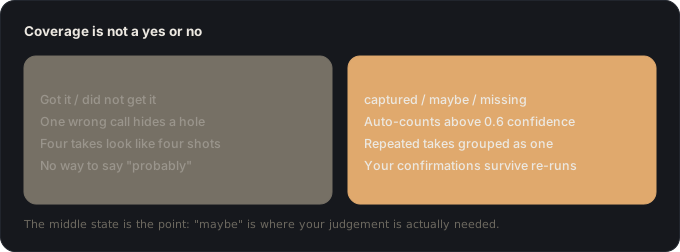
- captured, maybe, or missing. Not a score: three states you can act on differently.
- Confidence-gated matching
- A match at or above 0.6 confidence auto-counts as captured. Below 0.4 a fresh match is not shown as a live suggestion at all, though you can still restore it. The band between is what 'maybe' means.
- A manual override
- Footage the matcher cannot connect can be marked captured by hand, and a re-run will not undo that.
- Burst and chronology detection
- Repeated takes of the same shot are grouped, and clips are ordered by capture time, so 'I shot it four times' does not read as four separate shots.
What it will not do
- It matches on what was said and what is described on screen. A purely visual shot with no speech and a thin visual description is the hardest case, and it is exactly what the manual override is for.
- A re-run preserves your confirmations and dismissals. Your decisions are not overwritten by a fresh model pass.
- It checks coverage, not quality. A shot can be captured and still be out of focus.
What it buys you
- Attention goes only where a human is actually needed.
- The thresholds are yours, so you decide how much the machine is allowed to assume.
- Filmstrip previews mean judging a clip does not require playing it.
Under the hood
The middle band is the product. Auto-accepting everything would be wrong often enough to erode trust, and reviewing everything by hand is what people already do and hate. Splitting the pile by confidence and spending your attention only on the uncertain part is the whole design. Previews are on-demand web-playable proxies, because raw camera codecs will not play in a browser view.
On a real video
 The New Entrepreneurs' Obsession Read the case study →
 Questions
What if it confirms something wrong?
Triage is undoable, and the thresholds are yours to move. Set the accept threshold higher if you want the machine assuming less.
Does this need a shot list?
Yes, this lens grades footage against a list. Without one, the footage-first flow is the better route.
Does it check what I said, or only what I filmed?
Both, in separate passes. Shot coverage is a matching problem; the narrative must-say check reads the transcript, because a shot can exist while the line that gives it meaning does not.
Shot check is one lens of Vanpelt Studio.