Docs Short finder
Turn one long video into Shorts worth posting
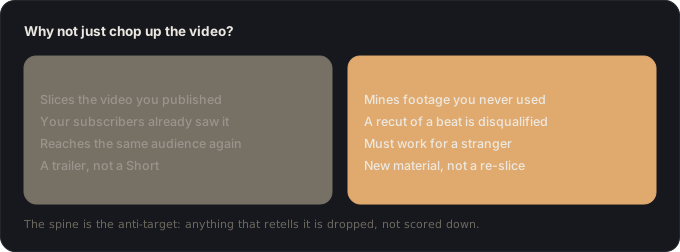
Most tools slice your video into clips your audience already watched. This mines the footage that never made the cut, so a Short is new material rather than a trailer for something they have seen.
The problem it solves
You shot four hours and published twelve minutes. The obvious move is to chop the published video into vertical clips, which is also what everyone else does, which is why those Shorts reach people who already subscribed and nobody else.
What it needs first
- Footage ingested in this project. Transcription is what makes precise in and out points possible, so a clip that has not been transcribed can only be offered as a cutaway, never as a talking window.
- A story spine. The divergence rule needs an anti-target: without a spine there is nothing for a candidate to be measured as different FROM.
- Packaging helps but is not required. When a locked title, promise and essence exist they are sent as context, so candidates are judged against the video you actually made.
How it works
- 1 It reads the whole card, not the cutThe search covers everything ingested: the tangents, the asides, the mishaps the main edit was always going to underuse.
- 2 Concept before frameEach candidate must state a standalone idea and name what makes it different from the long video. If that sentence cannot be written, the candidate is dropped rather than downgraded.
- 3 A real cut list comes backTwo to six cuts, each with in and out points, an arc position, and the verbatim transcript line that will be heard.
What you get back
- Two to six candidates
- Each one a standalone Short, not a segment of the long video.
- concept
- One sentence stating the idea, plus what makes it different from the long video. A candidate that cannot produce this sentence is dropped rather than scored down.
- hook_mech
- Why it earns the first two seconds, from a fixed set of seven: curiosity gap, before/after, how-to payoff, callback joke, hot take, relatable struggle, pattern break.
- cuts
- An ordered cut list. Each cut carries in and out timecodes, the verbatim transcript line that will be heard, and its arc position: hook, build, turn, payoff or tag.
- judge score
- A second pass scores the candidates so the list arrives ranked rather than in the order the model happened to emit them.
What it will not do
- It never cuts anything. You get timecodes and lines; the edit happens in your NLE. This is a product boundary, not a missing feature.
- It cannot invent footage. If the four hours contain no standalone idea, the honest answer is a short list or none, and that is what you get.
- Only derived text leaves your machine: transcripts, visual descriptions, the spine. No video or audio is ever uploaded.
What it buys you
- Shorts that are new to your audience, not a second viewing of the same beats.
- The archive becomes a posting queue instead of dead storage.
- Each candidate names its hook mechanism, so you know why it should earn the first two seconds.
Under the hood
Two bars decide what survives. The stranger test: it must work for someone who has never seen and never will see the long video. The divergence rule: the spine is the anti-target, and anything that retells, recuts or teases a beat of it is disqualified rather than scored down. That second rule is why the output is not a highlight reel. Mechanically it is one model call on the mid tier, capped at 4096 tokens; if the reply is not valid JSON it is retried once with a JSON-only reminder, and a second scoring pass then judges the survivors.
On a real video
 My 20-hour Vietnam Sleeper Bus Mistake Read the case study →
 Questions
Does it cut the Shorts for me?
No. You get an ordered cut list with timecodes and verbatim lines, and you cut it. The app never applies an edit.
How is this different from an AI clipper?
A clipper looks inside the video you published. This looks at what you did not publish, and refuses candidates that duplicate it.
Do I need the long video finished first?
No. It works from ingested footage and a spine to diverge from.
Short finder is one lens of Vanpelt Studio.