Docs Assessment
Find out what your thumbnail says before you publish it
A thumbnail is never judged alone. It is judged beside the title, by someone with no idea what your video is. This grades the pair the way that stranger sees it.
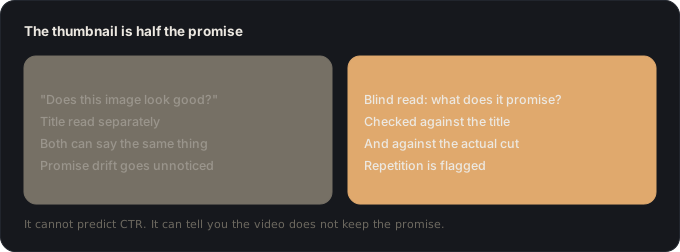
The problem it solves
You have looked at it for an hour, so you can no longer see it. You know what the video is, which means you cannot tell whether the image communicates that or whether you are supplying the meaning yourself.
What it needs first
- A finished cut, and the thumbnail you are considering. This lens runs after the edit, not before.
How it works
- 1 A blind read firstThe image and the title, nothing else. No promise, no spine, not even the on-image text you planned. It reports what it actually sees.
- 2 Then the graded passOnly after the blind read is recorded does the plan come in. The grade is the gap between what you meant and what came across.
- 3 Screen variants against an audienceThe A/B lens puts thumbnail and title pairs in front of a simulated audience and returns a ranked read with reasons, not just a winner.
What you get back
- A graded assessment
- The cut checked against a fixed best-practice checklist rather than a vibe, so two videos are graded the same way.
- A blind read of the thumbnail
- What a viewer takes from the image without knowing the video, which is the only question the thumbnail actually has to answer.
- Title and thumbnail as a pair
- Checked together, because the failure mode is usually not a weak title or a weak image but the two saying the same thing twice.
- A/B comparison
- Two candidates put against each other with a reasoned call, rather than a preference.
What it will not do
- It sends derived stills and the transcript text, never the source video.
- It is an opinion formed from best practice, not from your channel's history. Your own retention data is the stronger signal, and that is the next lens.
- It cannot predict CTR. Nothing can. It can tell you when a thumbnail makes a promise the video does not keep.
What it buys you
- You see the drift between intended and delivered, which is the failure you cannot self-diagnose.
- Title and thumbnail are graded as one unit, because that is how they are consumed.
- Image verdicts are cached, so testing a second title does not make the earlier judgements wobble.
Under the hood
The blindness is the mechanism, not a limitation. Pass A is deliberately withheld from the packaging brief and even the planned on-image text, because drift between the intended image and the delivered one is exactly what the lens exists to catch. Running the passes in the other order would let the plan tell the model what it is supposed to see.
Questions
Does it generate thumbnails?
No. It reads and grades the one you made. Knowing what yours communicates to a stranger is the hard part, not generation.
What does the simulated audience actually do?
It screens variants of the pair and returns a ranked verdict with reasons per variant, so you can disagree with the reasoning rather than just the ranking.
Does my thumbnail leave my machine?
The image goes to the model you chose, because grading requires seeing it. Your video and audio never do.
Assessment is one lens of Vanpelt Studio.