Docs Inventory
Search your footage the way you remember it
You do not remember clip names. You remember that someone said the thing on the rooftop. This finds that across every clip on the card, without scrubbing.
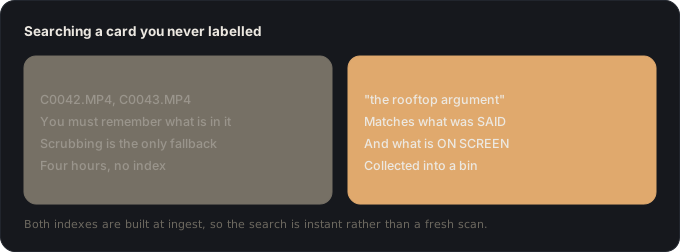
The problem it solves
Finding one moment in four hours is a scrubbing job, and scrubbing is how an afternoon disappears. Filenames tell you nothing and folders tell you less.
What it needs first
- Ingested footage. The search runs over each clip's pre-built visual index and transcript, so both are built at ingest rather than at search time.
How it works
- 1 Ask in plain wordsDescribe the moment the way you would to a person, not the way a filename would.
- 2 It matches on both indexesWhat was said and what is visible, so a silent shot is as findable as a spoken line.
- 3 Collect into a binHits gather into a named bin you can hand over, which is a different deliverable from a four-hour card and a hopeful message.
What you get back
- Matching clips for a plain-language query
- Ask for 'the rooftop argument' or 'coffee shops' and get clips back, matched on what was said AND what is on screen.
- Why each clip matched
- Said or on-screen, per hit, so you can tell a spoken mention from a visual appearance.
- A collected bin
- Matches can be grouped into a named workspace folder to hand to an editor, instead of a four-hour card and a description.
What it will not do
- It searches meaning, not filenames. That is the point: it works on cards you never labelled.
- Filing is careful about clips Organize already placed. Unfiled clips are moved into the bin; already-filed ones are copied, so a search never undoes your beat structure.
- Recall depends on the visual index. Something on screen for half a second and never mentioned aloud is the weak case.
What it buys you
- A moment becomes something you search for instead of hunt for.
- Silent B-roll is searchable, because every clip is described and not only transcribed.
- The result is a bin, so the search survives past the moment you ran it.
Under the hood
This is where the ingest cost pays off. Because a visual description was built for every clip regardless of speech, the search covers footage a transcript-only index would be blind to.
Questions
Does searching upload anything?
No. It queries indexes that were built locally at ingest.
How exact does my wording have to be?
It matches on meaning rather than string equality, so describing the moment works better than guessing a keyword.
Can I search across projects?
Search is per project, because the indexes belong to the project that ingested the footage.
Inventory is one lens of Vanpelt Studio.