Docs Verdict
Do you actually have a video?
Not "did I get shot 14", which is a checklist. The harder question: does what is on the card still add up to something worth twenty hours of editing? This answers it in writing, with evidence.
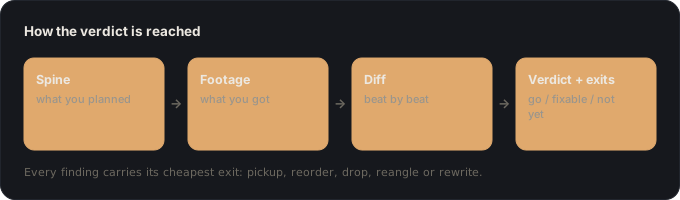
The problem it solves
The night after a shoot, you can tell something is off but not what. The alternative to knowing is starting the edit and finding out on day three, when the fix costs the video instead of an afternoon.
What it needs first
- A spine with beats. The verdict is a diff between plan and reality, so it needs the plan half.
- Ingested footage with transcripts. It needs the reality half, and both gates are checked before it will run rather than producing a confident verdict on nothing.
How it works
- 1 It reads the story against the footageNot the shot list, the story: whether the beats land, whether the promise is paid, whether the middle sags.
- 2 Every problem cites its evidenceFindings quote the transcript and name the clip, so you can check the checker rather than take its word.
- 3 Every problem gets its cheapest exitA pickup, a reorder, dropping a beat, a different angle. A problem without a price is just discouragement.
What you get back
- verdict
- Exactly one of go, fixable, or not_yet. It always commits to one: a missing or invalid verdict fails the parse rather than degrading into a maybe.
- headline + narrative
- A written answer with receipts, quoting transcript lines and naming clips, rather than a list of audit findings.
- findings
- Each one a specific problem, typed: missing_beat, off_script, reorder, trim_suggestion, or promise_mismatch.
- exit_kind
- Every finding carries its cheapest exit: pickup, reorder, drop_beat, reangle, or rewrite. A problem without a proposed way out is not a finding, it is a complaint.
- wins
- What is working, named explicitly, so the verdict is not only a list of things wrong.
What it will not do
- Every output is a suggestion. No edit is ever applied, and that is a product boundary rather than an unbuilt feature.
- It reads derived text only: transcripts, captions, the beat sheet. Your media never leaves the machine.
- It judges structure, not craft. It can tell you a payoff is unsupported; it cannot tell you the delivery was flat.
What it buys you
- You find out at the moment of maximum leverage, when a fix is still twenty minutes.
- It is a judgement with receipts rather than a list of audit findings.
- The fix-it queue turns the verdict into an ordered list of things to do next.
Under the hood
The verdict is the reason the rest exists, and it is deliberately not a checklist. A case study on this site shows why it is worth trusting: the pre-publish verdict and the post-publish retention pass, which never saw each other, independently flagged the same three problems on the same video.
On a real video
 My 20-hour Vietnam Sleeper Bus Mistake Read the case study →
 Questions
What if it says I do not have a video?
Then it says what is missing and what the cheapest way to get it is. Finding that out before the edit is the entire point.
Is this just an AI opinion?
It is a judgement, and it shows its evidence. Every finding names the clip and quotes the transcript so you can disagree with it on specifics.
Does it work without a plan?
It needs a spine to grade against. If you shot first, adopt an angle from the story miner and the verdict works normally.
Verdict is one lens of Vanpelt Studio.