Growth & analytics · Lesson 2
How to run a video post-mortem
Seven days after upload, every video deserves thirty minutes on one question, what does this teach the next video? The four-station read, run in order.
Somewhere around day seven, every video’s data stops being launch noise and becomes legible: impressions have found their level, the retention curve has its shape, the first cohort of viewers has finished telling you what they thought by staying or leaving. That’s when the video is worth thirty minutes of structured attention, not to grade it, but to run the one question growth actually runs on: what does this video teach the next one?
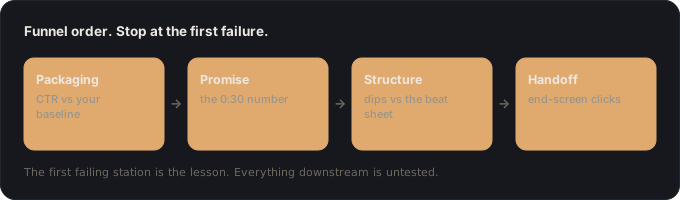
The discipline that makes post-mortems work is funnel order. A video can only fail at one station at a time (a viewer who never clicked never saw your middle) so you read the stations in sequence and stop at the first failure. That’s the lesson; everything downstream of it is untested.
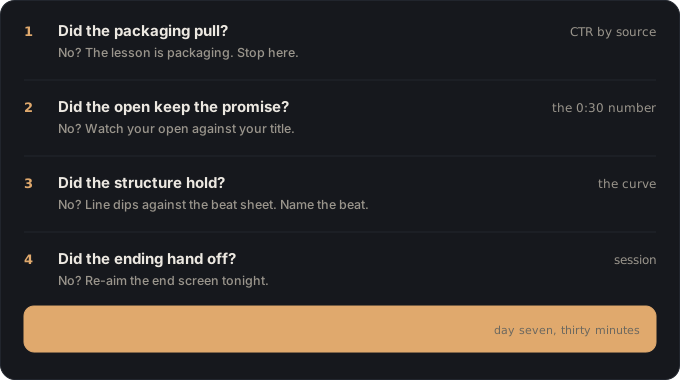
Station 1: did the packaging pull? (CTR)
Against your own baseline, by traffic source. Low CTR means the promise didn’t land in the feed, and nothing else about the video got a fair trial, because satisfaction data from too few viewers is noise. The lesson is a packaging lesson; an A/B test on this video is the cheap confirmation. Stop here, write it down.
Station 2: did the open keep the promise? (intro retention)
CTR fine, but the 30-second number cratered? The click was bought and the open didn’t deliver: the mismatch diagnosis, and YouTube’s own docs point the same direction: expectation match first, interest second. Watch your first 30 seconds with the title on a sticky note beside the screen; the gap is usually visible. Lesson: hook and packaging get written together next time.
Station 3: did the structure hold? (the curve)
Intro held, but the body bled? Now the full curve-reading earns its lesson: line the dips against the beat sheet and name the beat that failed, the slump shapes, the orphaned setup, the digression the transcript flagged and you shipped anyway. This station’s lessons are the deepest ones because they’re structural, and they’re the ones that the pre-edit story check exists to catch before shooting; a recurring station-3 failure means that check needs to run harder.
Station 4: did the ending hand off? (session)
Held to the end but no end-screen clicks, no session? The video succeeded and the channel didn’t collect: the ending opened no next question, or pointed at nothing. Cheapest fix in the whole funnel, often just re-aiming the end screen at a better target tonight.
Write the one lesson
The output is deliberately small: one sentence, phrased as an instruction to the next video, filed where planning happens, “Lead the thumbnail with the result, not the process.” “Beat 4 was missing again: story-check harder before shooting.” A post-mortem that ends in five lessons ends in zero; the funnel’s first failure is the lesson because it’s the one whose fix changes the most downstream data. And twice a year, read the lesson list itself: the recurring entries are your actual growth curriculum, told to you by your own audience, one video at a time.
Successes get the same treatment, by the way: a video that outperformed passed every station, and knowing which station it crushed (packaging? handoff?) is exactly the input the outlier play needs. That’s next lesson.
The post-mortem check
- Run at day seven, thirty minutes, calendar-enforced.
- Stations in funnel order; stopped at the first failure.
- The failure watched/read directly (the actual 30 seconds, the actual dip) not inferred from numbers alone.
- One lesson, one sentence, instruction-phrased, filed with the planning tools.
- The lesson list reviewed twice a year for the recurring curriculum.
🎬 Video script
- Open on the two post-mortem failure modes: the creator who never looks back, and the one who drowns in twenty metrics. “Both are skipping the tuition they already paid.”
- Draw the funnel and the stop-at-first-failure rule.
- Run a real post-mortem live through the stations; fail at station 2, watch the actual open against the title, write the sentence.
- Show a six-month lesson list and circle the recurring entry.
- Close: “One video, one lesson, next video better. That’s the entire growth loop.”
Sources
- YouTube Help, Measure key moments for audience retention: stations two and three: the intro metric and the curve.
- YouTube Help, Impressions & click-through-rate FAQs: station one, and reading CTR by traffic source.
Key takeaways
- Post-mortem at day seven, not hour six, the data needs time to mean something.
- Run the stations in funnel order: packaging, promise, structure, handoff, first failure found is the lesson.
- One video, one lesson, written as a next-video instruction, not a feelings review.